
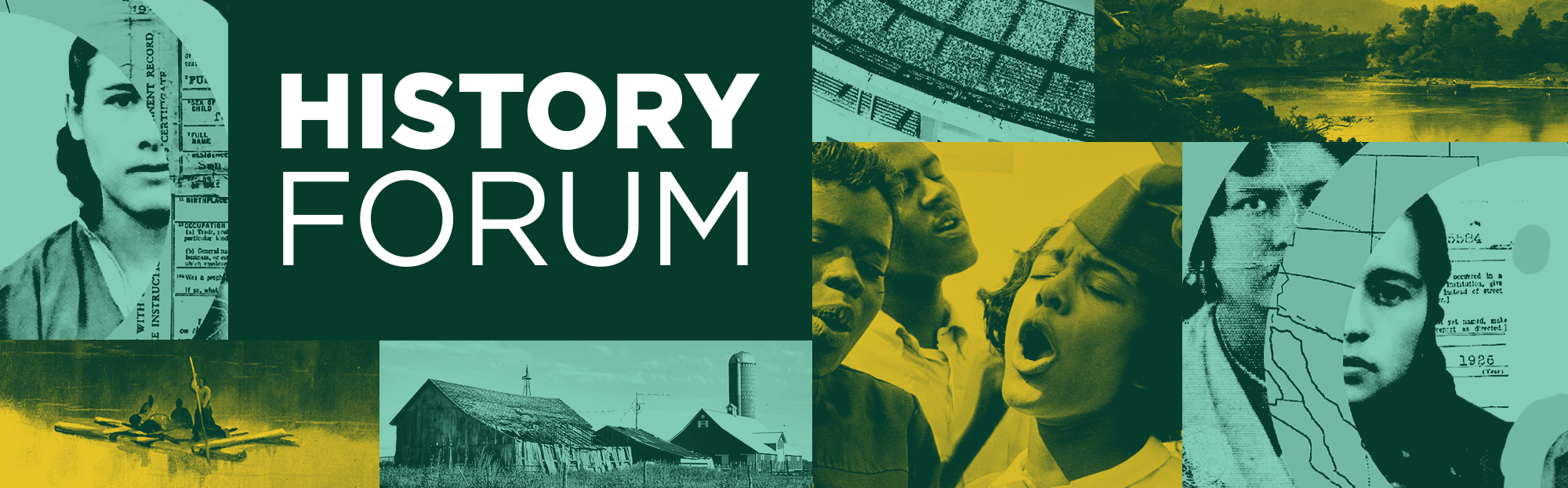
History Forum 2027
Join celebrated authors and award-winning historians for a thought-provoking series on our nation’s history. From little-known characters of the American West to the seismic impacts of the 1980s Farm Crisis, this season of the History Forum continues the tradition of bringing the best of American history to the Minnesota History Center.
Series pricing
- Series pricing (all 5 events): $100 $88
- Individual event tickets: $20
- MNHS members get 20% off all ticket sales
- Free student rush tickets day-of with student ID, K-12 & college (as space allows)
Series details
Five events from January to May showcase the power and complexity of our shared American story, encouraging dialogue, discovery, and a deeper understanding of the past.
- Events on Saturdays from 11:00am–12:30pm
- In-person and virtual tickets available
- Lectures will have live captioning
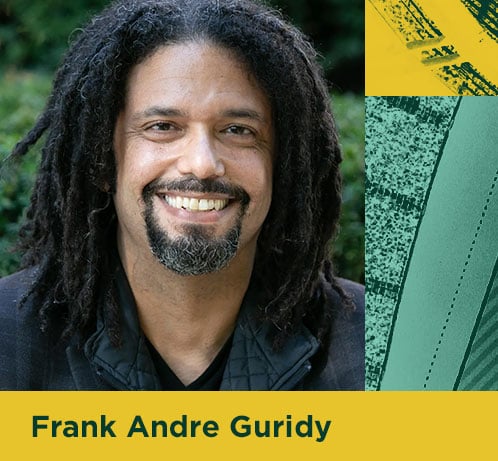
January 16
The Stadium: An American History of Politics, Protest, and Play
with Frank Andre Guridy
The deep and impactful story of the American stadium revealing how it has made, and remade, American life.
Join historian Frank Andre Guridy as he recounts the contested history of play, protest, and politics in American stadiums. Today’s stadiums are monuments to recreation, sports, and pleasure, yet since the earliest ballparks, stadiums have also functioned as public squares. From cultivating support for the status quo to protesting societal injustices, Guridy shows how stadiums have always been political venues. Moving between the field, the press box, and the locker room, The Stadium recovers the hidden history of these monuments to sport and their important role in the struggle for power and justice in America.
Biography
Frank Andre Guridy is the Dr. Kenneth and Kareitha Forde Professor of African American and African Diaspora Studies and Professor of History at Columbia University. He is an award-winning historian whose recent research has focused on sport history, urban history, and the history of American social movements. In addition to The Stadium, he is author of The Sports Revolution: How Texas Changed the Culture of American Athletics and Forging Diaspora: Afro-Cubans and African Americans in a World of Empire and Jim Crow.
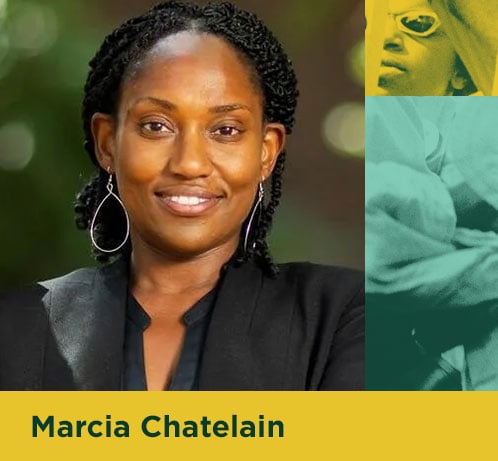
February 27
How Bright the Path Grows: The Untold Story of the Women Who Made the March on Washington
with Marcia Chatelain
From the Pulitzer Prize-winning author of Franchise comes the little-known story of the pioneering Black women artists and activists who were seen, but barely heard, at the 1963 March on Washington.
There is no shortage of footage immortalizing the men who spoke at the 1963 March on Washington for Jobs and Freedom, when 250,000 Americans gathered beneath the Lincoln Memorial to call for an end to segregation. But there is no “class photo” of the Black women who helped organize the march, performed on its main stage, or were honored during its Tribute to Negro Women Fighters for Freedom.
In How Bright the Path Grows, Marcia Chatelain weaves a gleaming group portrait of these singular women. Among this cohort were several household names like Josephine Baker, Rosa Parks, and Mahalia Jackson, but many were relative unknowns, including Minnesotan Anna Hedgeman, the coordinator who pushed in the eleventh hour for a tribute to Black women’s work.
Biography
Marcia Chatelain is the Penn Presidential Compact Professor of Africana Studies at the University of Pennsylvania. In addition to How Bright the Path Grows, she is author of the Pulitzer Prize-winning book Franchise: The Golden Arches in Black America and South Side Girls: Growing up in the Great Migration. Among the many recognitions for her scholarship and teaching, Chatelain has been recognized as a 2019 Andrew Carnegie Fellow and a 2026 Guggenheim Fellow.
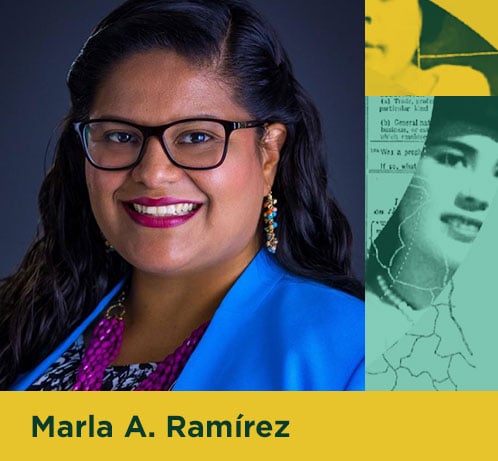
March 20
Banished Citizens: A History of the Mexican American Women Who Endured Repatriation
with Marla A. Ramírez
A moving portrait of a grim period in American immigration history, when US citizens were forced to relocate across the southern border.
From 1921 to 1944, approximately one million ethnic Mexicans living in the United States were removed across the border to Mexico. What officials called “repatriation” was in fact banishment: 60 percent of those expelled were US citizens, mainly working-class women and children whose husbands and fathers were Mexican immigrants. Join historian Marla A. Ramírez to learn the lasting effects of coerced mass removal on three generations of ethnic Mexicans.
A timely and wrenching account of expulsion and its afterlives, Banished Citizens illuminates the continuing social, legal, and economic consequences of a removal campaign still barely acknowledged on both sides of the border.
Biography
Marla A. Ramírez is an associate professor of History and Chicanx/e & Latinx/e Studies at the University of Wisconsin-Madison and a historian of the US–Mexico borderlands. Her first book, Banished Citizens, won multiple awards, including Mary Nickliss Prize in US Women’s and Gender History and the Philip Taft Labor History Award. In addition to her teaching and research, Ramírez is also a co-founder of the Wisconsin Latinx History Collective at UW, aimed at documenting the history of Latinx/e communities in Wisconsin, in partnership with the Wisconsin Historical Society.
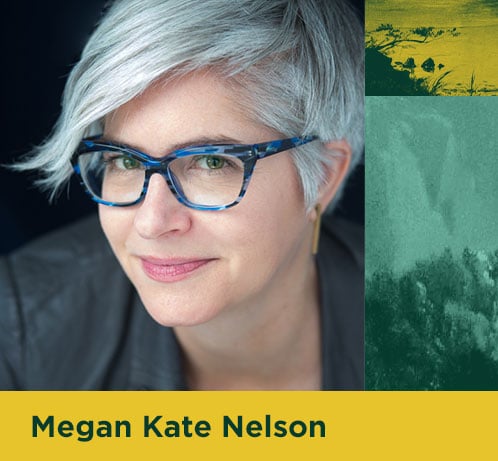
April 10
The Westerners: Mythmaking and Belonging on the American Frontier
with Megan Kate Nelson
From an award-winning historian, an epic account of the creation of the American West in the 19th century, shattering the traditional frontier myths.
Join historian Megan Kate Nelson as she traces two richly detailed and interwoven stories of the American West in The Westerners. The first reveals the captivating lives of women and men moving through the American West in the 19th century—Indigenous peoples, Black Americans, Mexican Americans, and Canadian and Asian immigrants. The second tracks the attempts by many Americans to erase these westerners from history, through a frontier myth that lionized individualism and conquest and celebrated white settlers traveling west in search of prosperity.
This vivid, eye-opening account highlights the perseverance and ingenuity of those who have been forgotten or erased, and challenges us to reimagine who we are, where we came from, and our understandings of the past.
Biography
Born and raised in Colorado, Megan Kate Nelson is a writer and historian based in Boston, Massachusetts. She has written about US western history, the Civil War, and American culture for The New York Times, The Washington Post, The Atlantic, Slate, Time, and Smithsonian Magazine. Nelson earned her BA in history and literature from Harvard University and her PhD in American studies from the University of Iowa. She is the author of Saving Yellowstone; The Three-Cornered War, a finalist for the Pulitzer Prize; Ruin Nation; and Trembling Earth.
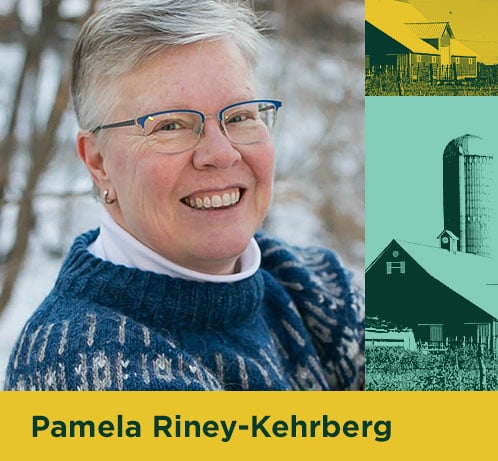
May 1
When a Dream Dies: Agriculture, Iowa, and the Farm Crisis of the 1980s
with Pamela Riney-Kehrberg
An award-winning history of the 1980s Farm Crisis told through the lives of the farmers, families, and communities impacted by it.
The Midwest in the 1980s was at the epicenter of a nationwide agricultural collapse unmatched since the Great Depression. In When a Dream Dies, historian Pamela Riney-Kehrberg gives an in-depth look into the worst of this crisis through the lives of Iowa farmers struggling to cope with disaster. While farms failed and banks foreclosed, rural and small-town Iowans were forced to think about themselves, their farms, and their futures in new ways. As the crisis spiraled, it transformed families and communities, impacting mental health, food security, and generational wealth and traditions. Join Riney-Kehrberg to learn about this often overlooked event, how it changed the future of America’s heartland, and how its legacy persists today.
Biography
Pamela Riney-Kehrberg is Distinguished Professor of history at Iowa State University specializing in American rural and agricultural history, as well as the history of childhood and youth, and the family. In addition to When a Dream Dies, she is the author of four books, including Childhood on the Farm: Work, Play and Coming of Age in the Midwest and The Nature of Childhood: An Environmental History of Growing Up in America since 1865. In addition to scholarly work, she has contributed to projects with the American Library Association, Ken Burns’ The Dust Bowl, and the National Council on History Education.

© 2026 Minnesota Historical Society

Funding provided by the State of Minnesota, the Legacy Amendment through the vote of Minnesotans on Nov. 4, 2008, and our generous donors and members.
Minnesota Historical Society
345 W. Kellogg Blvd., St. Paul, MN 55102
(800) 657-3773 | (651) 259-3000 | Contact MNHS
Box Office
(844) 667-8679 | (651) 259-3015