|
|
When "Father" Oliver H. Kelley died in Washington, D.C., at the age of eighty-seven he was a
revered patriarchal figure to most American farmers. He was the grand old man of the National
Grange, which he had founded in 1867 and served as secretary for eleven years. From its
beginnings in Minnesota, the organization had spread across the Midwest like wildfire during
the hard decade of the 1870s, and it had been the first of many groups to cry out on behalf of
the depressed and debt-ridden farmer. It had also pointed the way to a fuller social life and a
broader educational base in the nation's agricultural communities.
|
|
|
With Kelley's fame resting on this single great work, begun at the age of forty-one, it is small
wonder that history has neglected the eager young man who stepped off a steamboat at St.
Paul in June 1849 and for eighteen years devoted a large part of his energies to promoting
immigration and publicizing the agricultural potential of Minnesota. Kelley was from Boston
and like many Yankees had migrated west as soon as he turned twenty-one. He had spent six
months in Chicago, working in a drugstore and moonlighting as a reporter for the Chicago
Tribune. Then he moved on to Peoria, Illinois, and to Muscatine, Iowa, where he learned and
plied the trade of telegraph operator. In Muscatine he married eighteen-year-old Lucy Earle.
The couple promptly decided to try their luck in the new territory of Minnesota.
One of Kelley's first missions after disembarking with his bride at the frontier hamlet of St. Paul
was to find Governor Alexander Ramsey and present a letter of introduction from a mutual
friend in Muscatine. The letter recommended the young couple - especially Lucy - in warmly
sentimental terms and assured Ramsey that Kelley "possesses ample business capacity, with
active mind; and is anxious for steady employment."
The newlyweds soon made themselves at home in the small St. Paul community; both seem to
have been lively, social, and outgoing. Less than a month after their arrival they helped
organize a Fourth of July celebration at the newly opened American House. Mrs. Kelley
presided over the fireworks display, and Kelley volunteered a toast at the banquet. Within a
few weeks also Kelley had joined Minnesota's first Masonic Lodge and had played an active
part in the St. Paul precinct meeting to nominate representatives for the first territorial
legislature. When the legislature convened in September, he was elected messenger of the
House, and a short time later he was commissioned an "aide-de-camp" to Governor Ramsey.
After less than a year in St. Paul, however, Kelley succumbed to townsite fever. The location
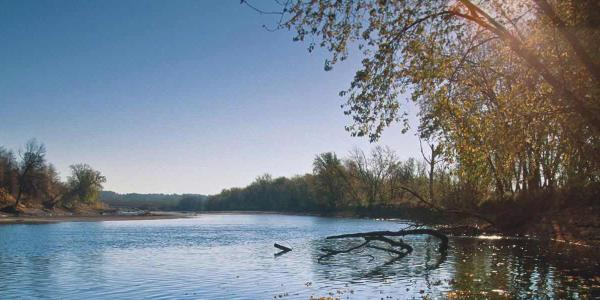
of the hour was Itasca, on the east bank of the Mississippi near present-day Elk River. An
attempt to make the projected city the temporary territorial capital in place of St. Paul had been
narrowly defeated in the legislature, and speculators were pouring into the area. The Kelleys
followed the rush. Autumn of 1950 found them established on the riverside claim that was to
be Kelley's permanent Minnesota home and, eventually, his monument. For Lucy it was soon
a grave; she died the next April, just as spring was returning to the upper Mississippi, and left
behind an infant daughter.
To care for the child, Kelley's mother traveled from Boston. Sorrow struck again in October
1851, when little Lucy also died. By that time, however, the older Mrs. Kelley had grown to like
the country so well that she joined Oliver in persuading the rest of the family to migrate.
Within a few years, a number of Kelley's relatives, including his parents and two brothers,
were living in the neighborhood.
Little land in the region had yet been broken for farming, and for two or three years Kelley's
interest centered in the development of Itasca. At first the town's prospects looked good: it
was backed by several of the territory's more substantial citizens, including Ramsey; it was
located on one of the Red River trails, which linked St. Paul with Pembina and the British
settlements; and at its levee the little steamer Governor Ramsey called regularly as it plied the
river between St. Anthony and Sauk Rapids. Itasca also had an active Indian trade, in which
Kelley himself engaged for a time. The discontented Winnebago continually wandered south
and east from their unpopular reservation at Long Prairie and sought food, weapons, and
liquor at a number of trading points along the eastern bank of the Mississippi. Itasca became
foremost among these in 1853, when a treaty signed by Governor Willis A. Gorman granted
the restless tribe a reserve along the Crow River, which flowed into the Mississippi from the
west at a point almost opposite the town. Although the treaty was never ratified, a large and
unruly community of Winnebago immediately settled at the mouth of the Crow, where they
lived in anticipation of trouble with nearby bands of Chippewa.
"Those were glorious days," Kelley wrote in later years with exaggerated satire. "A thousand
houses, an immense military depot, and hundreds of boats lying at the levee; martial law ruled
supreme; war dances invigorated the people, and fired the Indian heart; loud were the
speeches, and great deeds of valor from the warriors resounded from street to street. Big were
the expectations of the white population ... [but] the great war proved a great fizzle."
The prosperity of Itasca also fizzled two years later, when the Winnebago were moved to a
tract on the Blue Earth River in southern Minnesota. Within a short time the town had
disappeared - all but the post office, which still remained in 1868, when Kelley addressed a
letter to the secretary of the Minnesota Historical Society: "As a relic of the past I send you
herewith the first stake ever driven and the last to be found on the site of the ancient city of
Itasca. Should the history of Itasca ever be written, a great deal of information might be
secured, which would be of value to the rising generation, especially to young men starting
out in life, particularly if about to embark in town site speculations. ... Treasure this stake, for it
never can be replaced. There never will be another Itasca, there never can be." One suspects
that a bit of Kelley's youth went with it.
|
The yankee settler was shrewd enough to realize, however, that the future of Minnesota lay not in
the Indian trade but in the land. He turned to agriculture with an enthusiasm surprising for a
city-bred man. Since he had received a better-than-average education and had no rural
background to draw upon (his father was a tailor), Kelley became a confirmed "book farmer." Far
from apologizing for this, he campaigned eagerly for more experimentation, advanced
methods, and exchange of information among farmers. In December 1853, he wrote to the Prairie Farmer, published in Chicago: "I circulated your paper
and procured a few subscribers. Last year there were but two converts to book farming; this
year we number a dozen or more.
On his farm he built one of the first frame barns erected north of St. Anthony and sowed the
first timothy hay. He experimented over the years with everything from buckwheat to apples,
from melons to asparagus. Hard pressed by the drought of 1863, he installed an elaborate
irrigation system and became the Minnesota agent of J. D. West's patented pumps. He is also
said to have owned the first mechanical reaper in the state. As a practical farmer he seems to
have been moderately successful, moving steadily away from grain and stock raising and in
the direction of horticulture, vegetable gardening, and the nursery business, as nearby city
markets became more accessible. Yet there always remained about him a touch of the
promoter, a little of the smalltime politician, and even more of the journalist.
He was an active joiner. In 1852 an agricultural society was organized in Benton County and
for four years he served as its corresponding secretary. In this capacity he arranged speakers
for meetings, wrote incessantly to farm journals, touting the area's agricultural progress, and
for a while he acted as purchasing agent for local farmers in ordering equipment from St. Louis.
He was also active in launching the territorial agricultural society in January 1854. A later
decade found him serving on the first executive committee of the Minnesota Fruit Growers'
Association.
|
Having become known locally as "a graceful writer," he began contributing a regular column on
agriculture to the Sauk Rapids Frontierman. This he continued through 1855 and into early 1856,
at the same time serving as the paper's agent in southern Benton County and in Wright County.
Eventually his talents became known as far as Washington, and he wrote a ten-page essay on
Minnesota which was published as part of the report of the commissioner of agriculture for 1863.
Meanwhile Kelley had again proved himself susceptible to townsite fever, which reached epidemic proportions in
Minnesota during the late 185Os. With his brother Charles, he
surveyed and platted Northwood, located on the Mississippi just above the mouth of the
Crow River in Wright County. The site was not far from his original claim, though on the other
side of the Mississippi. A post office was established there, and in March 1856, Kelley was
appointed postmaster. Soon the new town boasted a hotel, a store, and a school, as well as a
burgeoning industry. The versatile Kelley had discovered a pumice-like substance on the
bank of the river which he began to package and market under the name "Excelsior Metal
Polish." The enterprise apparently did not long outlast Northwood, which, like many another
Minnesota "paper town," vanished after the panic of 1857. The post office was discontinued
in November 1859, and the store and schoolhouse were moved to nearby Dayton. The hotel
fell to ruin and may have been what Kelley had in mind, when he wrote of Minnesota in 1863:
"Occasionally one passes, in travelling, the ruins of some deserted house, which upon
inquiry, proves to be a hotel of a town site which was mortgaged for treble its real value in
1857, and 'thereby hangs a tale.'"
By 1864 Kelley had surmounted the hard years of sod-breaking, Indian scares, and financial
panic. He had become widely known and respected as one of the early settlers in central
Minnesota, and he was raising a family. A year after Lucy's death he had married Temperance
Baldwin Lane, a young schoolteacher who was, like himself, a native of Boston; thereafter, at
regular intervals of two years, four small daughters had appeared: Julia, Fanny, Grace, and
Garaphelia. His farm was a show place of the neighborhood. Nevertheless, he was restless.
In 1860 his parents had returned to Massachusetts, and after a try at farming, his brother
William had moved to St. Paul, where he entered on a lifetime career as a bookkeeper in the
First National Bank. Other relatives also had given up breaking Minnesota's soil. Among them
was Nathaniel Hall, Mrs. Kelley's brother-in-law, who had settled with his family near
Northwood some time before 1860 but had soon left Wright County. Kelley's soaring hopes
for the prosperity of Itasca and Northwood had come to nothing, and after two years of severe
drought in 1862-63, the future of farming looked grim.
Though busy with installing an extensive irrigation system, Kelley accepted that spring an
appointment as "regular correspondent" for the National Republican of Washington and
wrote to a number of prominent citizens, soliciting their contributions. "I have since 1849
written and had published, out of our State, over eight hundred letters regarding Minnesota
and it has become an old story," he told John H. Stevens. "I now seek some new matter by
way of soliciting suggestions from others. I claim to be as full of public spirit as a dog is full of
fleas ... and I am no seeker of office. My scribbling is my recreation — gratuitous."
Better pay was necessary, however, probably to meet the heavy costs of his investment in
irrigation. In the fall of 1864 he received through his old patron, Ramsey, a job as clerk under
the commissioner of agriculture and packed his bags for the trip to Washington.
Characteristically, he made his presence in the nation's capital count in two ways: he not only
worked for the government but served as a correspondent for the St. Paul Press. The articles
he wrote consisted mainly of popular gossip and sightseer's observations.
Spring took him back to Minnesota with an assignment from Commissioner Isaac Newton to
tour the state and report fully on its agricultural advantages. At the same time he became an
agent for Daniel A. Robertson's St. Paul nursery and seed store, and he may have doubled as
a salesman during his travels through the state that summer. Certainly he also plied his pen,
for in addition to his reports to Newton, he wrote two lengthy series of articles on Minnesota
... one for the St. Paul Press and the other for the Boston Post. Though the ground covered
was the same, the first was slanted for local consumption and the other aimed at prospective
immigrants. Kelley's journalistic style was chatty and jocular after the fashion of the time.
|
His essays suggest a sociable, inquisitive man with great reserves of optimism and good
will but no noteworthy insight. Aptly titled "Rambles Through Minnesota," the articles published in the Press described
trips up the Mississippi and Minnesota river valleys. Kelley's reports on industries, the growth
of towns, crops, soil, and weather were interspersed with recollections of old settlers, tips
to travelers on the best eating places, advice to farmers on how to poison gophers, and bits of
cracker-barrel philosophy. His growing interest in horticulture was evident throughout: everywhere he looked for apples.
From Redwood Falls, the westernmost point he reached, had come reports of valuable coal
deposits. Kelley made a particular point of looking into the matter for his readers, and after
touring the area, confidently predicted a great mining industry, for "THE COAL IS HERE IN
AN IMMENSE QUANTITY, and can be obtained by working into the river bank above high
water mark as readily as you can dig cellars in the sand stone under the bluff in St. Paul."
Early in November 1865, Kelley was re-called to Washington by Newton, who assured him of
an appointment in the South for the winter. After several weeks of impatient waiting he
discovered that Newton was wavering, so the Minnesotan took steps to assure the
appointment. According to his own account, he carried his case directly to President Andrew
Johnson, and in an interview during January 1866, the president promised him the commission.
He received it the same day, and two weeks later he left on his second tour within a year - this
time for the purpose of collecting facts to aid immigration and agricultural reconstruction in
the South. As on his previous trip, he not only sent official reports to Washington, but also
wrote newspaper articles.
It was during this southern tour that the idea of a farmers' organization began to develop in
Kelley's mind. Still a dedicated Mason, he found himself accepted as a brother member by
Masons throughout the South despite the general antagonism exhibited toward northerners.
Why not develop a similar organization among the nation's farmers, he wondered. The South
was overwhelmingly agricultural. Such an organization would bring men of the North and
South closer together, and farmers of both sections would have a channel through which to
cooperate in working for their common good.
He returned to Washington in April, then went on to Massachusetts, where he visited family
and friends. While there, he discussed the new idea with his wife's twenty-seven-year-old
niece, Caroline Hall, whom he had known earlier during her family's residence in Wright
County and had continued to correspond with. Encouraged by her enthusiastic reaction, he
went back to Minnesota and spent the summer on his farm, plowing and pondering.
With the coming of winter, financial pressures or simply the desire to be on the move took him
again to Washington, where he began to pull strings for another appointment. On December
21, 1866, Joseph A. Wheelock, editor of the Press and Ramsey's political hatchet man, wrote
from St. Paul to tell the senator of his concern at hearing that Kelley was being considered for
a position as secretary to the Senate post office committee. "Kelley is very much of a
humbug," Wheelock wrote. "He is a greenhorn - given to small dickerings without a particle of
discretion, and it would never do to take him into your confidence, if you ever take anybody
into your confidence - which I doubt." The editor suggested another candidate for the job,
"who could besides make an extremely desirable correspondent for the St. Paul Press. Kelley
wouldn't. He is too much like his own green corn." Ramsey heeded the words and bypassed
Kelley for the Senate committee, but he got him a clerkship in the post office department
instead - possibly for old times' sake.
|
|
Compared with the keen and cynical Wheelock, Kelley was in truth a simple man. Even then he was
privately dreaming of a great brotherhood of farmers that would unite the depressed and isolated men
and women who filled the soil; "Encourage them to read and think; to plant fruits and flowers, -
beautify their homes; elevate them; make them progressive." This vision he described in a letter to
a friend and added: "I long to see the great army of producers in our country, turn their eyes up
from their work; stir up those brains, now mere machines ... set them to thinking, - let them feel
that they are human beings, and the strength of the nation, their labor honorable, and farming the
highest calling on earth." No one could have then predicted that this particular dream was the one
to answer the wordless yearnings of thousands across the nation's farm belt - that promoted with the
single-minded fervor of a man like Kelley, it would give birth to a movement which in a few short years
was to shake the social and political foundations of the Midwest.
From his quiet niche in the post office department Kelley worked throughout 1867, busily filling in
the outlines of his grand scheme. Caroline Hall contributed many ideas, among them the vital one of
including women in the organization on an equal basis with men. Kelley took into his confidence a
select circle of sympathetic friends, mostly other government workers. Six of them, with him, became
founders of the Order of the Patrons of Husbandry, better known as the Grange, which was formally
established on December 4, 1867.
Kelley returned to Minnesota early in 1868, but thereafter his activities were centered on the Grange.
He had at last found his life's work and an outlet for all the restless energy that over nearly two
decades had contributed to the building of his adopted state.
|
In January 1966, Patricia Smith, a student at Macalester College engaged in a
work-study project between terms for the Minnesota Historical Society, did
extensive research in the society's collections and elsewhere on the early
life of Oliver H. Kelley. Although his work in founding the National Grange
is widely known, Kelley himself has always been a shadowy figure. His personal
papers have not survived; he has no direct descendants; and the traces of his
energetic career are widely scattered among many obscure sources. By
searching in newspapers, manuscripts and census records, Smith succeeded
in bringing together enough of these traces so that at least an outline of
Kelley's Minnesota years could be reconstructed. On the basis of these notes
Rhoda Gilman, then the editor of
Minnesota History, wrote this
article. Its publication honored the centennial of the National Grange, which was observed in December 1967.
The photos of Oliver H. Kelley, the Grange Office and Temperance Lane Kelley were taken from Kelley's
account of the Grange, Origin and Progress of the Order of the Patrons of Husbandry in the United
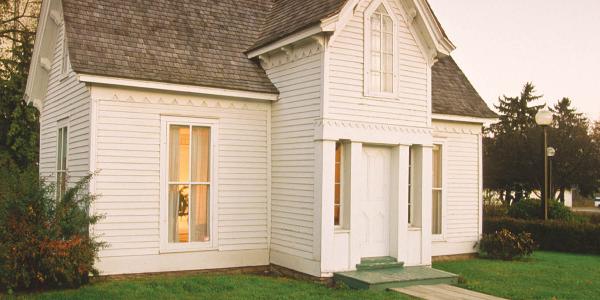
States: A History From 1866 to 1873 (Philadelphia, 1875). The photo of the restored house was taken
by Eugene D. Becker and the photo of the frame barn is from the National Park Service.
|