Samatar, Hussein (1964–2013)

Creator:
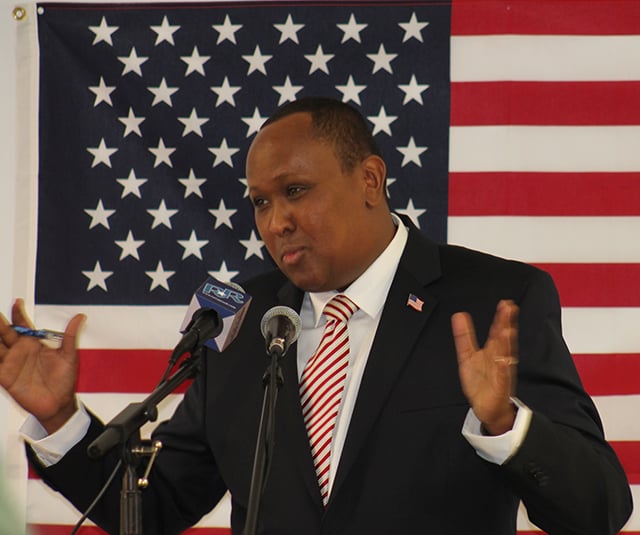
A man wearing a red-and-white-striped tie, a blue suit jacket, and a white dress shirt stands in front of a microphone with his hands lifted. An American flag is behind him.
Hussein Samatar in Minneapolis, 2012. Photo by Ibrahim Hirsi; used with permission.

Hussein Samatar was an entrepreneur, banker, and public servant who advocated for greater access to education for immigrant families. He founded and led the African Development Center, a nonprofit that provides financial education and loans to prospective immigrant entrepreneurs and homeowners. He was the first American of Somali descent elected to a public office in Minnesota (and possibly the US), inspiring a generation of young Somali Minnesotans to pursue civic engagement and public service.

Samatar was born in 1968 into a prominent family in Kismayo, Somalia, just a few years after the country gained independence from Italian and British colonial rule in the southern and northern territories, respectively. His father served as a high-ranking official under post-colonial Somali administrations, holding positions that included police commissioner and head of the country’s criminal investigation department. Samatar, the youngest of five, spent his early childhood in Kismayo, where he completed primary school, before moving with his family to the capital, Mogadishu. There, he attended high school and later earned a bachelor’s degree in economics from the Somali National University (SNU).

Meanwhile, Somalia’s political and economic conditions had gradually deteriorated. By 1969, the post-independence honeymoon had waned, and a military regime under Mohamed Siad Barre replaced the civilian government. Although Barre established efficient bureaucratic institutions, adopted a Latin-based writing system for Somali, and launched a national literacy campaign, his administration cracked down on those deemed a threat to his power. By the late 1970s and 1980s, armed opposition groups emerged to oust Barre.

In January 1991, just four days after Samatar graduated from SNU, the rebels overthrew the government. What began as anger and frustration toward the Barre regime escalated into a protracted civil war, with neighbors turning against one another. Soon, hundreds of thousands of people fled to neighboring countries such as Kenya, Ethiopia, and Yemen. Samatar was among those who fled to a Kenyan refugee camp.

By 1992, the United States began admitting Somali refugees. Two years later, Samatar became part of a growing Somali population that put down roots in Minneapolis’s Cedar-Riverside, East Phillips, Seward, and Whittier neighborhoods. In the 1990s and early 2000s, when internet access was rare among newcomers, Somalis used computers in public libraries to find employment, educational resources, and ways to connect with loved ones abroad.

Samatar’s regular spot was Franklin Library, a 1914 one-story, light-brown brick building in the East Phillips neighborhood. In its early years, the library served a community largely made up of Scandinavian and Jewish immigrants. By 1995, however, it mostly served the area’s growing Somali community, including Samatar, who used the library and its resources to teach himself English.

Samatar went on to secure employment as a business banker at Wells Fargo and earn an MBA in financial management from the University of St. Thomas. A few years later, as more immigrant entrepreneurs started small businesses, Samatar left corporate America for the nonprofit world. In 2002, he established and became the CEO of the African Development Center, a nonprofit that offers immigrants and refugees financial education and loans, as well as training in business development and homeownership.

In November 2005, Samatar entered the public eye when then-Minneapolis mayor R.T. Rybak appointed him to serve on the Minneapolis Library Board. The board was tasked, in part, with authorizing a tax levy to support the library and overseeing library operations. Samatar believed, according to the Star Tribune, that libraries were an “equalizer of opportunity for immigrant communities.”

In 2010, Samatar became the first American of Somali descent to hold an elected office in Minnesota, and most likely the US, when he won a seat on the Minneapolis Board of Education. He advocated for reforms to improve learning outcomes for students of color, who had lagged behind their white peers.

Samatar was a trusted voice in the Somali community. He represented the community’s interests in the Minnesota media landscape and organized events to address pressing community issues. His leadership inspired a generation of young Somali Americans who have won high-profile political offices in federal, state, and local governments in Minnesota and beyond.

On August 25, 2013, Samatar died in Minneapolis of complications from leukemia. He was forty-five.

In 2018, the city of Minneapolis opened Samatar Crossing, a bike and pedestrian path connecting the Cedar-Riverside neighborhood to downtown Minneapolis. The city named the path after Samatar in honor of his commitment to public service and bridge building.


Editor’s note: Samatar preferred to be described as an American of Somali descent rather than a Somali American. As he told a reporter in 2010, although he remained a part of the Somali diaspora, he had made Minnesota his home. This article refers to him as an American of Somali descent out of respect for this preference. At the same time, it uses the more common term “Somali Americans” to refer to the Somali community in Minnesota and the United States in general.

First Published: September 25, 2026
Last Modified: September 25, 2026

Bibliography

Feshir, Riham. “New Paved Path Connects Cedar-Riverside to Downtown Mpls.” MPR News, August 23, 2018.
https://www.mprnews.org/story/2018/08/23/new-path-connects-cedar-riverside-to-downtown-minneapolis

Haugen, Bryce. “Somali Man Celebrates New Post.” The Minnesota Daily, December 6, 2005.
https://mndaily.com/uncategorized/somali-man-celebrates-new-post/12/06/2005/snoadmin

Hawkins, Beth. “Hussein Samatar, ‘An Extraordinary Leader,’ Dies at 45.” MinnPost, August 26, 2013.
https://www.minnpost.com/learning-curve/2013/08/hussein-samatar-extraordinary-leader-dies-45

Hirsi, Ibrahim. “ADC Provides Minnesota’s African Immigrants Financial Education.” MinnPost, October 21, 2014.
https://www.minnpost.com/community-sketchbook/2014/10/adc-provides-minnesota-s-african-immigrants-financial-education

——— . “Minnesota Somalis Call for Actions to Support New Government and Bring Solutions to Chaotic Homeland.” Twin Cities Daily Planet, November 26, 2012.
https://www.tcdailyplanet.net/minnesota-somalis-call-actions-support-new-government-and-bring-solutions-chaotic-ho

Monserrate, Alberto. “A Major Loss for Minneapolis: Hussein Samatar Was an Inspirational Leader, Community-Builder.” Minneapolis Star Tribune, August 27, 2013.

Olson, Rochelle. “Rybak Picks Somali Man for Library Board; Minneapolis Mayor’s Move Might Make Hussein Samatar the Highest-Ranking Somali-Born Public Official in the Nation.” Minneapolis Star Tribune, November 30, 2005.

Samatar, Hussein. “Hussein Samatar: In America, Somalis Find Proud Footing.” Minneapolis Star Tribune, March 2, 2009.
https://www.startribune.com/hussein-samatar-in-america-somalis-find-proud-footing/40573592

Warholm-Wohlenhaus, Zee. “Franklin Library Celebrates 100 Years of Service.” Streets.MN, November 13, 2014.
https://streets.mn/2014/11/13/franklin-library-celebrates-100-years-of-service

Yuen, Laura. “First Somali-American Elected to Public Office in Minn.” MPR News, November 3, 2010.
https://www.mprnews.org/story/2010/11/03/hussein-samatar-first-somali-american-to-hold-public-office-in-minnesota

——— . “Hussein Samatar, A Somali–American Political Pioneer, Dies.” MPR News, August 25, 2013.
https://www.mprnews.org/story/2013/08/25/samatar-dies

Related Resources

Secondary

Aamot, Gregg. The New Minnesotans: Stories of Immigrants and Refugees. Syren Book Company, 2006.

Abdi, Cawo. Elusive Jannah: The Somali Diaspora and a Borderless Muslim Identity. University of Minnesota Press, 2015.

Abumaye, Maxamed. Black Muslim Refugee: Militarism, Policing, and Somali American Resistance to State Violence. University of California Press, 2025.

Chambers, Stefanie. Somalis in the Twin Cities and Columbus: Immigrant Incorporation in New Destinations. Temple University Press, 2017.

Kapteijns, Lidwien. Clan Cleansing in Somalia: The Ruinous Legacy of 1991. University of Pennsylvania Press, 2013.

Rawlence, Ben. City of Thorns: Nine Lives in the World’s Largest Refugee Camp. Portobello Books, 2016.

Yusuf, Ahmed Ismail. Somalis in Minnesota. Minnesota Historical Society Press, 2012.

Web

African Development Center.
https://www.adcminnesota.org

HCL 075
Minneapolis Public Library Board records, 1885–2007
Hennepin County Library Special Collections
Description: Signed board minutes of the Minneapolis Public Library Board from 1885 to 2007. In later years, corresponding documentation and board packet materials are included with the minutes. From 1885 to 1909, and again in 1911, the minutes were handwritten in bound volumes. All other minutes are typewritten.
https://archives.hclib.org/resources/minneapolis_public_library_board_records

Hennepin County Library. Franklin Library.
https://www.hclib.org/about/locations/franklin

Related Images

A man wearing a red-and-white-striped tie, a blue suit jacket, and a white dress shirt stands in front of a microphone with his hands lifted. An American flag is behind him.
Hussein Samatar in Minneapolis, 2012. Photo by Ibrahim Hirsi; used with permission.
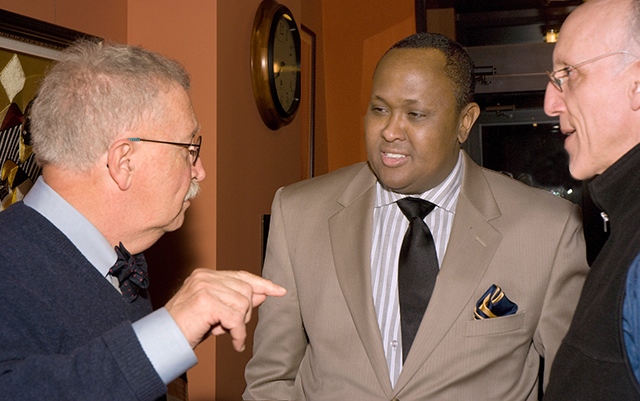
A man wearing a light taupe suit jacket, taupe-and-white striped shirt, and a black tie stands between two others, with a wall to his right painted a peach color.
Hussein Samatar (center) discusses an exhibit with visitors at the African Development Center in Minneapolis on December 17, 2009. Used with the permission of the African Development Center.
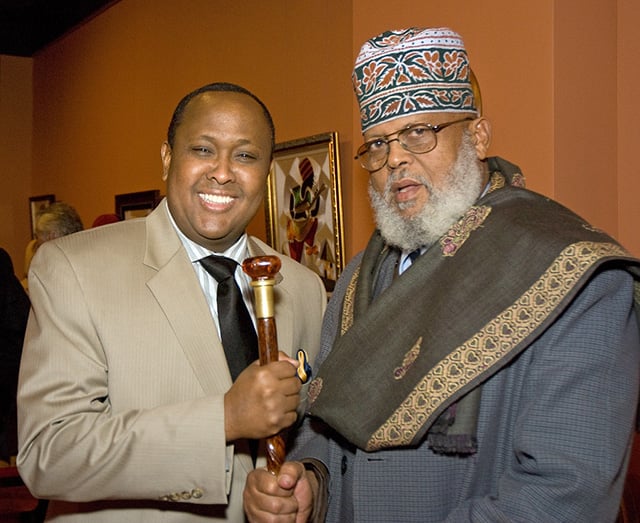
Two men stand next to each other. One wears a tan suit and a black tie and smiles broadly. The other wears a blue suit jacket, a textile wrap around his shoulders, and a kofia on his head. Both men grasp a wooden stick betwen them.
Hussein Samatar (left) and World Peace Organization leader Imam Sheikh Sa'ad Mousse Roble (right) at the African Development Center in Minneapolis, December 17, 2009. Used with the permission of the African Development Center.
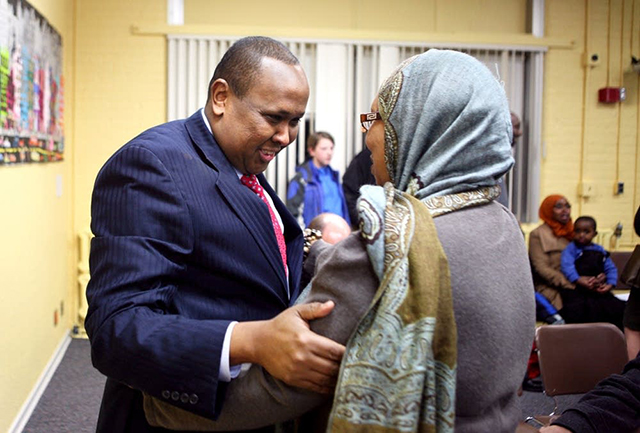
A man in a blue suit jacket holds the left arm of a woman wearing hijab, with yellow walls and other people behind them.
Hussein Samatar greets Qamar Ibrahim of Minneapolis before taking the oath of office for service on the Minneapolis School Board on January 11, 2010. Used with the permission of MPR (Minnesota Public Radio).
A light-rail train crosses a bridge over a freeway as vehicles pass underneath.
Samatar Crossing in the Cedar-Riverside neighborhood of Minneapolis on September 2, 2018, shortly after its opening. Photo by Minneapolis Public Works TPP.
A man wearing a red-and-white-striped tie, a blue suit jacket, and a white dress shirt stands in front of a microphone with his hands lifted. An American flag is behind him.

Hussein Samatar, 2012

Hussein Samatar in Minneapolis, 2012. Photo by Ibrahim Hirsi; used with permission.
© Hussein Samatar    

All rights reserved

A man wearing a light taupe suit jacket, taupe-and-white striped shirt, and a black tie stands between two others, with a wall to his right painted a peach color.

Hussein Samatar with visitors at the African Development Center, 2009

Hussein Samatar (center) discusses an exhibit with visitors at the African Development Center in Minneapolis on December 17, 2009. Used with the permission of the African Development Center.
© African Development Center    

All rights reserved

Holding Location

Flickr
Two men stand next to each other. One wears a tan suit and a black tie and smiles broadly. The other wears a blue suit jacket, a textile wrap around his shoulders, and a kofia on his head. Both men grasp a wooden stick betwen them.

Hussein Samatar and Imam Sheikh Sa’ad Mousse, 2009

Hussein Samatar (left) and World Peace Organization leader Imam Sheikh Sa'ad Mousse Roble (right) at the African Development Center in Minneapolis, December 17, 2009. Used with the permission of the African Development Center.
© African Development Center    

All rights reserved

Holding Location

Flickr
A man in a blue suit jacket holds the left arm of a woman wearing hijab, with yellow walls and other people behind them.

Hussein Samatar at his oath-of-office ceremony, 2010

Hussein Samatar greets Qamar Ibrahim of Minneapolis before taking the oath of office for service on the Minneapolis School Board on January 11, 2010. Used with the permission of MPR (Minnesota Public Radio).
© MPR Photo/Jeffrey Thompson    

All rights reserved

A light-rail train crosses a bridge over a freeway as vehicles pass underneath.

Samatar Crossing in Cedar-Riverside, 2018

Samatar Crossing in the Cedar-Riverside neighborhood of Minneapolis on September 2, 2018, shortly after its opening. Photo by Minneapolis Public Works TPP.

Turning Point

In 2010, Hussein Samatar wins a seat on the Minneapolis Board of Education, becoming the first American of Somali descent elected to public office in Minnesota. Throughout most of his life in the state, he advocates for improving student learning outcomes, expanding access to library resources for families, and empowering immigrant entrepreneurs and prospective homeowners.

Chronology

1964
Hussein Samatar is born in Kismayo, Somalia.
1991
Samatar graduates from the Somali National University.
1991
A civil war breaks out in Somalia.
2002
Samatar founds the African Development Center in Minneapolis.
2004
The African Development Center opens.
2005
Minneapolis Mayor R. T. Rybak appoints Samatar to the Minneapolis Library Board.
2006
Samatar begins his term as a member of the Minneapolis Library Board.
2010
Samatar is elected to the Minneapolis School Board.
2013
Samatar dies on August 25 in Minneapolis at the age of forty-five.
2018
Samatar Crossing opens in Minneapolis.

Bibliography

Feshir, Riham. “New Paved Path Connects Cedar-Riverside to Downtown Mpls.” MPR News, August 23, 2018.
https://www.mprnews.org/story/2018/08/23/new-path-connects-cedar-riverside-to-downtown-minneapolis

Haugen, Bryce. “Somali Man Celebrates New Post.” The Minnesota Daily, December 6, 2005.
https://mndaily.com/uncategorized/somali-man-celebrates-new-post/12/06/2005/snoadmin

Hawkins, Beth. “Hussein Samatar, ‘An Extraordinary Leader,’ Dies at 45.” MinnPost, August 26, 2013.
https://www.minnpost.com/learning-curve/2013/08/hussein-samatar-extraordinary-leader-dies-45

Hirsi, Ibrahim. “ADC Provides Minnesota’s African Immigrants Financial Education.” MinnPost, October 21, 2014.
https://www.minnpost.com/community-sketchbook/2014/10/adc-provides-minnesota-s-african-immigrants-financial-education

——— . “Minnesota Somalis Call for Actions to Support New Government and Bring Solutions to Chaotic Homeland.” Twin Cities Daily Planet, November 26, 2012.
https://www.tcdailyplanet.net/minnesota-somalis-call-actions-support-new-government-and-bring-solutions-chaotic-ho

Monserrate, Alberto. “A Major Loss for Minneapolis: Hussein Samatar Was an Inspirational Leader, Community-Builder.” Minneapolis Star Tribune, August 27, 2013.

Olson, Rochelle. “Rybak Picks Somali Man for Library Board; Minneapolis Mayor’s Move Might Make Hussein Samatar the Highest-Ranking Somali-Born Public Official in the Nation.” Minneapolis Star Tribune, November 30, 2005.

Samatar, Hussein. “Hussein Samatar: In America, Somalis Find Proud Footing.” Minneapolis Star Tribune, March 2, 2009.
https://www.startribune.com/hussein-samatar-in-america-somalis-find-proud-footing/40573592

Warholm-Wohlenhaus, Zee. “Franklin Library Celebrates 100 Years of Service.” Streets.MN, November 13, 2014.
https://streets.mn/2014/11/13/franklin-library-celebrates-100-years-of-service

Yuen, Laura. “First Somali-American Elected to Public Office in Minn.” MPR News, November 3, 2010.
https://www.mprnews.org/story/2010/11/03/hussein-samatar-first-somali-american-to-hold-public-office-in-minnesota

——— . “Hussein Samatar, A Somali–American Political Pioneer, Dies.” MPR News, August 25, 2013.
https://www.mprnews.org/story/2013/08/25/samatar-dies

Related Resources

Secondary

Aamot, Gregg. The New Minnesotans: Stories of Immigrants and Refugees. Syren Book Company, 2006.

Abdi, Cawo. Elusive Jannah: The Somali Diaspora and a Borderless Muslim Identity. University of Minnesota Press, 2015.

Abumaye, Maxamed. Black Muslim Refugee: Militarism, Policing, and Somali American Resistance to State Violence. University of California Press, 2025.

Chambers, Stefanie. Somalis in the Twin Cities and Columbus: Immigrant Incorporation in New Destinations. Temple University Press, 2017.

Kapteijns, Lidwien. Clan Cleansing in Somalia: The Ruinous Legacy of 1991. University of Pennsylvania Press, 2013.

Rawlence, Ben. City of Thorns: Nine Lives in the World’s Largest Refugee Camp. Portobello Books, 2016.

Yusuf, Ahmed Ismail. Somalis in Minnesota. Minnesota Historical Society Press, 2012.

Web

African Development Center.
https://www.adcminnesota.org

HCL 075
Minneapolis Public Library Board records, 1885–2007
Hennepin County Library Special Collections
Description: Signed board minutes of the Minneapolis Public Library Board from 1885 to 2007. In later years, corresponding documentation and board packet materials are included with the minutes. From 1885 to 1909, and again in 1911, the minutes were handwritten in bound volumes. All other minutes are typewritten.
https://archives.hclib.org/resources/minneapolis_public_library_board_records

Hennepin County Library. Franklin Library.
https://www.hclib.org/about/locations/franklin