Hastings State Hospital

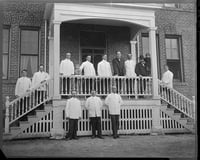
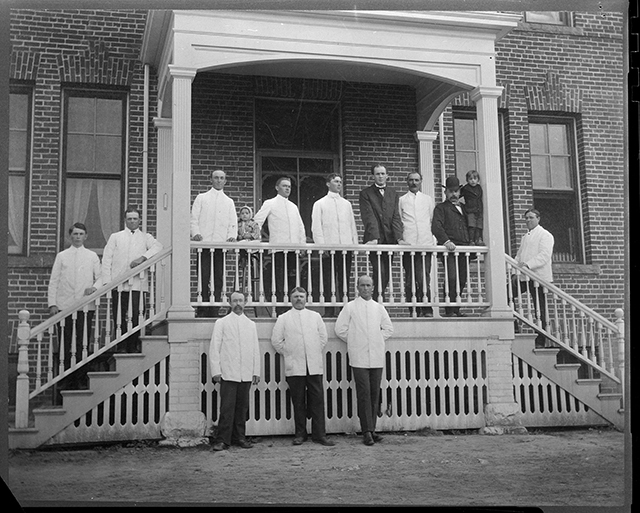
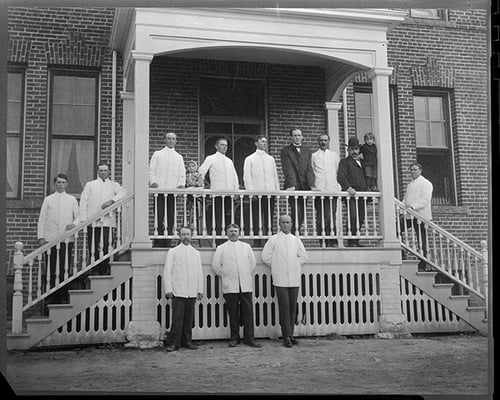
Twelve people, most of them in white medical coats, stand beside, on, and in front of the porch of a brick building, with stairs leading up to a raised platform.
Twelve employees of Hastings State Hospital, April 26, 1900. Robert Carmichael, Hastings’ first superintendent, stands under the porch roof, third from the right. William J. Yanz, who succeeded Carmichael in 1901, stands two places from Carmichael’s right.

Hastings State Asylum for the Insane opened in 1900, and over the next seventy-eight years it housed 16,015 patients. By the 1940s it was a city in itself, with its own farm, power station, and residences. Due to improvements in the treatment of mental illness, however, including the use of psychotropic drugs, the number of residents declined until the hospital was no longer needed. It closed on May 1, 1978.

The Minnesota legislature authorized the creation of Hastings State Asylum for the Insane in 1899. At the time, state governments used asylums to house mentally ill persons, but also to isolate them and “protect” society from them. Staff provided minimal treatment, offered patients little enrichment, and restrained them with cuffs, belts, and straitjackets. Institutionalization of this kind was the norm for fifty years.


Local boosters had promoted Hastings as an ideal site for a new state hospital starting in 1895. In addition to railroad access, the area had good drainage, water power, lime kilns, a brickyard, and onsite dolomite for building materials. The state legislature noticed and purchased 643 acres west of the city for $15,000.


Design of the hospital’s buildings was influenced by the work of Dr. Thomas Kirkbride, who in 1854 had first advocated for asylums to include an administrative building with attached wings for patients to live in. The state legislature authorized construction of a complex costing up to $56,500, and Hastings opened in April of 1900 with 115 patients transferred from Rochester State Hospital. After Anoka State Hospital, which had opened a month earlier, Hastings was the second asylum in Minnesota created exclusively for people with mental illness.


The hospital received patients over the next two years for a total of 308 by August 27, 1903. In that year, administrators abandoned Kirkbride’s arrangement of wards for the cottage plan, which allowed patients to live in standalone houses for a more home-like setting. At Hastings’ peak in the 1940s, there were forty buildings with tunnels connecting them.


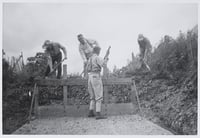
A 460-acre farm was established soon after the hospital opened. Patients did much of the work, growing oats, potatoes, corn, onions, parsnips, rutabagas, squash, beans, and fruit. They also raised dairy cows, pigs, turkeys, and chickens. In 1921, there were five employees and thirty-one patient workers. The hospital’s kitchen canned food and made pickles and sauerkraut. Also in 1921, an industrial department operated for a short time, making mattresses, pillows, sheets, towels, and napkins.


In the 1930s, Hastings introduced a program to improve patient behavior. Under the new rules, patients lost the privileges of watching movies, attending parties, and eating in the dining room when they mistreated staff or each other. The change allowed Hastings to reduce the number of patients wearing restraints from fifty-two-to four over six months. The program was not adopted by other hospitals until the 1960s.


Treatment of the mentally ill changed over the years. A process called hypothesized focal silent infection therapy could involve the removal of patients’ teeth, pancreas, ovaries, and parts of the colon. In the 1930s and 1940s, doctors administered insulin therapy to chemically induce comas with the intention to “rest” patients’ brains. Electroconvulsive therapy (ECT) to cause seizures began in the 1930s. Until the 1950s, doctors at Hastings (as at other hospitals) performed a frontal lobotomy by placing a pick through a patient’s eye socket and chiseling away brain tissue. In the mid-1950s, tranquilizers and psychotropic drugs were discovered that enabled more humane and successful treatment.


As of May 1958, Hastings employed 271 staff, including two resident psychiatrists, two consulting psychiatrists, three resident doctors, and one dentist. The nursing department had 148 positions.
The federal Community Mental Health Acts of 1963 and 1965 led to de-institutionalization—the transfer of mentally ill people from state hospitals to alternatives like group homes. Medicare and Medicaid forbid payment to state hospitals, but they allowed payment to outpatient clinics and providers. Community psychiatry began.


By 1968, Hastings had become a multi-program mental health treatment facility for people with chemical dependencies and intellectual disabilities. In the 1970s, a regional approach was created, with Hastings responsible for Ramsey, Washington, and Dakota counties.


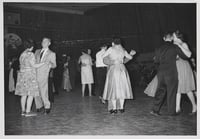
The transition from custodial to community-oriented treatment was successful. In 1972, Hastings had the shortest length of hospitalization of any state hospital, with 50 percent of patients discharged in fifty-three days or less. Only 19 percent of patients were hospitalized for two years or longer. Staff consistently reported a congenial working atmosphere, and several lived on site. Staff families attended weekly movies, sleigh rides, dances, and parties.


A February 17, 1970, report on Hastings to the Minnesota legislature noted an average daily patient census in 1961 at 880; by January 7, 1970, it was 415. Instead of expanding, however, the hospital closed on May 1, 1978. All patients (130) were transferred or discharged to homes or other state hospitals. 

First Published: November 13, 2026
Last Modified: November 13, 2026

Bibliography

Boyd, Mary Ann, and Rebecca Luebert. Psychiatric Nursing: Contemporary Practice. Sixth edition. Wolters Kluwer, 2018.

Center for Educational Policy Studies, University of Minnesota. “Minnesota’s State Hospitals.” Report prepared for the Minnesota State Planning Agency, January 31, 1985.
https://mn.gov/mnddc/learning/document/GT033.PDF

Erickson, William D. “‘Something Must be Done for Them’: Establishing Minnesotan's First Hospital for the Insane.” Minnesota History 53, no. 2 (Summer 1992): 42–55.
https://storage.googleapis.com/mnhs-org-support/mn_history_articles/53/v53i02p042-055.pdf

Ferraro, Nick. “History Project Tells Stories of Life at the Old Hastings State Hospital.” St. Paul Pioneer Press, January 30, 2012.
https://www.twincities.com/2012/01/30/history-project-tells-stories-of-life-at-the-old-hastings-state-hospital

Flight Deck (publication of the Hastings State Hospital), May 1, 1966. Special edition. Available at the Minnesota Historical Society library as RC445.M6 H2.

Foote, Susan Bartlett. The Crusade for Forgotten Souls: Reforming Minnesota’s Mental Institutions, 1946–1954. University of Minnesota Press, 2018.

Grob, Gerald N. From Asylum to Community: Mental Health Policy in Modern America. Princeton University Press, 1991.

Genealogy Trails History Group. Genealogy and History, Dakota County, Minnesota. Minnesota State Hospital–Administrative News.
https://genealogytrails.com/minn/dakota/institutions_admin.html

Hastings State Hospital published records and reports, 1915–1980
State Archives Collection, Minnesota Historical Society, St. Paul
Description: Includes procedures manuals, policy manuals, and reports (1950s–1979); Tuesday Topics (monthly HSH newsletter, 1968–1978); monthly reports (1956–1978); farm reports (1921–1963); and miscellaneous publications dealing with the hospital's history, legislative building requests, dairy cattle, industrial department, finances, psychiatric care for discharged patients, and closure.
https://storage.googleapis.com/mnhs-finding-aids-public/library/findaids/gr01111.html

“An Ideal Site Is Offered: Hastings’ Location for the New Asylum Excels All.” St. Paul Pioneer Press, November 10, 1895.
https://newspaperhub.mnhs.org/?a=d&d=sppp18951110

Lynch, Lillian. “A Glimpse of Hastings State Hospital—Then and Now.” Hospitality (newsletter of Hastings State Hospital), May 1958, 5–11. Available at the Minnesota Historical Society library as RC445.M6 H32.

Minnesota Legislature Office of the Revisor of Statutes. Minnesota Session Laws–31st Legislature. 1899 Regular Session. Chapter 230.
https://www.revisor.mn.gov/laws/1899/0/General+Laws/Chapter/230/pdf

Minnesota Legislature Office of the Revisor of Statutes. Minnesota Session Laws–70th Legislature. 1977 Regular Session. Chapter 453.
https://www.revisor.mn.gov/laws/1977/0/Session+Law/Chapter/453/pdf

Olson, Gordon W. “The Impact of Closure of Hastings (MN) State Hospital. Governor's Planning Council on Developmental Disabilities.” Report to the Governor’s Planning Council on Developmental Disabilities. Minnesota State Planning Agency, January 1980.
https://mn.gov/mnddc/past/pdf/80s/80/80-olson-impact-closure-hastings.pdf

Quinlan, Joseph J. “Hastings State Hospital.” Minnesota Welfare (official publication of the Minnesota Department of Public Welfare) 17 (Winter 1965): 6–38, 48. Available as part of Hastings State Hospital published records and reports, 1915–1980 (see citation below).

Resman, Michael. Asylums, Treatment Centers, and Genetic Jails: A History of Minnesota’s State Hospitals. North Star Press of St. Cloud, 2013.

Rosenberg, Kenneth Paul, and Jessica DuLong. Bedlam: An Intimate Journey Into America’s Mental Health Crisis. Avery, 2019.

Smith, Norvin (Hastings State Hospital medical director). “A Word to the Wise.” Flight Deck (newsletter of Hastings State Hospital) 2, no. 2 (December 5, 1963). Available at the Minnesota Historical Society library as RC445.M6 H2.

Tuesday Topics (official bulletin of Hastings State Hospital Employees) 19, No. 4 (January 23, 1973). Available as part of Hastings State Hospital published records and reports (see citation above).

[Untitled]. Hastings Democrat, February 18, 1897.

Varcarolis, Elizabeth M. Essentials of Psychiatric Mental Health Nursing. Second edition. Elsevier Saunders, 2013.

Related Resources

Primary Sources

108.D.10.6F
Patient record books, 1900–1962
Hastings State Hospital
State Archives Collection, Minnesota Historical Society, St. Paul
Description: Summary information for case nos. 1–8492. Information provided includes each patient’s name, age, occupation, civil condition, education, habits, and “form of insanity.”
https://libguides.mnhs.org/ld.php?content_id=79688107

Secondary Sources

Hastings Community TV. “Our Voices: Hastings State Hospital Oral History Project.” YouTube playlist.
https://www.youtube.com/playlist?list=PLW43dgaBmZ7V0M8HpLvY_zNwPC7rkSCbA

“Hastings State Hospital.” Asylum Projects.
https://www.asylumprojects.org/index.php?title=Hastings_State_Hospital

Web Sources

State Hospitals: Historical Patient Records: Hastings. Minnesota Historical Society.
https://libguides.mnhs.org/sh/hastings

Related Images

Twelve people, most of them in white medical coats, stand beside, on, and in front of the porch of a brick building, with stairs leading up to a raised platform.
Twelve employees of Hastings State Hospital, April 26, 1900. Robert Carmichael, Hastings’ first superintendent, stands under the porch roof, third from the right. William J. Yanz, who succeeded Carmichael in 1901, stands two places from Carmichael’s right.
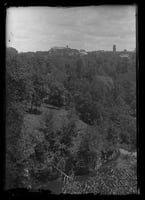
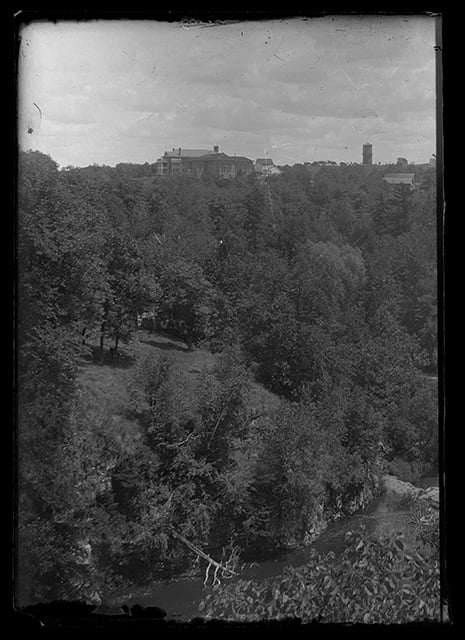
A view of a wooded bluff rom across a body of water, with a building at its highest point, center top.
Bird’s eye view of Hastings State Hospital, 1905.
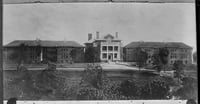
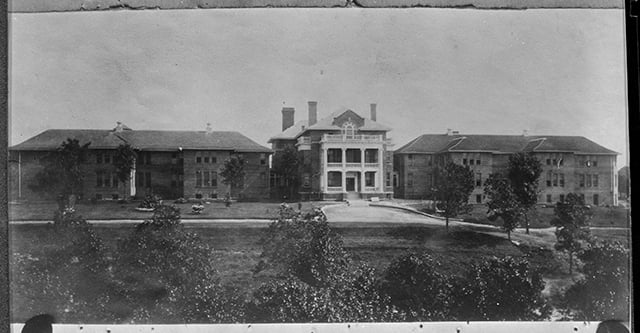
A central three-story building with columns flanked by two side buildings, with a road and driveway leading to the central building.
The central building and adjacent wings of Hastings State Hospital, ca. 1906.
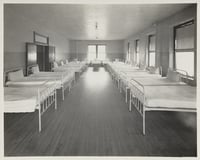
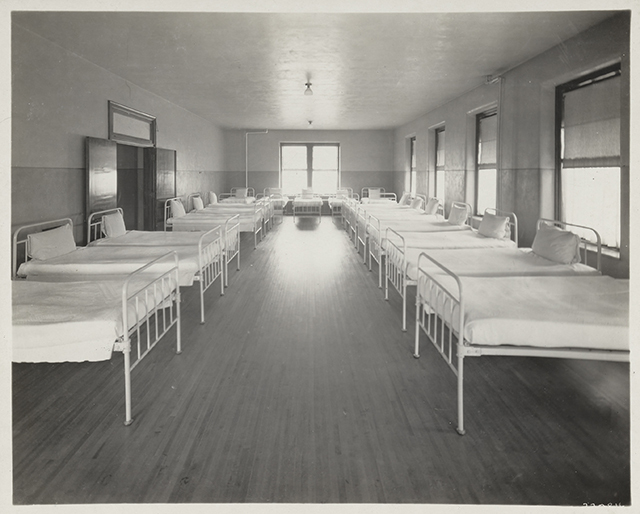
Beds on two sides of a narrow read lead to a vanishing point in the center background.
Beds inside Hastings State Hospital, 1912.
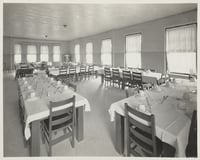
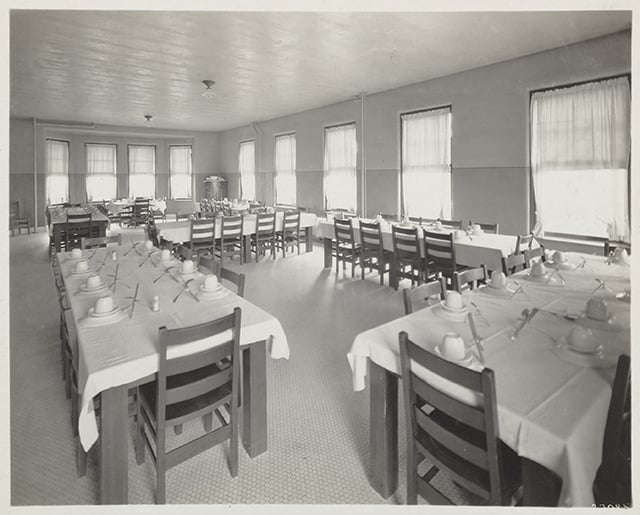
Wooden chairs and tables with tablecloths and place settings sit around the perimeter of a room with nine visible windows.
The dining room inside Hastings State Hospital, 1911.
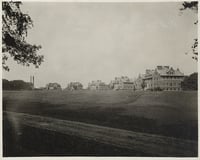
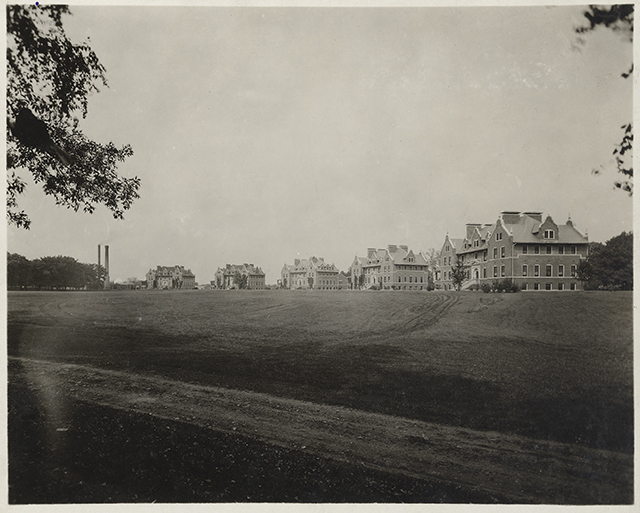
Four-story brick buildings sit on the horizon line of a landscape behind a road, with trees at the edges.
The ground and buildings of Hastings State Hospital, 1912.
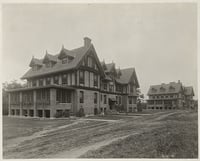
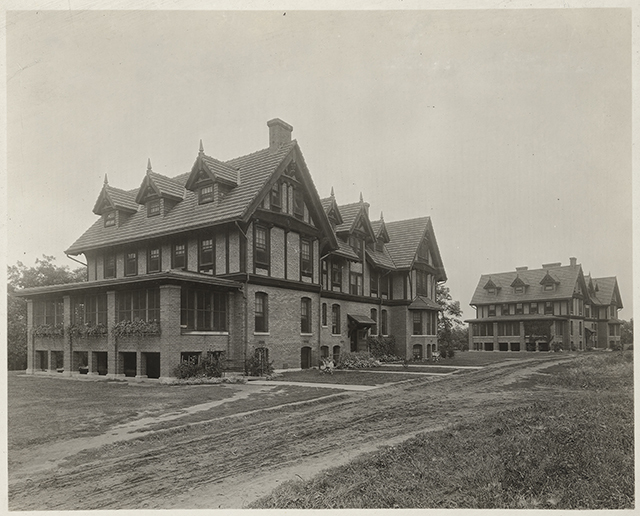
Buildings with dormer windows on the top story sit along a network of dirt paths.
Four cottages at Hastings State Hospital, ca. 1912.
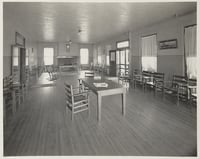
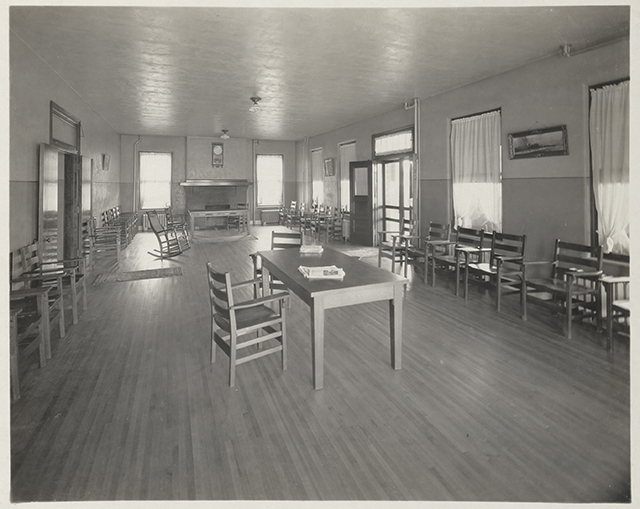
A mostly unfurnished rectangular room. Wooden chairs line the walls, and a table and chairs sit in the center of the image.
The day room inside Hastings State hospital, 1912.
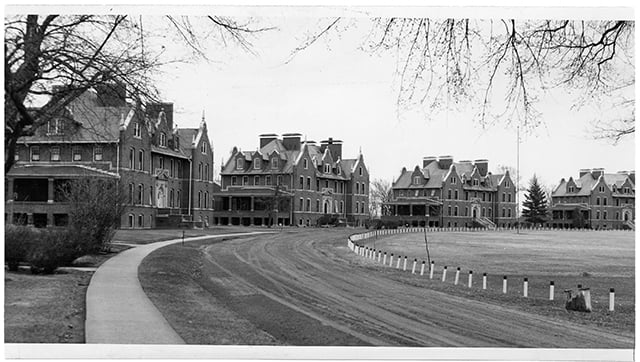
Four four-story cottages with dormer windows on the upper levels line an oval drive, with tree branches intruding into the frame from above.
Hastings State Hospital, ca. 1940.
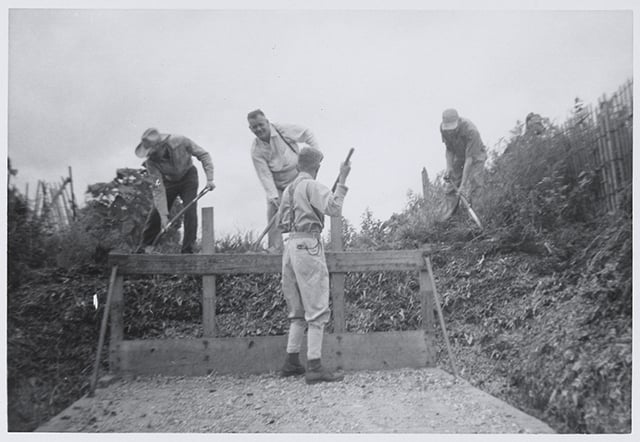
Laborers with suspenders and shovels work in an outdoor fenced-in area.
Patients work on the farm at Hastings State Hospital, ca. 1959.
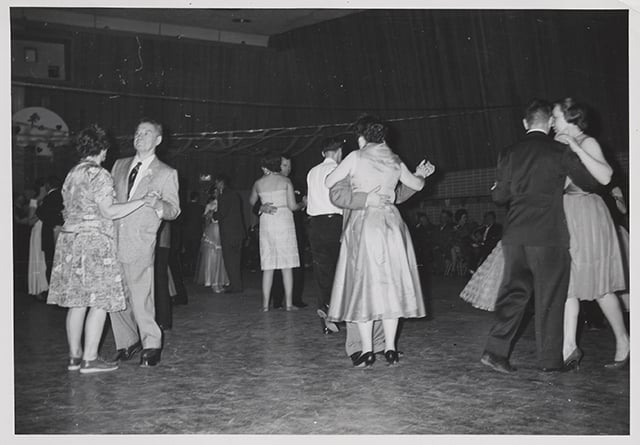
Couples wearing dresses and suits dance on a ballroom floor against a dark background.
A dance held for patients at Hastings State Hospital on April 26, 1965.
Twelve people, most of them in white medical coats, stand beside, on, and in front of the porch of a brick building, with stairs leading up to a raised platform.

Hastings State Hospital staff, 1900

Twelve employees of Hastings State Hospital, April 26, 1900. Robert Carmichael, Hastings’ first superintendent, stands under the porch roof, third from the right. William J. Yanz, who succeeded Carmichael in 1901, stands two places from Carmichael’s right.

Holding Location

Minnesota Historical Society
A view of a wooded bluff rom across a body of water, with a building at its highest point, center top.

Bird’s eye view of Hastings State Hospital, 1905

Bird’s eye view of Hastings State Hospital, 1905.

Holding Location

Minnesota Historical Society
A central three-story building with columns flanked by two side buildings, with a road and driveway leading to the central building.

Hastings State Hospital, ca. 1906

The central building and adjacent wings of Hastings State Hospital, ca. 1906.

Holding Location

Minnesota Historical Society
Beds on two sides of a narrow read lead to a vanishing point in the center background.

Beds inside Hastings State Hospital, 1912

Beds inside Hastings State Hospital, 1912.

Holding Location

Minnesota Historical Society
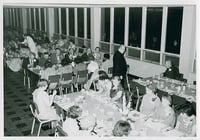
Wooden chairs and tables with tablecloths and place settings sit around the perimeter of a room with nine visible windows.

Hastings State Hospital’s dining room, 1911

The dining room inside Hastings State Hospital, 1911.

Holding Location

Minnesota Historical Society
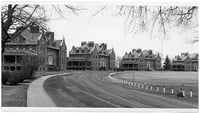
Four-story brick buildings sit on the horizon line of a landscape behind a road, with trees at the edges.

Hastings State Hospital, 1912

The ground and buildings of Hastings State Hospital, 1912.

Holding Location

Minnesota Historical Society
Buildings with dormer windows on the top story sit along a network of dirt paths.

Cottages at Hastings State Hospital, ca. 1912

Four cottages at Hastings State Hospital, ca. 1912.

Holding Location

Minnesota Historical Society
A mostly unfurnished rectangular room. Wooden chairs line the walls, and a table and chairs sit in the center of the image.

Day room inside Hastings State hospital, 1912

The day room inside Hastings State hospital, 1912.

Holding Location

Minnesota Historical Society
Four four-story cottages with dormer windows on the upper levels line an oval drive, with tree branches intruding into the frame from above.

Hastings State Hospital, ca. 1940

Hastings State Hospital, ca. 1940.

Holding Location

Minnesota Historical Society
Laborers with suspenders and shovels work in an outdoor fenced-in area.

Patients work on the farm at Hastings State Hospital, ca. 1959

Patients work on the farm at Hastings State Hospital, ca. 1959.

Holding Location

Minnesota Historical Society
Couples wearing dresses and suits dance on a ballroom floor against a dark background.

Dance for patients at Hastings State Hospital, 1965

A dance held for patients at Hastings State Hospital on April 26, 1965.

Holding Location

Minnesota Historical Society

Turning Point

In 1977, the state legislature authorizes Hastings to be closed on May 1, 1978. The second state veterans’ home opens on the former site of the hospital three days after the closure. Patients are transferred or discharged; employees move to other state hospitals, quit, retire, or stay on at the veterans’ home.

Chronology

1900
Hastings State Asylum for the Insane opens on April 26 and receives 115 transfer patients from Rochester State Hospital.
1901
A patient cemetery opens as far away from the hospital's main building as possible. (A second cemetery was not added until 1944.)
1901
The first patient to die at Hastings is buried there on July 16.
1903
A bridge is built over the Vermillion River, providing a direct connection to Hastings’ downtown.
1905
On September 2, fifty women arrive at Hastings and remain there until their transfer out by November 15, 1910. Afterward, there were no female patients again until August 25, 1944, when 174 women were transferred to Hastings from Rochester State Hospital.
1919
The institution’s name changes to Hastings State Asylum.
1928
The first occupational therapist begins work at Hastings.
1937
The Minnesota legislature changes the asylum’s name to Hastings State Hospital. Alongside that change, the first on-site psychiatrist, Dr. Ralph Rossen, is hired.
1940
The hospital counts its largest number of patients ever (1,100) on June 30.
1949
Governor Luther Youngdahl pushes for reforms in his “Crusade for Forgotten Souls.” The state legislature mandates improvements in funding, staffing, and conditions for the mentally ill. Hastings is the first Minnesota hospital to discontinue the use of physical restraints on patients.
1950s
Dr. Rossen initiates more reforms, including a single diet for patients and staff, a psychiatric team for each patient, liberal visiting hours, and daily ward rounds by physicians.
1957
On March 25, the institution is renamed Hastings State Hospital, with the position of chief executive officer eliminated in favor of a medical director.
1963
Farm operations cease on December 31, with only seven employees and nine workers.
1968
A treatment program for people with developmental disabilities begins on April 1, and a treatment program for chemically dependent patients begins on September 1.
1964
The last patient burial at Hastings occurs on December 28. 901 patients are buried there.
1978
Hastings State Hospital closes on May 1. All patients are either transferred or discharged to homes or other state hospitals or facilities. The second state veterans’ home is established on the site of the hospital.
1980s
The non-profit group Remembering With Dignity identifies all patients buried at Hastings and provides marked gravestones.

Bibliography

Boyd, Mary Ann, and Rebecca Luebert. Psychiatric Nursing: Contemporary Practice. Sixth edition. Wolters Kluwer, 2018.

Center for Educational Policy Studies, University of Minnesota. “Minnesota’s State Hospitals.” Report prepared for the Minnesota State Planning Agency, January 31, 1985.
https://mn.gov/mnddc/learning/document/GT033.PDF

Erickson, William D. “‘Something Must be Done for Them’: Establishing Minnesotan's First Hospital for the Insane.” Minnesota History 53, no. 2 (Summer 1992): 42–55.
https://storage.googleapis.com/mnhs-org-support/mn_history_articles/53/v53i02p042-055.pdf

Ferraro, Nick. “History Project Tells Stories of Life at the Old Hastings State Hospital.” St. Paul Pioneer Press, January 30, 2012.
https://www.twincities.com/2012/01/30/history-project-tells-stories-of-life-at-the-old-hastings-state-hospital

Flight Deck (publication of the Hastings State Hospital), May 1, 1966. Special edition. Available at the Minnesota Historical Society library as RC445.M6 H2.

Foote, Susan Bartlett. The Crusade for Forgotten Souls: Reforming Minnesota’s Mental Institutions, 1946–1954. University of Minnesota Press, 2018.

Grob, Gerald N. From Asylum to Community: Mental Health Policy in Modern America. Princeton University Press, 1991.

Genealogy Trails History Group. Genealogy and History, Dakota County, Minnesota. Minnesota State Hospital–Administrative News.
https://genealogytrails.com/minn/dakota/institutions_admin.html

Hastings State Hospital published records and reports, 1915–1980
State Archives Collection, Minnesota Historical Society, St. Paul
Description: Includes procedures manuals, policy manuals, and reports (1950s–1979); Tuesday Topics (monthly HSH newsletter, 1968–1978); monthly reports (1956–1978); farm reports (1921–1963); and miscellaneous publications dealing with the hospital's history, legislative building requests, dairy cattle, industrial department, finances, psychiatric care for discharged patients, and closure.
https://storage.googleapis.com/mnhs-finding-aids-public/library/findaids/gr01111.html

“An Ideal Site Is Offered: Hastings’ Location for the New Asylum Excels All.” St. Paul Pioneer Press, November 10, 1895.
https://newspaperhub.mnhs.org/?a=d&d=sppp18951110

Lynch, Lillian. “A Glimpse of Hastings State Hospital—Then and Now.” Hospitality (newsletter of Hastings State Hospital), May 1958, 5–11. Available at the Minnesota Historical Society library as RC445.M6 H32.

Minnesota Legislature Office of the Revisor of Statutes. Minnesota Session Laws–31st Legislature. 1899 Regular Session. Chapter 230.
https://www.revisor.mn.gov/laws/1899/0/General+Laws/Chapter/230/pdf

Minnesota Legislature Office of the Revisor of Statutes. Minnesota Session Laws–70th Legislature. 1977 Regular Session. Chapter 453.
https://www.revisor.mn.gov/laws/1977/0/Session+Law/Chapter/453/pdf

Olson, Gordon W. “The Impact of Closure of Hastings (MN) State Hospital. Governor's Planning Council on Developmental Disabilities.” Report to the Governor’s Planning Council on Developmental Disabilities. Minnesota State Planning Agency, January 1980.
https://mn.gov/mnddc/past/pdf/80s/80/80-olson-impact-closure-hastings.pdf

Quinlan, Joseph J. “Hastings State Hospital.” Minnesota Welfare (official publication of the Minnesota Department of Public Welfare) 17 (Winter 1965): 6–38, 48. Available as part of Hastings State Hospital published records and reports, 1915–1980 (see citation below).

Resman, Michael. Asylums, Treatment Centers, and Genetic Jails: A History of Minnesota’s State Hospitals. North Star Press of St. Cloud, 2013.

Rosenberg, Kenneth Paul, and Jessica DuLong. Bedlam: An Intimate Journey Into America’s Mental Health Crisis. Avery, 2019.

Smith, Norvin (Hastings State Hospital medical director). “A Word to the Wise.” Flight Deck (newsletter of Hastings State Hospital) 2, no. 2 (December 5, 1963). Available at the Minnesota Historical Society library as RC445.M6 H2.

Tuesday Topics (official bulletin of Hastings State Hospital Employees) 19, No. 4 (January 23, 1973). Available as part of Hastings State Hospital published records and reports (see citation above).

[Untitled]. Hastings Democrat, February 18, 1897.

Varcarolis, Elizabeth M. Essentials of Psychiatric Mental Health Nursing. Second edition. Elsevier Saunders, 2013.

Related Resources

Primary Sources

108.D.10.6F
Patient record books, 1900–1962
Hastings State Hospital
State Archives Collection, Minnesota Historical Society, St. Paul
Description: Summary information for case nos. 1–8492. Information provided includes each patient’s name, age, occupation, civil condition, education, habits, and “form of insanity.”
https://libguides.mnhs.org/ld.php?content_id=79688107

Secondary Sources

Hastings Community TV. “Our Voices: Hastings State Hospital Oral History Project.” YouTube playlist.
https://www.youtube.com/playlist?list=PLW43dgaBmZ7V0M8HpLvY_zNwPC7rkSCbA

“Hastings State Hospital.” Asylum Projects.
https://www.asylumprojects.org/index.php?title=Hastings_State_Hospital

Web Sources

State Hospitals: Historical Patient Records: Hastings. Minnesota Historical Society.
https://libguides.mnhs.org/sh/hastings