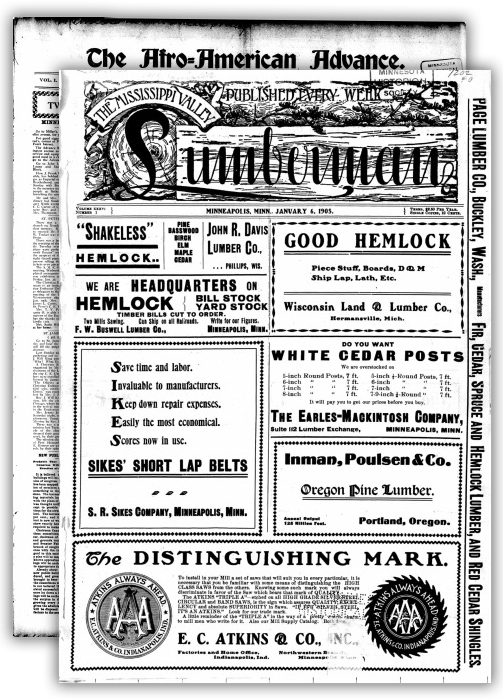

The Broad Axe
The broad axe (St. Paul, Minn.) 1891-1903 Browse the title
The Broad Axe was an eight-page, five-column weekly newspaper published in St. Paul from 1891 to 1903 by Albert L. Graves. It served the West Side of St. Paul (at the time, the Sixth Ward) – an area south of downtown St. Paul, but on the west side of the Mississippi River. Predominantly a working-class neighborhood, the West Side of St. Paul during the 1890s and early 1900s was home to several different immigrant groups, including a large number of eastern European and Russian Jews, as well as Germans, Irish, and Scandinavians. Many of these new immigrants came to the area seeking work in the local businesses on the West Side, which included breweries, foundries, quarries, and manufacturing plants.
The Broad Axe was a strongly Democratic paper that took a Populist political stance on the issues of the day, such as supporting the Pullman strikers in 1894. At the time he began the Broad Axe, Albert L. Graves was serving as Assistant Secretary of State for the state of Minnesota, and he began the paper as a means of furthering the Populist agenda that he so strongly supported. The Broad Axe was a staunch supporter of William Jennings Bryan in his presidential campaigns, publishing the full texts of his speeches given at the 1900 Democratic National Convention. By 1902, Graves had retired from the paper, handing the editorial duties to Harley O. Doolittle, who oversaw the paper until it ended publication in 1903.

The Minnesota Digital Newspaper Hub is a searchable website from the Minnesota Historical Society that makes millions of pages of Minnesota newspapers available online.
The Hub contains geographically and culturally diverse newspapers published between 1849 and today. Due to potential copyright restrictions most issues published after 1977 can only be accessed from the Gale Family Library at the Minnesota History Center.
Content statement
Content in the Minnesota Digital Newspaper Hub is presented as part of the historical record. Some content may be difficult and harmful to view, including graphic images, offensive language, and negative stereotypes that reflect the culture and biases of an earlier time period.
The Minnesota Historical Society's newspaper digitization program is made possible through support from the National Endowment for the Humanities and the National Digital Newspaper Program (NDNP), the Legacy Amendment's Arts and Cultural Heritage Fund through the vote of Minnesotans on Nov. 4, 2008, and many other organizations and individual donors.
Material in the Digital Newspaper Hub may be protected by copyright law (U.S. Code Title 17).
Looking for more information on MNHS digital newspaper collections? Visit Digital Newspapers at MNHS