
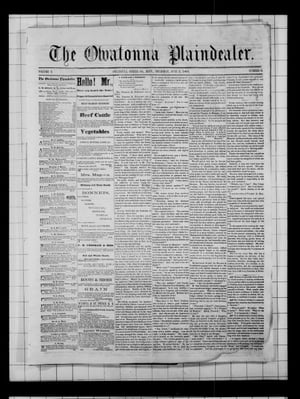
The Owatonna Plaindealer was published weekly in Owatonna, Minnesota, the county seat of Steele County in southern Minnesota. Owatonna was developed on land originally occupied by the Dakota people. The Straight River flows through Owatonna and connects with the Cannon River, a tributary of the Mississippi River. In 1865, Owatonna contained five general stores, three family groceries, one clothing store, one flouring mill, and two sawmills. Dr. Lewis Halsey Kelley, Sr. established the Plaindealer in April 1863. Kelley had previously co-founded the Rochester Republican of Rochester, Minnesota, and had worked as a physician before taking up the editor’s pen.
The Plaindealer served as the "Official Paper of the County" for Steele County. The printing office was first located on Bridge Street west of the county office building. In October 1864, the printing office was moved to Broadway Street, east of Barker’s Exchange and north of the public square. Issues were generally printed with six columns and four pages of content, featuring local to international news, poetry, and Owatonna business directories.
The Plaindealer was politically Republican in leaning. The slogan "Liberty and union, now and forever, one and inseparable," was added starting with the June 30, 1864 issue, during the apex of the US Civil War. During the war the Plaindealer also targeted Copperheads – northerners who sympathized with the South. In the 1865 state election, the Plaindealer endorsed Owatonna resident Josiah Benjamin Crooker as the Republican candidate for the Minnesota House of Representatives District 16. In the September 21, 1865 issue, the paper derided Crooker’s opponent in the Republican primary, Rev. Adolphus Town, as the nominee of a "Copperhead Convention."
The Plaindealer received a refreshed look with the December 7, 1865 issue, including the addition of a seventh column of content and expanded coverage of local, regional market, congressional, and national news. In the same issue, the Plaindealer reported on large population increases in Steele County and Owatonna: "Owatonna has all the elements for one of the largest, if not the largest city in Southern Minnesota…and it will not be three years before your lands will double in value, and your productions in the same ratio." Kelley sold the Plaindealer to William Wallace Higbee, Rev. Charles L. Tappan, and Charles Preston Hathaway in July 1866, and the newspaper was retitled the Republican Journal. Kelley later operated the Northfield Enterprise and Faribault Democrat newspapers.
The Minnesota Digital Newspaper Hub is a searchable website from the Minnesota Historical Society that makes millions of pages of Minnesota newspapers available online.
The Hub contains geographically and culturally diverse newspapers published between 1849 and today. Due to potential copyright restrictions most issues published after 1977 can only be accessed from the Gale Family Library at the Minnesota History Center.
Content statement
Content in the Minnesota Digital Newspaper Hub is presented as part of the historical record. Some content may be difficult and harmful to view, including graphic images, offensive language, and negative stereotypes that reflect the culture and biases of an earlier time period.
The Minnesota Historical Society's newspaper digitization program is made possible through support from the National Endowment for the Humanities and the National Digital Newspaper Program (NDNP), the Legacy Amendment's Arts and Cultural Heritage Fund through the vote of Minnesotans on Nov. 4, 2008, and many other organizations and individual donors.
Material in the Digital Newspaper Hub may be protected by copyright law (U.S. Code Title 17).
Looking for more information on MNHS digital newspaper collections? Visit Digital Newspapers at MNHS