


Lumbering - Camp Was Two Days' Walk from Aitkin:
Camp Was Two Days' Walk from Aitkin:
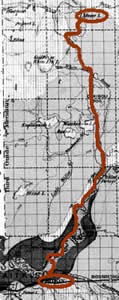
Minnesota Historical Society Library Collection
"...we walked 10 miles to Sutton's stopping place and then 4 miles beyond to Lo Seavey's Ranch where we stayed all night. This was a typical log 'stopping place' located at the junction of the Big Willow and the Mississippi.... The next morning we left the 'river road' at Seavey's Ranch and pushed north for the Moose River Camp where we arrived about noon."
Joseph DeLaittre, A Story of Early Lumbering in Minnesota (Minneapolis: DeLaittre Dixon Co., 1969).
Crossing the Mississippi
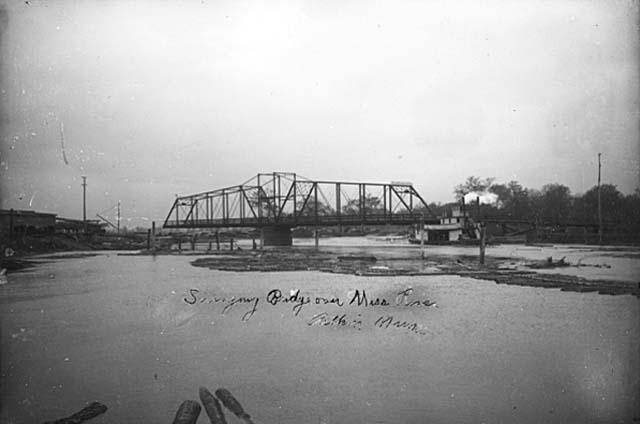
Minnesota Historical Society Photograph Collection, Location no. MA3.9 AT4 r2, Negative no. 34639
"The lumberjacks always claimed that Angus Macmillan (an old timer with the company) crossed the Mississippi at this point, before the bridge was built, by taking a couple of hefty rocks under each arm to hold him down, and walking across on the bottom. It seems he couldn't swim."
Joseph DeLaittre, A Story of Early Lumbering in Minnesota (Minneapolis: DeLaittre Dixon Co., 1969).
Spending the Night
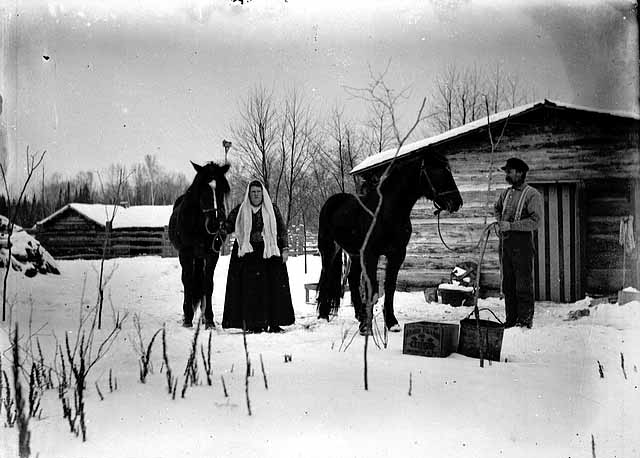
Stump farms like this one in Aitkin County were built on cutover lands. Removing the stumps to farm was hard work, and the soil that was good for the white pine trees turned out to be less desirable for other crops.
Man and woman with horses on farm, Aitkin County (?), ca. 1910.
"There were quite a number of small farms scattered through this country in those days, which offered rude accommodations to the lumberjacks walking up to the camps or back to town. Pete Waldeck, Mother Allen, Mr. Gardiner, and Scotty Munder all kept such stopping places. Many of these establishments were pretty rough, and the lumberjacks claimed that sometimes the eggs were deliberately burned to disguise the rotten taste."
Joseph DeLaittre, A Story of Early Lumbering in Minnesota (Minneapolis: DeLaittre Dixon Co., 1969).