
The Lumber Camp
Cook Shack
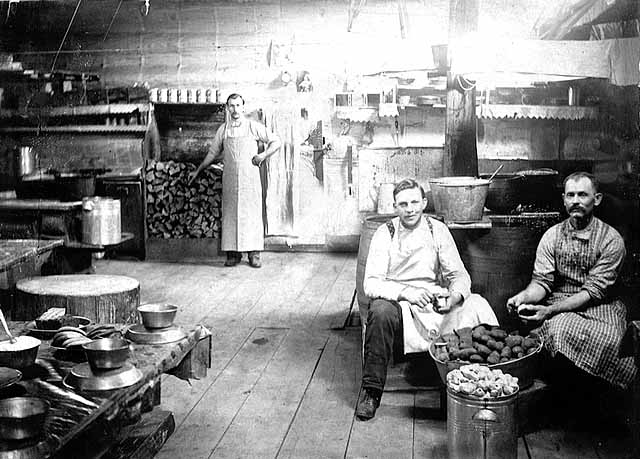
Kitchen of a Bovey and DeLaittre lumber camp near Aitkin, 1900.
Minnesota Historical Society Photograph Collection , Location No. HD5.7 p112, Negative No. 1799
"A cook shanty ... houses the kitchen and dining department. The former usually is placed in one end of the building, and the remaining space is devoted to dining tables.... Benches are provided for seats."
Logging: The Principles and General Methods of Operation in the United States.
Ralph Clement Bryant, Logging: The Principles and General Methods of Operation in the United States (New York: John Wiley & Sons, Inc., 1923).
Sleep Camp
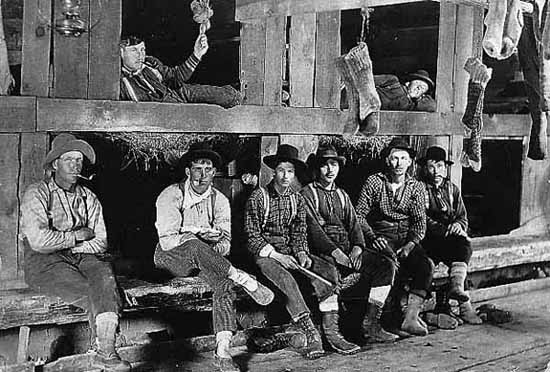
Bunkhouse scene from Ole Emerson Camp, Wisconsin, 1905.
Minnesota Historical Society Photograph Collection, Location No. HD5.7 p106, Negative No. 9066"A bunk house ... provides lounging and sleeping quarters for the men. Double bunks, two stories high, are built along the side wall and often across the ends of the building. Each bunk accommodates two men. Straw or hay may be supplied in lieu of mattresses. Blankets may or may not be supplied by the camp."
—Logging: The Principles and General Methods of Operation in the United States.
Ralph Clement Bryant, Logging: The Principles and General Methods of Operation in the United States (New York: John Wiley & Sons, Inc., 1923).
Blacksmith Shop
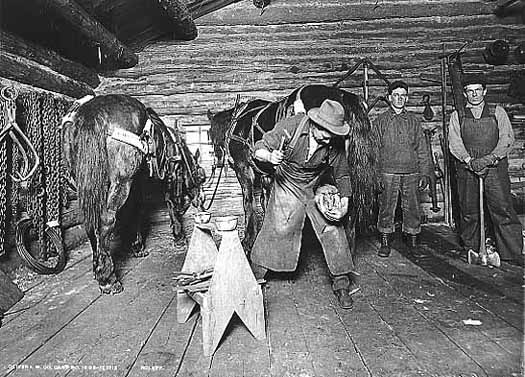
Blacksmith shoeing horse at a lumber camp, 1912.
Photographer: William F. Roleff (1873-1943)Minnesota Historical Society Photograph Collection, Location: Album 95, Negative No. 32278
Every camp has "a blacksmith shop where horses are shod, and sleds and other equipment made and repaired."
—Logging: The Principles and General Methods of Operation in the United States.
Ralph Clement Bryant, Logging: The Principles and General Methods of Operation in the United States (New York: John Wiley & Sons, Inc., 1923).
Stables
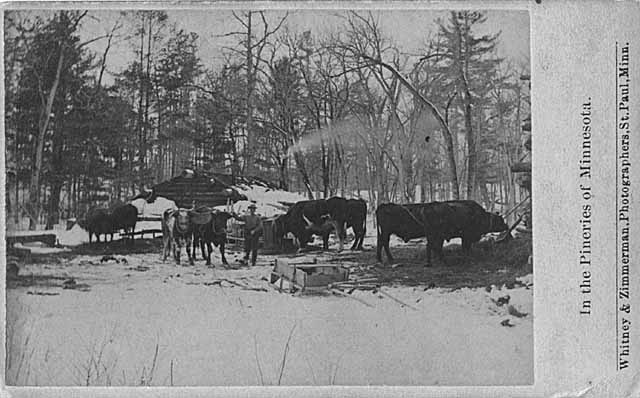
Feeding the oxen in the lumber camp, 1870.
Photographer: Whitney & ZimmermanMinnesota Historical Society Photograph Collection, Location No. HD5.1 r10; Negative No. 70672
"Stables or hovels ... afford proper protection to animals. They are equipped with stalls, feed boxes, harness racks and grain bins. Each animal usually is allowed a stall space of 5 by 10 feet."
—Logging: The Principles and General Methods of Operation in the United States.
Ralph Clement Bryant, Logging: The Principles and General Methods of Operation in the United States (New York: John Wiley & Sons, Inc., 1923).
Filer's Shop
Photographer: William F. Roleff (1873-1943)
Minnesota Historical Society Photograph Collection, Location: Album 95, Negative no. 3509-B
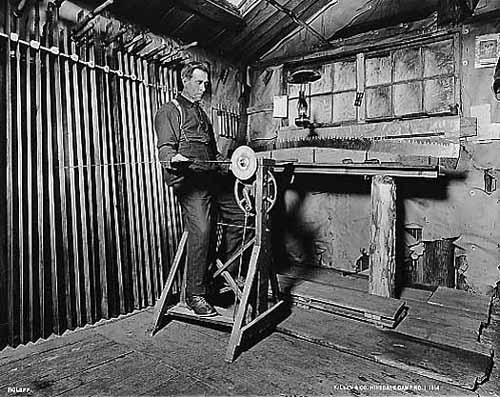
Lumberjacks need sharp saws, so each camp has a person whose job is to file the blades, one tooth at a time. It takes nearly an hour to sharpen a saw, and the "dentist" sometimes sharpens 12 - 15 saws each day.
—Logging: The Principles and General Methods of Operation in the United States.
See: Ralph Clement Bryant, Logging: The Principles and General Methods of Operation in the United States (New York: John Wiley & Sons, Inc., 1923).
Office and Store
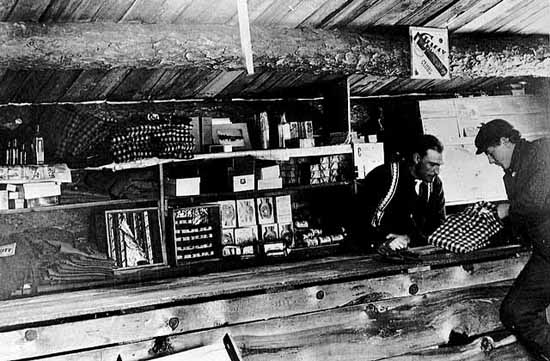
Minnesota Historical Society Photograph Collection, Location no. HD5.7 p98, Negative no. 20724
"An office and store, sometimes called a 'van,' which is the headquarters and the sleeping place of the foreman, camp clerk and log scaler. The equipment of the room consists of bunks for the men, a few shelves on which goods are displayed, and a rough counter over which they are sold, two or three homemade chairs, and a box stove. The store carries supplies required by the woodsmen, such as shoes, clothing, tobacco and a few drugs."
—Logging: The Principles and General Methods of Operation in the United States.
Ralph Clement Bryant, Logging: The Principles and General Methods of Operation in the United States (New York: John Wiley & Sons, Inc., 1923).
Outhouse
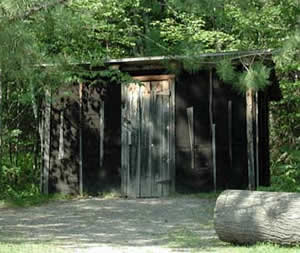
Outhouse at the Forest History Center (Grand Rapids, Minnesota)
Minnesota Historical Society
Every camp needs an latrine. Sometimes it's just a pole slung between two trees with a pit below. Other times it has walls and maybe a roof. Either way, it's cold and a lumberjack doesn't want to spend much time here. "Logging berries" (prunes) are a favorite food.
See: Ralph Clement Bryant, Logging: The Principles and General Methods of Operation in the United States (New York: John Wiley & Sons, Inc., 1923).