Steele, Franklin (ca. 1813–1880)

Creator:
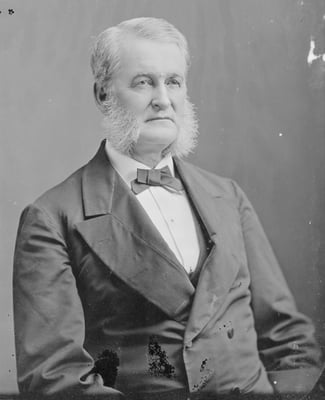
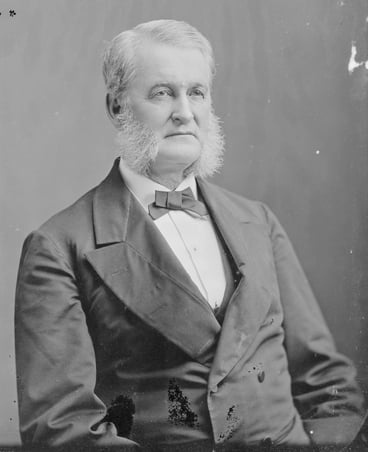
Seated man wearing a suit and bow tie with white hair, including white mutton-chop whiskers.
Franklin Steele, ca. 1875.

An attorney, businessman, city founder, war profiteer, and land speculator, Franklin Steele became one of the wealthiest men and most prominent landowners in Minnesota in the 1850s. He and his associates exploited the legal system to swindle tens of thousands of acres set aside by treaties specifically for Indigenous people, garnering enormous profits and paying the rightful land owners next to nothing.

Born in Pennsylvania, Franklin Steele came to Minnesota in the late 1830s. Around 1838 he began working as Fort Snelling’s sutler (storekeeper/banker)––a lucrative position that connected him to fur traders like Henry Sibley, who married Steele’s sister. In this role, he oversaw the post’s store for decades.

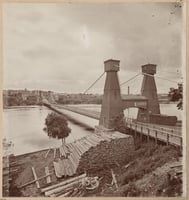
The 1840s and 1850s saw Steele engaged in a frenzy of activity. He claimed a swath of prime real estate on the east side of St. Anthony Falls (Owámniyomni), then founded a sawmill there as well as the town of St. Anthony (which merged with Minneapolis in 1872). His company oversaw the construction of the first suspension bridge across the Mississippi in 1855, charging tolls when travelers crossed from St. Anthony to Minneapolis.

In 1857, Senator Henry Rice notified Steele of the government’s imminent sale of Fort Snelling and thousands of surrounding acres. Steele sprang into action and raised huge sums of capital (including checks he sent to Rice personally totalling $30,000) to purchase the fort for $90,000. He hoped to found another town and make profits by selling individual lots. His ownership of the fort was controversial even at the time, sparking an investigation in Congress.

When the Civil War broke out in 1861, Steele’s empire reached its zenith: he owned Minnesota’s central military installation and charged the government for the use of the land. He secured lucrative government contracts to supply the soldiers there. He refused to make further payments on the fort after 1861, writing, “I do not intend to make the other payments as long as there is no demand made for the money. My contract is good [...].” Despite a federal lawsuit against him, Steele leased the fort back to the government for $2,000 per month during the war, eventually settling his debts by an act of Congress in 1871.

From the mid-1850s on, Steele led an elaborate, questionably legal scheme to acquire land that had been promised in the 1830 Treaty of Prairie du Chien to mixed-race Dakota people. They were issued “scrip”—paper coupons that could be exchanged for up to 640 acres per person. The law dictated that the scrip was non-transferable, preventing land speculators like Steele from buying it.

Nevertheless, Steele and his network acquired Native peoples’ scrip by having the rightful owners sign legal instruments called land patents and powers of attorney. These papers gave the white men legal agency to buy, sell, trade, or take possession of the land, and to act on their behalf. In most cases, the Native landowners received just pennies per acre for their scrip.

Steele’s network, which included businessmen, bankers, land dealers, and politicians around the country, bartered the scrip for stock, cash, and ownership of companies. Some used it themselves to claim land. Surviving records show that Steele and his associates took at least 35,000 acres of land promised to Native people, but the total is likely significantly higher.

Steele found profit even in genocide. In 1862, in the aftermath of the US–Dakota War, the military forcibly removed Dakota people from their lands and interned them at a concentration camp beside Fort Snelling. Steele saw this not as a humanitarian crisis but as an opportunity for financial gain; he sold food and supplies to the imprisoned Dakota people. Facing disease, forced starvation, and misery, some sold or traded their scrip to Steele for rations just to survive the inhumane conditions. Their legally stolen lands would be worth untold hundreds of millions of dollars today.

In the last fifteen years of his life (1865–1880), Steele used his wartime profits and scrip to develop his businesses outside of Minnesota. He and his associates opened silver mines in Nevada and speculated on lands in California. By the time Steele died in 1880, his estate had ballooned to millions of dollars. An inventory of his properties described more than 2,200 parcels of land which Steele owned in part or in full on his death. He died one of the wealthiest men in Minnesota and was buried in Washington, DC. Steele County as well as Franklin Steele Square and Franklin Avenue (both in Minneapolis) bear his name.

.
Cite
Magnolia, Alex. "Steele, Franklin (ca. 1813–1880)." MNopedia, Minnesota Historical Society. https://www.mnhs.org/mnopedia/search/index/person/steele-franklin-ca.-1813-1880
Print This Page
First Published: December 05, 2025
Last Modified: December 05, 2025

Bibliography

A/.S814
Franklin Steele papers, 1839–1888
Manuscripts Collection, Minnesota Historical Society, St. Paul
Description: Correspondence and financial records of this Minnesota lumberman and entrepreneur.

DeCarlo, Peter. Fort Snelling at Bdote: A Brief History. Minnesota Historical Society Press, 2020.

Folwell, William Watts. A History of Minnesota. Vol. 1. Minnesota Historical Society Press, 1956.

—————. The Sale of Fort Snelling, 1857. Minnesota Historical Society, 1915.

“Fort Snelling Investigation.” H.R. Rep. No. 351, 35th Cong., 1st Sess. (1858).
https://digitalcommons.law.ou.edu/indianserialset/1416

Franklin Steele to H. Reynolds, May 19, 1860. Box 6, folder 3 of the Franklin Steele papers, 1839–1888 (A/.S814), Manuscripts Collection, Minnesota Historical Society, St. Paul.

“History of the Board of Regents.” University of Minnesota.
https://regents.umn.edu/history-board-regents

Kane, Lucille M. The Waterfall that Built a City. Minnesota Historical Society, 1966.

Loehr, Rodney C. “Franklin Steele, Frontier Businessman.” Minnesota History 27, no. 4 (December 1946): 309–318.
https://storage.googleapis.com/mnhs-org-support/mn_history_articles/27/v27i04p309-318.pdf

Millikan, William. “The Great Treasure of the Fort Snelling Prison Camp.” Minnesota History 62, no. 1 (Spring 2010): 4–17.
https://storage.googleapis.com/mnhs-org-support/mn_history_articles/62/v62i01p004-017.pdf

Monjeau-Marz, Corinne L. The Dakota Indian Internment At Fort Snelling, 1862–1864. Prairie Smoke Press, 2006.

Neill, Edward D. History of Hennepin County and the City of Minneapolis, including the Explorers and Pioneers of Minnesota. North Star Publishing Company, 1881.
https://archive.org/details/cu31924006600484

OH 183.21
Oral history interview with Ed LaBelle, June 7, 2012
US–Dakota War of 1862 Oral History Project Oral History Collection, Minnesota Historical Society, St. Paul
Description: Ed LaBelle (Sisseton–Wahpeton Dakota) describes his personal history, including his family’s experience in the US–Dakota War of 1862.
https://www.mnhs.org/search/collections/record/ede90586-ed03-4332-83ed-3950e635d62d

Osman, Steven E. Fort Snelling and the Civil War. Ramsey County Historical Society, 2017.

Parmenter, Jon. “Flipped Scrip, Flipping the Script: The Morrill Act of 1862, Cornell University, and the Legacy of Nineteenth-Century Indigenous Dispossession.” Cornell University and Indigenous Dispossession Project, October 1, 2020.
https://blogs.cornell.edu/cornelluniversityindigenousdispossession/2020/10/01/flipped-scrip-flipping-the-script-the-morrill-act-of-1862-cornell-university-and-the-legacy-of-nineteenth-century-indigenous-dispossession

Ress, David. The Half Breed Tracts in Early National America: Changing Concepts of Land and Place. Springer Nature, 2019.

Ross, Drew M. Becoming the Twin Cities: Swindles, Schemes, and Enduring Rivalries. Minnesota Historical Society Press, 2025.

Smith, Hampton. Confluence: A History of Fort Snelling. Minnesota Historical Society Press, 2021.

Stevens, John H. Personal Recollections of Minnesota and its People and Early History of Minneapolis. N.p., 1900.
https://archive.org/details/personalrecollec00stev/page/n3/mode/2up

“Treaty with the Sauk and Foxes, etc., 1830.” July 15, 1830.
https://treaties.okstate.edu/treaties/treaty-with-the-sauk-and-foxes-etc-1830-0305

Welles, H. T. Autobiography And Reminiscences. Vol. 2. M. Robinson, 1899.
https://babel.hathitrust.org/cgi/pt?id=wu.89076993872

Related Resources

Secondary

Gilman, Rhoda R. Henry Hastings Sibley: Divided Heart. Minnesota Historical Society Press, 2004.

Podruchny, Carolyn, and Laura Lynn Peers, eds. Gathering Places: Aboriginal and Fur Trade Histories. University of British Columbia Press, 2010.

Related Images

Seated man wearing a suit and bow tie with white hair, including white mutton-chop whiskers.
Franklin Steele, ca. 1875.
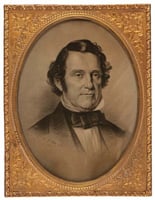
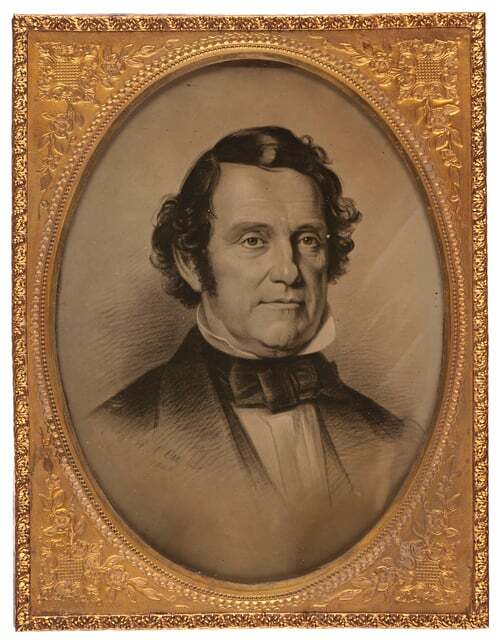
Black-and-white image of a man's head and shoulders surrounded by an oval. Outside the oval is a frame with gold decorations.
Franklin Steele, ca. 1856. Ambrotype based on a drawing or engraving.
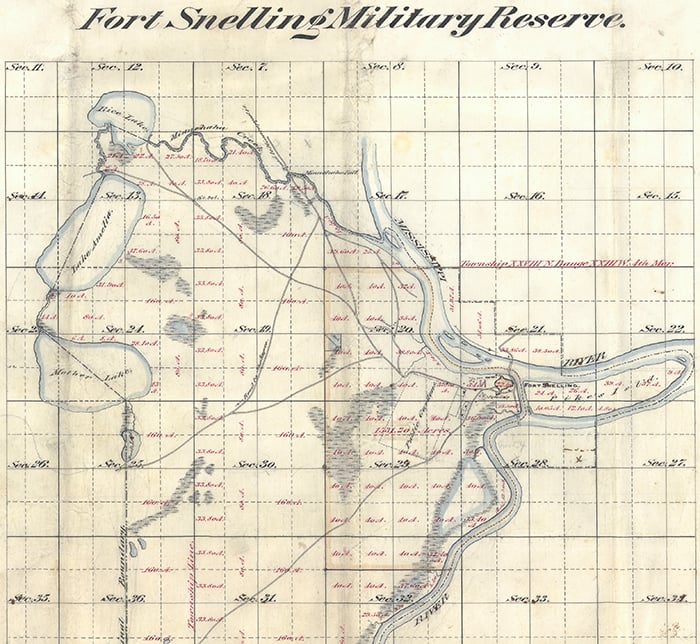
Hand-drawn map of the intersection of two rivers, with red writing adding details throughout.
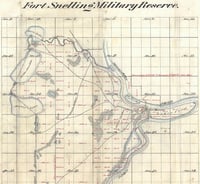
A detail view of a map (“Conveyance of described lands in the Fort Snelling Reservation by the United States Government to Franklin Steele”) of the roughly 6,400-acre Fort Snelling Military Reserve, encompassing much of present-day Minneapolis–St. Paul International Airport and Lake Nokomis. Undated but ca. 1857. Cropped from the original. Minnesota Historical Society reserve collection (+Reserve CP597.63 +S914).
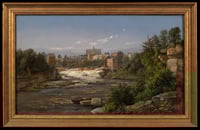
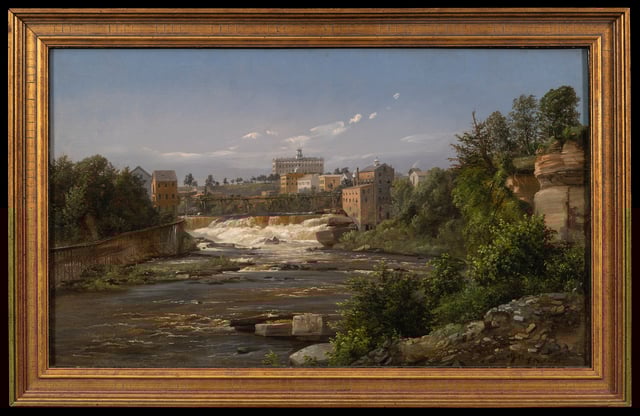
Color oil painting of St. Anthony Falls, with green trees growing alongside the river under a blue sky.
An idealized view of St. Anthony in the 1850s showing the bluffs of the Mississippi River, the stone buildings and mills of St. Anthony, and the falls (Owámniyomni). The Winslow House stands at center. Oil-on-canvas painting by Ferdinand Reichardt, 1857.
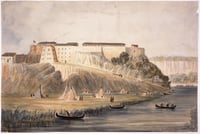
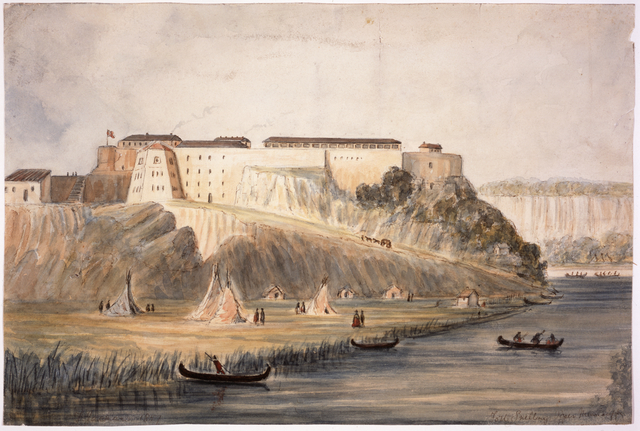
Painting in muted greens, blues, and pinks showing a fort under a grey-white sky, with a field and tipis below it. People row canoes on the river at right.
Watercolor-on-paper painting of Fort Snelling by F. Jackson, 1857.
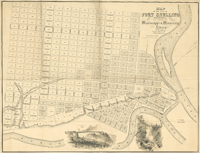
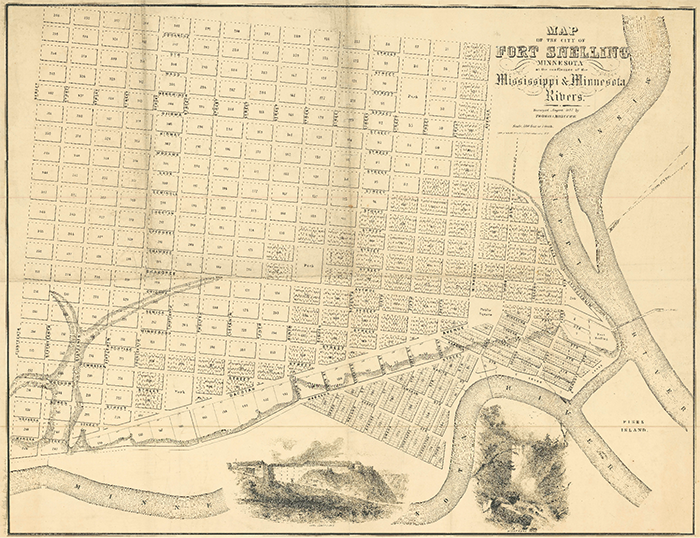
Hand-drawn sepia map showing the intersection of two rivers, and above and to their left the streets of an unbuilt city.
Map of the planned city of Fort Snelling as surveyed by Thomas I. Moncure in August 1857. After purchasing the fort and its surrounding lands, Franklin Steele planned out a large city, the City of Fort Snelling, near the confluence of the Mississippi and Minnesota Rivers. It never materialized. The lands today encompass Minneapolis-St. Paul International Airport and South Minneapolis.
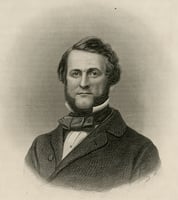
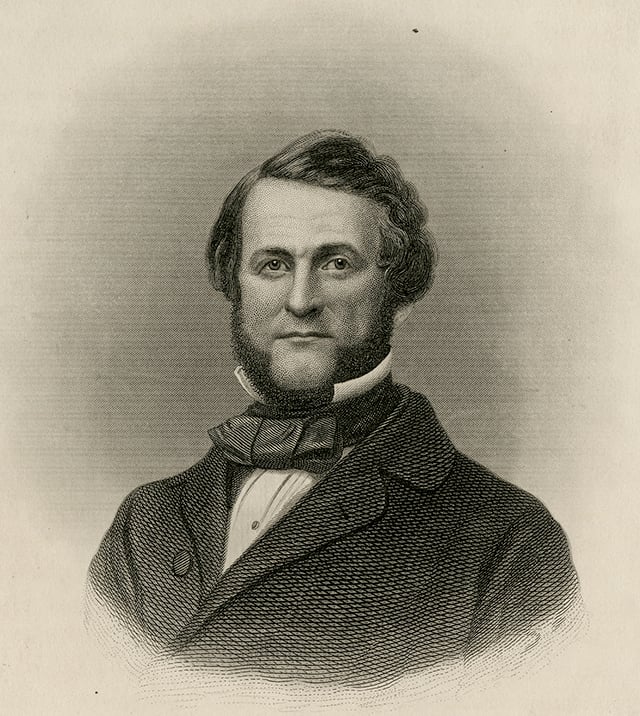
Engraved image of a man's head and shoulders. He wears a suit jacket and a bow tie. He has a beard and curly hair.
Engraving of Franklin Steele, ca. 1860.
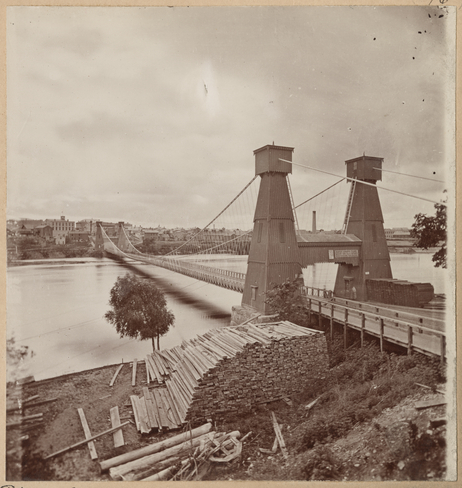
Sepia photograph of a suspension bridge. Stacks of logs are piled up in the foreground.
The Father Louis Hennepin Bridge between St. Anthony and Minneapolis, photographed in 1868 by Willian Henry Illingworth. Franklin Steele and his companies owned the bridge.
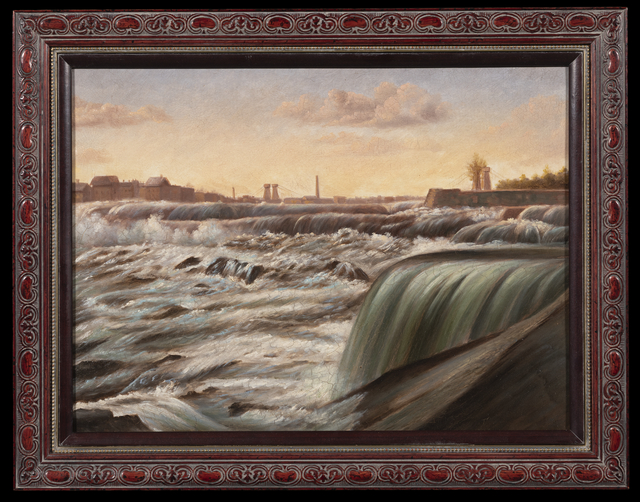
Oil painting of waves cascading down a river waterfall with yellow and blue sky and clouds on the horizon.
Oil-on-canvas painting of St. Anthony Falls, ca. 1885. Towers and a few of the lines of a suspension bridge are visible in the distance. A smoke stack is above center. The bridge was built by a company owned by Franklin Steele in 1855.
Seated man wearing a suit and bow tie with white hair, including white mutton-chop whiskers.

Franklin Steele, ca. 1875

Franklin Steele, ca. 1875.
Black-and-white image of a man's head and shoulders surrounded by an oval. Outside the oval is a frame with gold decorations.

Franklin Steele, ca. 1856

Franklin Steele, ca. 1856. Ambrotype based on a drawing or engraving.
Hand-drawn map of the intersection of two rivers, with red writing adding details throughout.

Detail view of a map of the Fort Snelling Military Reserve, undated but ca. 1857

A detail view of a map (“Conveyance of described lands in the Fort Snelling Reservation by the United States Government to Franklin Steele”) of the roughly 6,400-acre Fort Snelling Military Reserve, encompassing much of present-day Minneapolis–St. Paul International Airport and Lake Nokomis. Undated but ca. 1857. Cropped from the original. Minnesota Historical Society reserve collection (+Reserve CP597.63 +S914).

Holding Location

Minnesota Historical Society
Color oil painting of St. Anthony Falls, with green trees growing alongside the river under a blue sky.

St. Anthony, 1857

An idealized view of St. Anthony in the 1850s showing the bluffs of the Mississippi River, the stone buildings and mills of St. Anthony, and the falls (Owámniyomni). The Winslow House stands at center. Oil-on-canvas painting by Ferdinand Reichardt, 1857.
Painting in muted greens, blues, and pinks showing a fort under a grey-white sky, with a field and tipis below it. People row canoes on the river at right.

Fort Snelling, 1857

Watercolor-on-paper painting of Fort Snelling by F. Jackson, 1857.
Hand-drawn sepia map showing the intersection of two rivers, and above and to their left the streets of an unbuilt city.

Map of the planned city of Fort Snelling, 1857

Map of the planned city of Fort Snelling as surveyed by Thomas I. Moncure in August 1857. After purchasing the fort and its surrounding lands, Franklin Steele planned out a large city, the City of Fort Snelling, near the confluence of the Mississippi and Minnesota Rivers. It never materialized. The lands today encompass Minneapolis-St. Paul International Airport and South Minneapolis.
Engraved image of a man's head and shoulders. He wears a suit jacket and a bow tie. He has a beard and curly hair.

Franklin Steele, ca. 1860

Engraving of Franklin Steele, ca. 1860.
Sepia photograph of a suspension bridge. Stacks of logs are piled up in the foreground.

Father Louis Hennepin Bridge, 1868

The Father Louis Hennepin Bridge between St. Anthony and Minneapolis, photographed in 1868 by Willian Henry Illingworth. Franklin Steele and his companies owned the bridge.
Oil painting of waves cascading down a river waterfall with yellow and blue sky and clouds on the horizon.

St. Anthony Falls, ca. 1885

Oil-on-canvas painting of St. Anthony Falls, ca. 1885. Towers and a few of the lines of a suspension bridge are visible in the distance. A smoke stack is above center. The bridge was built by a company owned by Franklin Steele in 1855.

Turning Point

In 1857, Steele purchases Fort Snelling and thousands of surrounding acres from the US government for $90,000. He pays one-third of the price up front and later refuses to continue payments on the rest of the $60,000. Congress investigates the sale.

Chronology

1813 or 1814
Franklin Steele is born in Pennsylvania.
1837
Steele arrives at Fort Snelling, then part of Wisconsin Territory. He soon begins working as Fort Snelling’s sutler: a shopkeeper, postmaster, and small-scale banker.
1838
Steele claims lands on the east bank of the Mississippi, beside St. Anthony Falls (Owámniyomni). Eventually, he incorporates St. Anthony as a town, sells lots to develop businesses and homes, and builds a sawmill on the site.
1851
Steele donates land to build the East Bank campus for the University of Minnesota. He is named as one of the first regents of the university, serving until 1860.
1854
Henry Rice, Minnesota Territory’s delegate in Congress, authors a bill to allow the government to issue scrip coupons to mixed-race Dakota people, in fulfillment of promises in the 1830 Treaty of Prairie du Chien.
1855
A company founded and directed by Steele builds the first suspension bridge across the Mississippi, from St. Anthony to Minneapolis. The Hennepin Avenue Bridge crosses the river at roughly the same location today.
1857
Steele buys Fort Snelling and surrounding land. A financial panic in the same year scuttles his plans to build a city on the reserve.
1858
As Minnesota becomes a state, the legislature debates appointing Franklin Steele as the state’s second US senator, alongside Henry Rice. Instead, it selects James Shields. All three are Democrats.
1858
A property lawsuit pertaining to land in St. Anthony pits Franklin Steele against investors and landowners in front of the US Supreme Court. Steele prevails.
1860
Nearly bankrupt, Steele debates fleeing to England to avoid East Coast creditors coming after him. He is able to weather the financial storm.
1861–65
Steele earns thousands of dollars per month as a government contractor by selling food and supplies to the soldiers stationed at Fort Snelling during the Civil War.
1862–63
Dakota people are imprisoned at a concentration camp near Fort Snelling, owned by Steele. Steele secures a contract to sell supplies to the prisoners. Due to malnutrition, forced famine, and measles, hundreds of Dakota people die in the camp.
1862–63
Steele acquires mixed-race scrip in exchange for food and supplies from the starving, imprisoned Dakota prisoners in the Fort Snelling concentration camp.
1868
Steele claims that the US government owes him $162,000 for using Fort Snelling between 1861 and 1865. Several years later, the War Department eventually compensates him in land from the reserve.
1880
Franklin Steele dies and is buried in Oak Hill Cemetery in Washington, DC.

Bibliography

A/.S814
Franklin Steele papers, 1839–1888
Manuscripts Collection, Minnesota Historical Society, St. Paul
Description: Correspondence and financial records of this Minnesota lumberman and entrepreneur.

DeCarlo, Peter. Fort Snelling at Bdote: A Brief History. Minnesota Historical Society Press, 2020.

Folwell, William Watts. A History of Minnesota. Vol. 1. Minnesota Historical Society Press, 1956.

—————. The Sale of Fort Snelling, 1857. Minnesota Historical Society, 1915.

“Fort Snelling Investigation.” H.R. Rep. No. 351, 35th Cong., 1st Sess. (1858).
https://digitalcommons.law.ou.edu/indianserialset/1416

Franklin Steele to H. Reynolds, May 19, 1860. Box 6, folder 3 of the Franklin Steele papers, 1839–1888 (A/.S814), Manuscripts Collection, Minnesota Historical Society, St. Paul.

“History of the Board of Regents.” University of Minnesota.
https://regents.umn.edu/history-board-regents

Kane, Lucille M. The Waterfall that Built a City. Minnesota Historical Society, 1966.

Loehr, Rodney C. “Franklin Steele, Frontier Businessman.” Minnesota History 27, no. 4 (December 1946): 309–318.
https://storage.googleapis.com/mnhs-org-support/mn_history_articles/27/v27i04p309-318.pdf

Millikan, William. “The Great Treasure of the Fort Snelling Prison Camp.” Minnesota History 62, no. 1 (Spring 2010): 4–17.
https://storage.googleapis.com/mnhs-org-support/mn_history_articles/62/v62i01p004-017.pdf

Monjeau-Marz, Corinne L. The Dakota Indian Internment At Fort Snelling, 1862–1864. Prairie Smoke Press, 2006.

Neill, Edward D. History of Hennepin County and the City of Minneapolis, including the Explorers and Pioneers of Minnesota. North Star Publishing Company, 1881.
https://archive.org/details/cu31924006600484

OH 183.21
Oral history interview with Ed LaBelle, June 7, 2012
US–Dakota War of 1862 Oral History Project Oral History Collection, Minnesota Historical Society, St. Paul
Description: Ed LaBelle (Sisseton–Wahpeton Dakota) describes his personal history, including his family’s experience in the US–Dakota War of 1862.
https://www.mnhs.org/search/collections/record/ede90586-ed03-4332-83ed-3950e635d62d

Osman, Steven E. Fort Snelling and the Civil War. Ramsey County Historical Society, 2017.

Parmenter, Jon. “Flipped Scrip, Flipping the Script: The Morrill Act of 1862, Cornell University, and the Legacy of Nineteenth-Century Indigenous Dispossession.” Cornell University and Indigenous Dispossession Project, October 1, 2020.
https://blogs.cornell.edu/cornelluniversityindigenousdispossession/2020/10/01/flipped-scrip-flipping-the-script-the-morrill-act-of-1862-cornell-university-and-the-legacy-of-nineteenth-century-indigenous-dispossession

Ress, David. The Half Breed Tracts in Early National America: Changing Concepts of Land and Place. Springer Nature, 2019.

Ross, Drew M. Becoming the Twin Cities: Swindles, Schemes, and Enduring Rivalries. Minnesota Historical Society Press, 2025.

Smith, Hampton. Confluence: A History of Fort Snelling. Minnesota Historical Society Press, 2021.

Stevens, John H. Personal Recollections of Minnesota and its People and Early History of Minneapolis. N.p., 1900.
https://archive.org/details/personalrecollec00stev/page/n3/mode/2up

“Treaty with the Sauk and Foxes, etc., 1830.” July 15, 1830.
https://treaties.okstate.edu/treaties/treaty-with-the-sauk-and-foxes-etc-1830-0305

Welles, H. T. Autobiography And Reminiscences. Vol. 2. M. Robinson, 1899.
https://babel.hathitrust.org/cgi/pt?id=wu.89076993872

Related Resources

Secondary

Gilman, Rhoda R. Henry Hastings Sibley: Divided Heart. Minnesota Historical Society Press, 2004.

Podruchny, Carolyn, and Laura Lynn Peers, eds. Gathering Places: Aboriginal and Fur Trade Histories. University of British Columbia Press, 2010.