21-MO-20 (archaeological site)

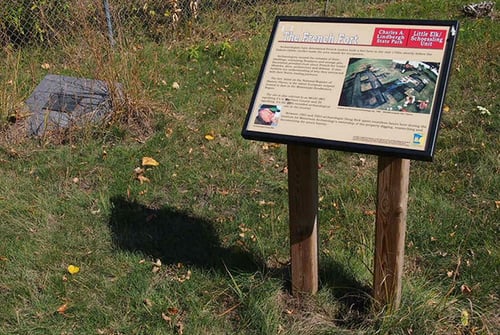
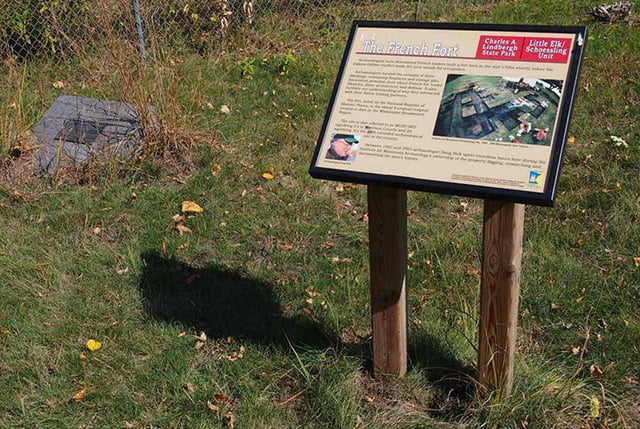
A sign with text and a color image stands on two wooden supports in front of a grassy background. A historical marker set into the earth is visible at left.
A historical sign and marker at 21-MO-20, the archaeological site of a 1700s fur-trading fort at the confluence of the Little Elk and Mississippi rivers (Morrison County). Photo by Wikimedia Commons user McGhiever, September 28, 2013. CC BY-SA 3.0

The confluence of rivers is an ideal place for human settlement, offering strategic, spiritual, and practical reasons for occupation. One such location is two miles north of the modern-day city of Little Falls, where the Little Elk River flows into the west bank of the Mississippi River. The place occupies a unique environmental setting: a 340-mile-long band encompassing a patchwork of forests, wetlands, and prairie openings rich with game.

Access to abundant natural resources, as well as transportation along the waterways, has made the confluence a place of human occupation since approximately 400 BCE, as shown by the presence of archaeological sites containing ceramics and other artifacts. The Indigenous peoples who lived there throughout the Woodland period (1,000 BCE to 1,000 CE) were semi-nomadic hunters and horticulturalists.

When the Ojibwe moved west from Gichi Gamii (Lake Superior) due to pressures from European settlement beginning in the 1690s, they pushed the Dakota farther south. The band of mixed environs that extends from the southeast to the northwest across what is today the state of Minnesota became a contested zone between the Dakota and Ojibwe. Both nations vied for access to game, including beavers.

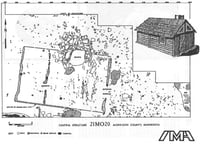
The fur trade, which began in Minnesota in the mid-1600s, brought French explorers to the area, and by the mid-1700s, a fur-trading fort was built near the confluence of the Little Elk and Mississippi rivers. Three buildings were constructed, along with a pallisade. The buildings included a large central structure, 16.4 feet by 24.6 feet, consisting of two rooms. The first featured a stone hearth, around which occupants played games or made trade goods; the second was a smaller space used for storing trade goods, furs, and supplies. Two smaller buildings that stood to the north and south of the central structure, both with a fireplace, likely provided living quarters. The leader of the fort lived in the northern structure, while workers occupied the southern building.

Since most beaver trapping was done during the winter, traders occupied the fort between the fall and the spring. In the spring, the fort’s occupants made arduous journeys back to their trading home posts to deliver their furs. There, they stocked up on new trade goods for the next season, such as beads, fabric, metal goods, guns, and gun flints.

The fort was only briefly occupied. The reasons for its abandonment are unclear; some of the buildings burned. It is unknown if the fire was deliberate or accidental.

21-MO-20 underwent intensive and rigorous archaeological excavation during the 1980s under the guidance of the Institute for Minnesota Archaeology’s Douglas Birk. Birk hypothesized that the site was Fort Duquesne, a French fur trade post operated by Joseph Marin de la Malgue. Marin, as he was known, was a French military officer, trader, and explorer. According to extant documents, Marin’s post was built in 1752. Many aspects of the site support the idea that the site is Marin’s post, including its location, the number and types of buildings, and artifact assemblages. Birk, however, stated in 1991 that his working hypothesis needed to be tested with every new turn of a trowel or archival page. While the site was extensively excavated, no final site analysis and report was completed.

In 2023, archaeologist Robb Mann presented an analysis of ceramic sherds from 21-MO-20 and concluded that they were British Delftware rather than French faience, as Birk has classified them. Mann’s study raises questions, since British Delftware is not known in this area until about 1760. The fort’s location was not only contested between the Ojibwe and Dakota, it was also a contested zone between British and French traders until the 1780s, when British dominance took hold. The presence of several British ceramic items could indicate that the British occupied the site after the French abandoned it, which was a common practice.

.
Cite
Zschomler, Kristen. "21-MO-20 (archaeological site)." MNopedia, Minnesota Historical Society. https://www.mnhs.org/mnopedia/search/index/place/21-mo-20-archaeological-site
Print This Page
First Published: April 02, 2026
Last Modified: April 02, 2026

Bibliography

Birk, Douglas. “French Presence in Minnesota: The View from Site MO20 Near Little Falls.” In French Colonial Archaeology: the Illinois Country and the Western Great Lakes, edited by John A. Walthall, 237–266. University of Illinois Press, 1991.

Douglas A. Birk archaeology papers, 1958-2017
Department of Anthropology, St. Cloud State University, St. Cloud
Description: The collection contains the professional work papers of Minnesota historical archaeologist Douglas A. Birk as well as Birk’s research library and the 21-MO-20 archaeological collection.
https://stcloudstate.libraryhost.com/index.php/douglas-a-birk-archaeology-papers

Mann, Rob. “Life, Land, Water, and Time: Archaeologist Doug Birk and the Little Elk Heritage Preserve.” Open Rivers: Rethinking Water, Place and Community no. 12 (Fall 2018) 28–36.
https://openrivers.lib.umn.edu/article/life-land-water-and-time-archaeologist-doug-birk

——— . “The Light and the Heat: Evidence of Godliness, Domesticity, and Colonial Encounters at the Little Elk Mission.” Minnesota Archaeologist 81 (2024): 101–112.

Minnesota Archaeological Society. “French or British: Identifying the 18th Century Ceramics from a Minnesota Fur Trade Post.” YouTube video recorded on November 28, 2023. https://www.youtube.com/watch?v=nGfpqSUAo4w

Minnesota Parks and Trails Organization. Charles A. Lindbergh State Park.
https://parksandtrails.org/state-parks/charles-lindbergh/https://parksandtrails.org/state-parks/charles-lindbergh

Nassaney, Michael S. The Archaeology of the North American Fur Trade. University Press of Florida, 2015.

National Park Service. Joseph Nicollet.
https://www.nps.gov/people/joseph-nicollet.htm

Nute, Grace Lee. "Posts in the Minnesota Fur-Trading Area, 1660–1855." Minnesota History 11, no. 4 (1930): 353–385.
https://www.mnhs.org/hubfs/sites/default/files/exhibits-to-go/fur-trade/educational-resources/posts-mn-fur-trade.pdf

——— . The Voyageur. Minnesota Historical Society, 1955.

——— . The Voyageur's Highway: Minnesota's Border Lake Land. Minnesota Historical Society, 1941.

Office of the State Archaeologist of Minnesota. Contact Period: An Overview of Contact Period Archaeology in Minnesota (1650–1837.
https://mn.gov/admin/archaeologist/the-public/mn-archaeology/contact-period

Smithsonian Institute Archives. Nicollet Expedition (1838, 1839).
https://siarchives.si.edu/collections/auth_exp_fbr_eace0027

Related Resources

Primary

 M115
George Nelson Reminiscences, [between 1802 and 1832]
Manuscript Collection, Minnesota Historical Society, St. Paul
Description: Reminiscences (forty-four pages, handwritten) of Nelson, an employee of the XY, North West, and Hudson's Bay fur trading companies.

Secondary

 Gilman, Carolyn. Where Two Worlds Meet: The Great Lakes Fur Trade. St. Paul: Minnesota Historical Society, 1982. 


Related Images

A sign with text and a color image stands on two wooden supports in front of a grassy background. A historical marker set into the earth is visible at left.
A historical sign and marker at 21-MO-20, the archaeological site of a 1700s fur-trading fort at the confluence of the Little Elk and Mississippi rivers (Morrison County). Photo by Wikimedia Commons user McGhiever, September 28, 2013. CC BY-SA 3.0
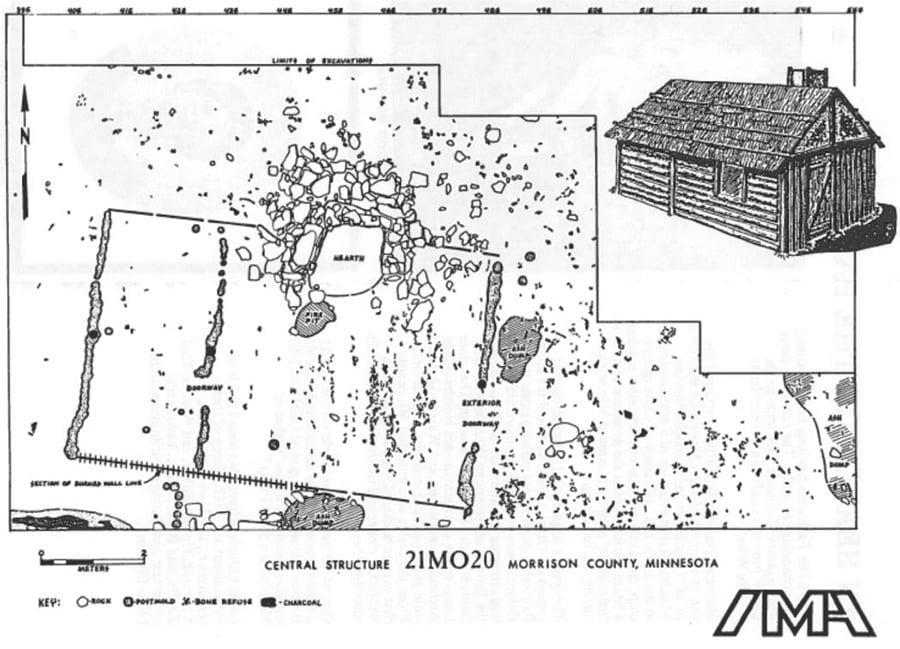
Black-and-white overhead drawing of the footprint of an excavation site, with a conjectural drawing of the reconstructed building at the upper right.
An archaeological plan view and artist’s reconstruction of the central structure at 21-MO-20. Created by Douglas Birk. From “French Presence in Minnesota: The View from Site MO20 Near Little Falls,” in French Colonial Archaeology: the Illinois Country and the Western Great Lakes, edited by John A. Walthall (University of Illinois Press, 1988), 24.
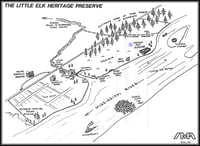
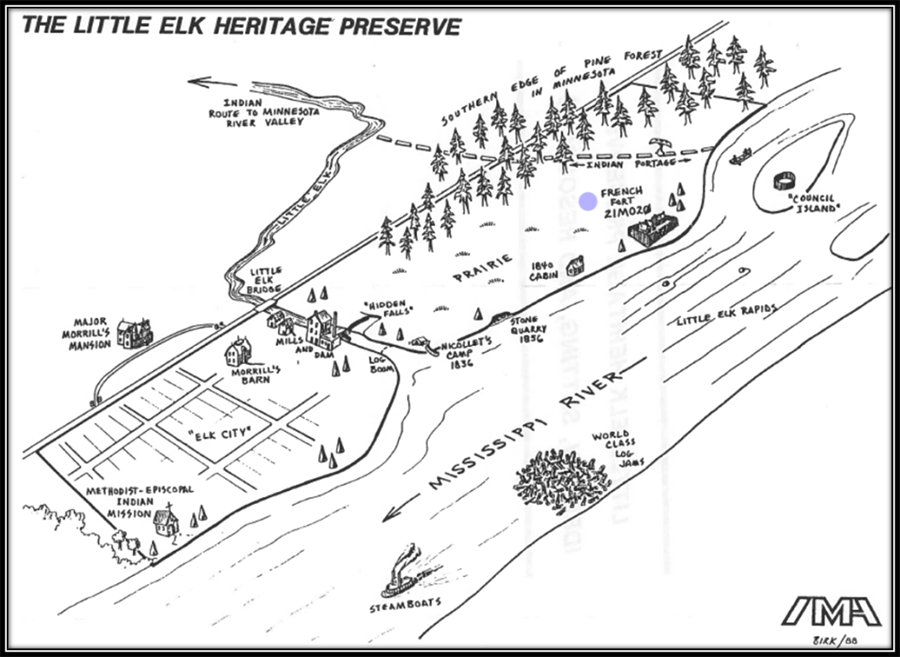
A drawn bird's-eye view of a confluence of two waterways, with trees at the top and right and structures throughout, situated to the left of a river.
The Little Elk Heritage Preserve drawn by Douglas Birk, 1988. Site 21-MO-20 is labeled at the upper right, and identified by a purple dot. Created by Douglas Birk. From “French Presence in Minnesota: The View from Site MO20 Near Little Falls,” in French Colonial Archaeology: the Illinois Country and the Western Great Lakes, edited by John A. Walthall (University of Illinois Press, 1988), 24.
A sign with text and a color image stands on two wooden supports in front of a grassy background. A historical marker set into the earth is visible at left.

Historical sign and marker at 21-MO-20

A historical sign and marker at 21-MO-20, the archaeological site of a 1700s fur-trading fort at the confluence of the Little Elk and Mississippi rivers (Morrison County). Photo by Wikimedia Commons user McGhiever, September 28, 2013. CC BY-SA 3.0
Black-and-white overhead drawing of the footprint of an excavation site, with a conjectural drawing of the reconstructed building at the upper right.

Plan view and artist’s reconstruction of 21-MO-20

An archaeological plan view and artist’s reconstruction of the central structure at 21-MO-20. Created by Douglas Birk. From “French Presence in Minnesota: The View from Site MO20 Near Little Falls,” in French Colonial Archaeology: the Illinois Country and the Western Great Lakes, edited by John A. Walthall (University of Illinois Press, 1988), 24.
A drawn bird's-eye view of a confluence of two waterways, with trees at the top and right and structures throughout, situated to the left of a river.

Little Elk Heritage Preserve

The Little Elk Heritage Preserve drawn by Douglas Birk, 1988. Site 21-MO-20 is labeled at the upper right, and identified by a purple dot. Created by Douglas Birk. From “French Presence in Minnesota: The View from Site MO20 Near Little Falls,” in French Colonial Archaeology: the Illinois Country and the Western Great Lakes, edited by John A. Walthall (University of Illinois Press, 1988), 24.

Turning Point

In 2023, archaeologist Robb Mann presents a study of ceramic sherds from 21-MO-20 that points to occupation of the site by British rather than French traders.

Chronology

400 BCE
As early as this year, Indigenous people occupy the area near the confluence of the Mississippi and Little Elk rivers. They remain there throughout the Woodland period (1000 BCE–1000 CE).
1679
French emissary Sieur du Lhut (Daniel Greysolon) makes contact with the Dakota living at Bde Wakan (Sacred Lake; Mille Lacs). The Dakota allow the Ojibwe and French traders to access their fur-rich lands east of the Mississippi River.
1737
The Ojibwe invade Dakota villages at Bde Tanka (Big Lake; Lake Pepin).The Ojibwe gain control over the rich game lands of the Upper Mississippi River, initiating a demographic shift by pushing the Dakota further south and west.
1750s–1770s
The French and English vie for dominance in the fur trade with their Ojibwe partners.
1750s and/or 1760s
Fur traders live at the fur post near the confluence of the Little Elk and Mississippi rivers between the fall and spring, trading with Ojibwe trappers.
1838
At the invitation of the Ojibwe leader Bagone-giizhig (Hole-in-the-Day), a Methodist-Episcopal mission is established at a church near the fort site.
1841
Missionaries abandon the church.
1960s
A young man digs into rock piles on his uncle’s land. He keeps the artifacts he finds in a shoe box.
1978
The young man shows the artifacts to Douglas Birk, an archaeologist working for the Minnesota Historical Society.
1980s
Douglas Birk and the Institute for Minnesota Archaeology (IMA) begin to excavate the site, which they label 21-MO-20.
1984
The fort and surrounding site are listed in the National Register of Historic Places. The site was also listed in the National Register of Historic Places in 2001. In both documents, the site is described as a French fur post.
1985
Remains of the cabin’s fireplace are discovered by archaeologist Douglas Birk.
1988
The IMA gains title to a ninety-three-acre land parcel including site 21-MO-20. The parcel is named the Little Elk Heritage Preserve and used for research, education, and stewardship.
2003
The IMA disbands.
2003
21-MO-20 is incorporated into the boundaries of Charles A. Lindbergh State Park to help ensure its continued preservation and protection.
2023
Robb Mann relies on analysis of ceramics from 21-MO-20 to suggest that the post was used by British rather than French fur traders, and that it was built in or after 1763.

Bibliography

Birk, Douglas. “French Presence in Minnesota: The View from Site MO20 Near Little Falls.” In French Colonial Archaeology: the Illinois Country and the Western Great Lakes, edited by John A. Walthall, 237–266. University of Illinois Press, 1991.

Douglas A. Birk archaeology papers, 1958-2017
Department of Anthropology, St. Cloud State University, St. Cloud
Description: The collection contains the professional work papers of Minnesota historical archaeologist Douglas A. Birk as well as Birk’s research library and the 21-MO-20 archaeological collection.
https://stcloudstate.libraryhost.com/index.php/douglas-a-birk-archaeology-papers

Mann, Rob. “Life, Land, Water, and Time: Archaeologist Doug Birk and the Little Elk Heritage Preserve.” Open Rivers: Rethinking Water, Place and Community no. 12 (Fall 2018) 28–36.
https://openrivers.lib.umn.edu/article/life-land-water-and-time-archaeologist-doug-birk

——— . “The Light and the Heat: Evidence of Godliness, Domesticity, and Colonial Encounters at the Little Elk Mission.” Minnesota Archaeologist 81 (2024): 101–112.

Minnesota Archaeological Society. “French or British: Identifying the 18th Century Ceramics from a Minnesota Fur Trade Post.” YouTube video recorded on November 28, 2023. https://www.youtube.com/watch?v=nGfpqSUAo4w

Minnesota Parks and Trails Organization. Charles A. Lindbergh State Park.
https://parksandtrails.org/state-parks/charles-lindbergh/https://parksandtrails.org/state-parks/charles-lindbergh

Nassaney, Michael S. The Archaeology of the North American Fur Trade. University Press of Florida, 2015.

National Park Service. Joseph Nicollet.
https://www.nps.gov/people/joseph-nicollet.htm

Nute, Grace Lee. "Posts in the Minnesota Fur-Trading Area, 1660–1855." Minnesota History 11, no. 4 (1930): 353–385.
https://www.mnhs.org/hubfs/sites/default/files/exhibits-to-go/fur-trade/educational-resources/posts-mn-fur-trade.pdf

——— . The Voyageur. Minnesota Historical Society, 1955.

——— . The Voyageur's Highway: Minnesota's Border Lake Land. Minnesota Historical Society, 1941.

Office of the State Archaeologist of Minnesota. Contact Period: An Overview of Contact Period Archaeology in Minnesota (1650–1837.
https://mn.gov/admin/archaeologist/the-public/mn-archaeology/contact-period

Smithsonian Institute Archives. Nicollet Expedition (1838, 1839).
https://siarchives.si.edu/collections/auth_exp_fbr_eace0027

Related Resources

Primary

 M115
George Nelson Reminiscences, [between 1802 and 1832]
Manuscript Collection, Minnesota Historical Society, St. Paul
Description: Reminiscences (forty-four pages, handwritten) of Nelson, an employee of the XY, North West, and Hudson's Bay fur trading companies.

Secondary

 Gilman, Carolyn. Where Two Worlds Meet: The Great Lakes Fur Trade. St. Paul: Minnesota Historical Society, 1982.