Forest Fires

Creator:
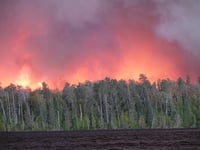
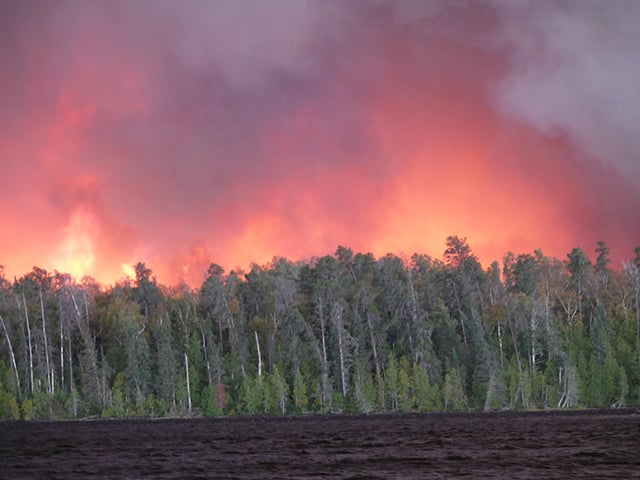
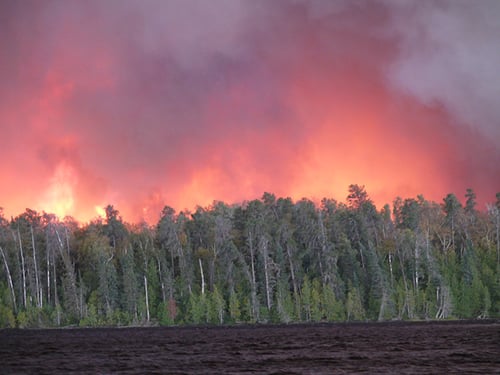
Flames and smoke rise above a mostly green treeline, with water in the foreground.
The Pagami Creek Fire inside the Superior National Forest on September 12, 2011. Photo by the US Forest Service (USFS)—Superior National Forest.

Before settlers came to what is now Minnesota, Indigenous people stewarded forests by setting fires. These controlled burns eliminated dead trees and underbrush that could have fueled unstoppable, more destructive fires. Although settlers continued this practice in the 1800s, they did so as industrial expansion was building up ignitable fuel. The Hinckley Fire of 1894 and the Cloquet Fire of 1918, caused by this buildup as well as drought, rank among the deadliest forest fires in recorded history.

Fire has fundamentally shaped Minnesota’s environment. In forested regions through the mid-1800s, Native people set controlled fires to break up the habitats of game animals, and to make space for crops and wild plants like blueberries. They did this regularly to support both the environment and their own goals. High-intensity crown fires, by contrast, were uncontrolled. Also called stand-replacing fires, these were caused by natural sources such as storms (which downed trees) and lightning (which ignited them). They burned treetops, sometimes casting firebrands that sparked new fires miles away. Unlike the fires set by Native people, stand-replacing fires occurred every couple of centuries and started new cycles of forest succession.

Colonization transformed the region’s longstanding fire regime. Settlers used fire as a tool to clear brush and transform forest into farmland. Setting fires every year, however, desensitized them to seeing smoke, which they regarded as a regular occurrence. Beginning in the 1870s and continuing through the 1920s, Minnesota experienced periods of drought at the same time that the logging and mining industries developed. The expansion of railroads into northern Minnesota’s forests began in earnest during the 1880s alongside the development of the Iron Range, which allowed logging companies to push deeper into previously inaccessible regions. Sparks from trains caused more than half of all forest fires. In this environment of increased settlement, industrial activity, and drought, small fires converged to form large, destructive, stand-replacing fires.

Before 1900, logging was an incredibly wasteful industry, with most companies leaving behind their slash (narrowed tops, branches, etc.). Slash dried out in the spring and summer, and by fall became a powerful incendiary. One result was the Hinckley Fire (1894), which killed at least 413 people. Survivors buried their deceased family and friends in mass graves (“death trenches”), with one serving as the final resting place for ninety victims. The fire wiped out the city of Hinckley, home to about 1,200 people at the time. But the region was also home to an uncounted number of Native American and backcountry settlers. At least twenty-three Ojibwe people living on the Mille Lacs Reservation died in the Hinckley Fire. The number of dead among other Indigenous people, squatters, and backwoodsmen may have been much higher.

The Hinckley Fire helped reform forest-management policies. Afterward, Minnesota created the position of chief fire warden and appointed Civil War veteran Christopher Columbus Andrews to the post. Once in office, Andrews deputized local fire wardens to levy fines against companies that did not burn the slash piles they left behind. This was an imperfect system, however, as local wardens hesitated to punish their community members. Since there was no minimum penalty for not burning slash, many fines were, according to Andrews, “as low as $5.00 and $1.00.”

Not all destructive fires resulted in high death tolls. The 1908 fire season, for example, burned more than 400,000 acres across Minnesota. The costliest of these was the Chisholm Fire, which burned 20,000 acres of forest on the rapidly industrializing Mesabi Iron Range. Flames imperiled the Mesabi, with reports that fire completely surrounded Hibbing. The fire did not cause any casualties, but it did cause nearly $1.5 million in damages in the richest iron-producing region in the world. It also led to renewed calls for fire prevention as the state narrowly avoided a second Hinckley.

After Chisholm, the state followed Andrews’s advice by passing H.F. No. 76 in 1909. The law divided the state into fire districts, employed rangers, and increased the state’s annual fire budget to $21,000. While this was an improvement, the Forestry Commission was still woefully underfunded. Andrews had asked for $38,000—a figure he regarded as inadequate to manage Minnesota’s fire problem.

Drought persisted in Minnesota, and the 1910 season was the worst of all. The historically dry year made the Forestry Commission burn through its funds as fast as the fires raged across the state. By the end of August, the fire fund had run out, forcing Andrews to recall his rangers from their districts on September 1.

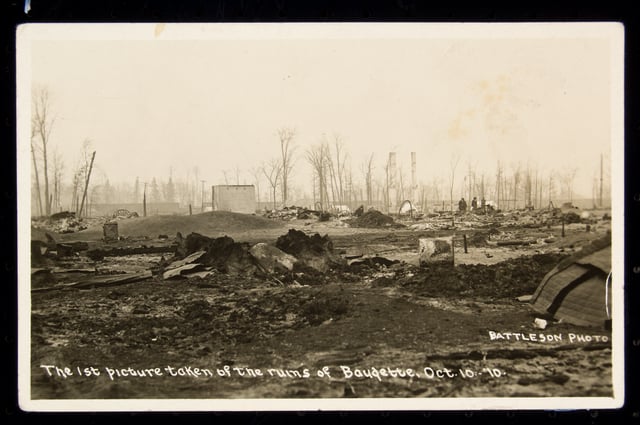
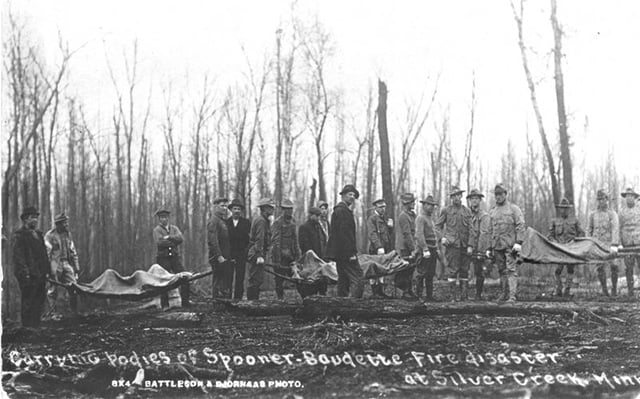
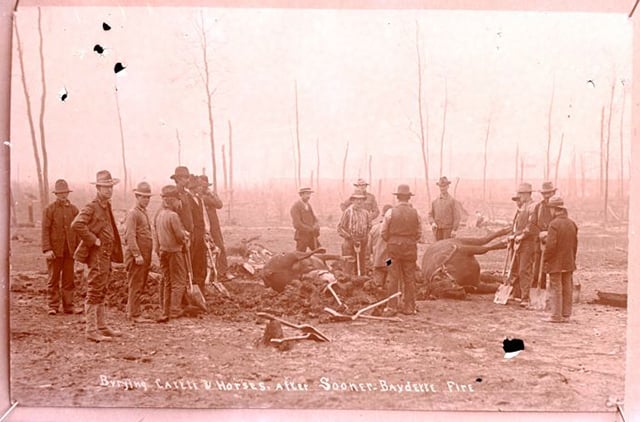
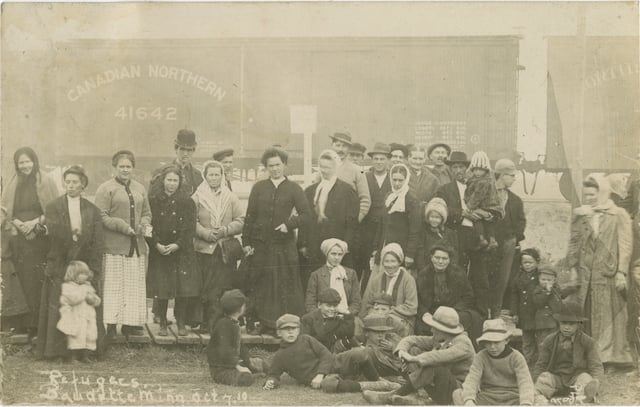
On October 7, a mere thirty-six days after Andrews pulled his rangers out of their districts, perfect weather conditions whipped up fires that had been smoldering for weeks into an inferno. More than a million forested acres burned in Minnesota during 1910. The biggest of these, the Baudette Fire, burned more than 300,000 acres, destroying the towns of Baudette and Spooner, killing at least twenty-nine people, and leaving thousands more homeless. Andrews and many other Minnesotans claimed the responsibility for the disaster lay with the state legislature. According to Andrews, if the legislature had approved his request for a $38,000 budget, it would have allowed the ranger service to continue through the rest of the fire season. Less than a year after the Baudette Fire, the state established the Minnesota Forest Service.

World War I contributed to slash buildup in Minnesota and relaxed policing of logging companies. William T. Cox, the state’s chief forester, was appointed special recruiting officer for forestry engineers and contributed 1,000 men for work in forestry battalions in Europe. As a result, however, Cox reported that “the war had drained so many men out of the north country that it was hard to find even an emergency fire-fighting force.”

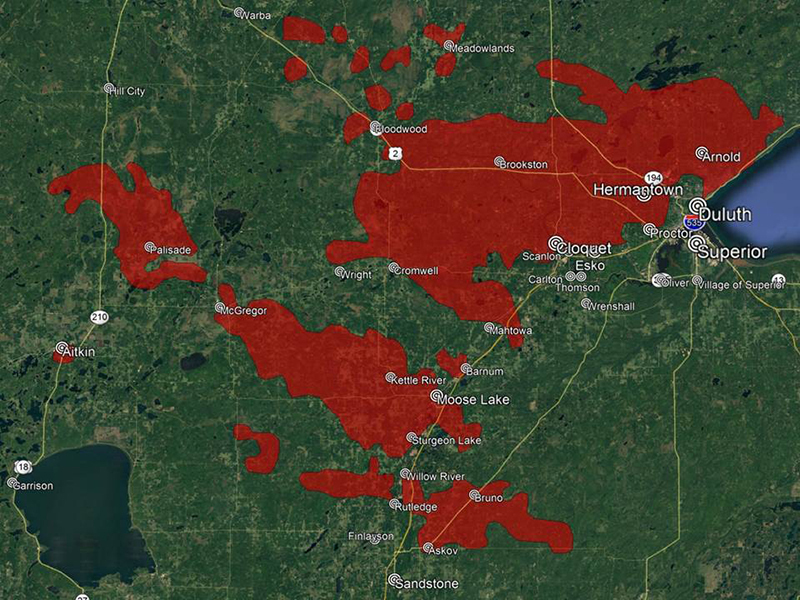
In early October of 1918, flames raged across more than 250,000 acres toward the densely populated Twin Ports of Duluth and Superior, home to more than 100,000 people. Like most settlement-era fires, what became known as the Cloquet Fire was not one fire but many, whipped into a conflagration by prime weather conditions. It left the Twin Ports largely unaffected but destroyed much of the surrounding area, including the towns of Cloquet and Moose Lake. Most of the Fond du Lac reservation burned, resulting in a devastating loss of property and livestock––though the Ojibwe people living there suffered no deaths.

The Cloquet Fire killed at least 453 people and injured or displaced more than 52,000 others, most of whom sought refuge in the Twin Ports. Relief efforts for the white settlers was swift, largely administered by the National Guard and the American Red Cross. The Fond du Lac Ojibwe, however, were not as lucky. Only those who had accepted the allotment of land into private plots received relief, and even this took years to arrive. The Cloquet Fire is the worst disaster in Minnesota history, and it, like the other fire disasters, was only partly natural.

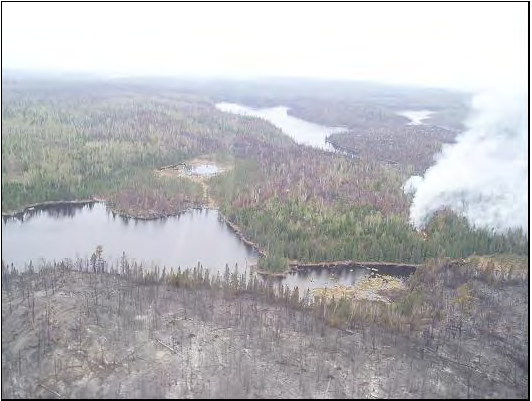
Logging’s decline, the US Forest Service, and state regulation reduced forest fires in Minnesota overall after 1920. Large fires persist in the twenty-first century, however, due to the Forest Service’s fire-suppression policies––efforts to remove fire from the American landscape that build up fuel loads. Fuel-load buildup contributed to both the Ham Lake Fire in 2007 and the Pagami Creek Fire in 2011.

Warming temperatures and renewed use of fossil fuels in the early 2000s made fires—and their smoke—common sights in Minnesota, Canada, and the Upper Midwest. Despite regulations passed during the 1990s and 2000s to reverse ozone deterioration, explosive forest fires undid that progress.

First Published: July 27, 2026
Last Modified: July 27, 2026

Bibliography

A/.A565

C. C. Andrews and family papers, 1843–1930
Manuscripts Collection, Minnesota Historical Society, St. Paul
Description: Correspondence, diaries, and other papers of this Civil War general, United States minister to Norway and Sweden (1869–1877), consul general to Brazil (1882–1885), chief fire warden of Minnesota (1895–1905), state forestry commissioner (1905–1911), and member of the state forestry board (1905–1922).
https://storage.googleapis.com/mnhs-finding-aids-public/library/findaids/01568.html

Åkermark, Gudmund Emanuel. The Cyclone of Fire, or, The Hinckley Fire: A True Description of the Century’s Most Gruesome Catastrophe. Companion Publishing, 1894.
https://storage.googleapis.com/mnhs-finding-aids-public/library/findaids/lb00018/lb00018-000001.pdf

Andrews, Christopher Columbus. Christopher C. Andrews: Pioneer in Forestry in the United States. Edited by Alice E. Andrews. Arthur H. Clark, 1928.
https://babel.hathitrust.org/cgi/pt?id=mdp.39015068555427

Barzen, Mimi. “The Great Hinckley Fire–1894.” Minnesota Department of Natural Resources.
https://www.dnr.state.mn.us/forestry/history/hinckley-fire.html

Cardille, Jeffrey A., Stephen J. Ventura, and Monica G. Turner. “Environmental and Social Factors Influencing Wildfires in the Upper Midwest, United States.” Ecological Applications 11, no. 1 (February 2001): 111–127.
https://www.jstor.org/stable/3061060

Carroll, Francis M., and Franklin R. Raiter. "'At the Time of Our Misfortune': Relief Efforts Following the 1918 Cloquet Fire." Minnesota History 48, no. 7 (Fall 1983): 270–282.
https://storage.googleapis.com/mnhs-org-support/mn_history_articles/48/v48i07p270-282.pdf

Carroll, Francis M. The Fires of Autumn: The Cloquet–Moose Lake Disaster of 1918. Minnesota Historical Society Press, 1990.

——— . "The People Versus the Government: The 1918 Cloquet Fire and the Struggle for Compensation." Journal of Forest History 29, no. 1 (January 1985): 4–21.

Chisholm Fire relief records, 1908–1909
Manuscripts Collection, Minnesota Historical Society, St. Paul
Description: Reports, correspondence, and financial records of a committee that coordinated relief to sufferers from a forest fire that destroyed the town of Chisholm on September 5, 1908.
https://storage.googleapis.com/mnhs-finding-aids-public/library/findaids/gr01041.html

Cox, William T. Annual Report of the State Forestry Board of Minnesota for the Year Ending July 31, 1918. Minnesota Forestry Board, 1918.
https://collection.mndigital.org/catalog/p16022coll11:285

Larson, Esther E. Tales From the Minnesota Forest Fires: A Personal Experience of a Rural School Teacher. Webb Publishing, ca. 1912. Available at the Minnesota Historical Society library as F607 .L33 / SD421 .L33.

Fires of 1918 Archive files. Carlton County Historical Society, Cloquet.

Haase, Camela R. "Early Social Workers as Disaster Relief Workers: The Minnesota Fires of 1918 and the Work of the Red Cross." Minnesota History 65, no. 7 (Fall 2017): 248–259.
https://storage.googleapis.com/mnhs-org-support/mn_history_articles/65/v65i07p248-259.pdf

Hirst, Marlys, ed. The Great Minnesota Forest Fire of 1910. Lake of the Woods County Historical Society, 1910.

Interview with Ernest Wilbert Hallett, Crosby, Minnesota, 1937. WPA Oral History Collection, Crow Wing County Historical Society, Brainerd.
https://collection.mndigital.org/catalog/cwc:1842

Interview with Henry Oberbillig, Crow Wing County, Minnesota, 1939. WPA Oral History Collection, Crow Wing County Historical Society, Brainerd.
https://collection.mndigital.org/catalog/cwc:2453

Laine, Mary. "Great Hinckley Fire, 1894." MNopedia, Minnesota Historical Society, March 16, 2020.
https://www.mnhs.org/mnopedia/search/index/event/great-hinckley-fire-1894

Larson, Evan R., et al. “Indigenous Fire Stewardship Shaped North American Great Lakes Forests.” PNAS (Proceedings of the National Academy of Sciences of the United States of America) 122, no. 34 (August 2025).
https://www.pnas.org/doi/10.1073/pnas.2500024122

Magee, Rick. "Andrews, Christopher Columbus (1829–1922)." MNopedia, Minnesota Historical Society, November 18, 2024.

Minnesota National Guard administrative files, 1861–1948
Manuscripts Collection, Minnesota Historical Society, St. Paul
Description: Records documenting the activities and duties of the National Guard, including clothing and supplies, personnel, instruction, equipment and ordnance, court martial, enlistment, unit establishment and name changes, expeditions, finances, pensions, history, injuries and deaths, officer examinations, officer rosters, World War I casualties, US Military Code, and relationship with the US War Department.
https://storage.googleapis.com/mnhs-finding-aids-public/library/findaids/gr00859.html

Miscellaneous forest fire relief files, 1910–1921
Minnesota Governor’s Office
State Archives Collection, Minnesota Historical Society, St. Paul
Description: Correspondence, financial records, a report by C. C. Andrews, and miscellany document forest fires in Lake of the Woods County, relief provided to fire victims, and subsequent construction of a firebreak at Baudette (1910–1911).
https://storage.googleapis.com/mnhs-finding-aids-public/library/findaids/gr01043.html

Minnesota State Commission for the Relief of Fire Sufferers records, 1894–1895
State Archives Collection, Minnesota Historical Society, St. Paul
Description: Records of a commission created to provide relief for victims of the Hinckley fire, and of fires near New York Mills and Milaca, and in Carlton, Cass, Itasca, Kanabec, and Todd counties.
https://storage.googleapis.com/mnhs-finding-aids-public/library/findaids/gr01044.html

Native Americans Archives files. Carlton County Historical Society, Cloquet.

Nelson, Hayden L. “The Past, Present, and Future of Forest Fires.” NiCHE (Network in Canadian History & Environment), June 13, 2026.
https://niche-canada.org/2026/06/13/the-past-present-and-future-of-forest-fires

Nelson, Paul. "Cloquet, Duluth, and Moose Lake Fires, 1918." MNopedia, Minnesota Historical Society, June 8, 2015.
https://www.mnhs.org/mnopedia/search/index/event/cloquet-duluth-and-moose-lake-fires-1918

Norrgard, Chantal. "Welfare State, Settler State: Ojibwes, Social Citizenship, and Disaster Relief in the Great Fire of 1918." Journal of the Gilded Age and Progressive Era 14, no. 4 (October 2015): 521–530.

Larson, Martha. “The 1918 forest fire of Aitkin and Carlton Counties of Minnesota, circa 1965.” Available at the Minnesota Historical Society library as P1193-1.

Newman, May Gorman. “Death at my heels, 1953.” Available at the Minnesota Historical Society library as P1193-2.

Wilcox, Alice A. Nelson. “The Hinckley fire, circa 1954.” Available at the Minnesota Historical Society library as P1193-3.

Shearer, Helen Benson. "The 1918 Cloquet fire, 1980 March 29." Available at the Minnesota Historical Society library as P1193-4.

P1835
Frank Yetka legal files, 1926–1935
Manuscripts Collection, Minnesota Historical Society, St. Paul
Description: Correspondence, a petition, newspaper clippings, legal documents, brochures, service contracts, and stock certificates documenting a Cloquet lawyer's representation of claimants in two separate cases.

Proceedings of the Lake States Forest Fire Conference: Held at St. Paul, Minn., Dec. 6–7, 1910. The American Lumberman, 1911.
https://babel.hathitrust.org/cgi/pt?id=hvd.hnsrne&seq=11

Pyne, Stephen J. Fire in America: A Cultural History of Wildland and Rural Fire. Princeton University Press, 1982.

“Reported Cremated.” The Minneapolis Tribune, September 8, 1894.
https://www.mnhs.org/newspapers/lccn/sn83016771/1894-09-08/ed-1/seq-1

Rice, Anna M. "General Christopher C. Andrews: Leading the Minnesota Forestry Revolution." The History Teacher 36, no. 1 (November 2002): 91–115.

Richardson, H. W. "The Northeastern Minnesota Forest Fires of October 12, 1918." Geographical Review 7, no. 4 (April 1919): 220–232.

Minnesota Forest Fires Relief Commission. “Final report of Minnesota Forest Fires Relief Commission,” 1921. Available at the Minnesota Historical Society as SD421 .M66.

Searle, Newell. "Minnesota State Forestry Association: Seedbed of Forest Conservation." Minnesota History 44, no. 1 (Spring 1974): 16–29.
https://storage.googleapis.com/mnhs-org-support/mn_history_articles/44/v44i01p016-029.pdf

Searle, Newell R. “Minnesota Forestry Comes of Age: Christopher C. Andrews, 1895–1911.” Forest History Newsletter 17, no. 2 (July 1973): 14–25.

Williams, B. J., B. Song, and T. M. Williams. "Visualizing Mega-Fires of the Past: A Case Study of the 1894 Hinckley Fire, East-Central Minnesota, USA." Forest Ecology and Management 294 (2013): 107–119.

Related Resources

Primary

P1788
John W. Blair papers, 1867–1915
Manuscripts Collection, Minnesota Historical Society, St. Paul
Description: Papers collected by a Black St. Paul and Duluth Railway Company porter, mostly concerning his heroic rescue of train passengers and townspeople during the disastrous 1894 forest fire in Hinckley.

Secondary

Bramwell, Lincoln. Wilderburbs: Communities on Nature’s Edge. University of Washington Press, 2014.

Cronon, William. Nature’s Metropolis: Chicago and the Great West. W. W. Norton, 1992.

Holbrook, Stewart. "The Peshtigo Fire." American Scholar 13, no. 2 (Spring 1944): 201–209.

Hultquist, Tom. "The Great Midwest Fires of 1871." National Weather Service.
https://www.weather.gov/grb/peshtigofire2

Miller, Char, ed. Burn Scars: A Documentary History of Fire Suppression, from the Colonial Origins to the Resurgence of Cultural Burning. Oregon State University Press, 2024.

Nelson, Hayden L. "Smoke from Their Fires: Or, Environment and Region in Canada and the Upper Midwest." Middle West Review 11, no. 1 (Fall 2024): 89–111.

Schaefer, Joseph. "Great Fires of Seventy-One." Wisconsin Magazine of History 11, no. 1 (September 1927): 96–106.

Terrie, Philip G. "'The Necessities of the Case': The Response to the Thumb Fire of 1881." Michigan Historical Review 31, no. 2 (Fall 2005): 90–116.

Williams, Michael. Americans and Their Forests: A Historical Geography. Cambridge University Press, 1989.

Wills, Matthew. "Peshtigo: The Nation's Deadliest Fire." JStor Daily, October 8, 2023.
https://daily.jstor.org/peshtigo-the-nations-deadliest-fire

Web

Great Lakes Fire History Digital Archive, created and curated by Hayden L. Nelson.
https://firearchive.omeka.net

Related Images
Flames and smoke rise above a mostly green treeline, with water in the foreground.
The Pagami Creek Fire inside the Superior National Forest on September 12, 2011. Photo by the US Forest Service (USFS)—Superior National Forest.
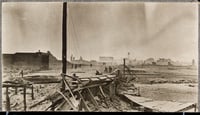
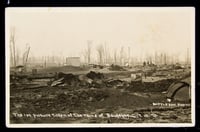
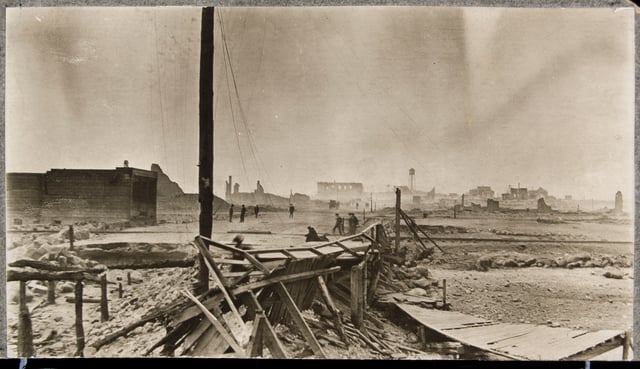
A destroyed structure sits in the foreground next to a standing wooden pole, with charred buildings and fire survivors in the background.
View of Hinckley’s Main Street on the morning after the fire, September 1894.
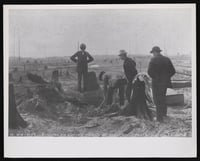
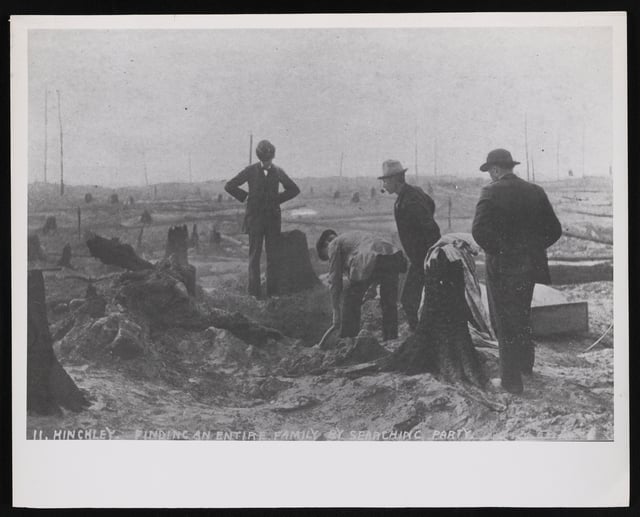
Four men wearing hats gathering around a hole in charred earth, with burnt tree stumps close to them as well as in the background.
A search party finds victims in the ruins of the Hinckley fire, 1894.
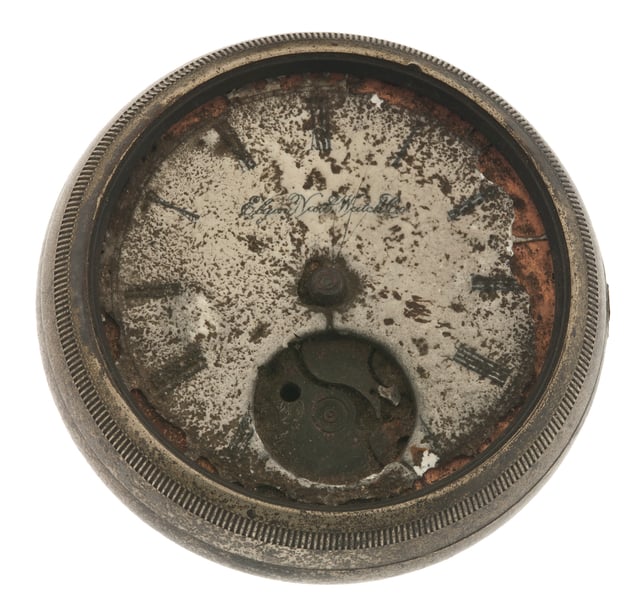
The face of round pocketwatch destroyed by fire sits against a white background.
A pocket watch taken from the hand of a victim of the Hinckley Fire, 1894. The watch has a silver alloy case and a white porcelain face. Manufactured in 1884 by the Elgin National Watch Company of Elgin, Illinois.
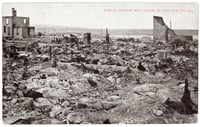
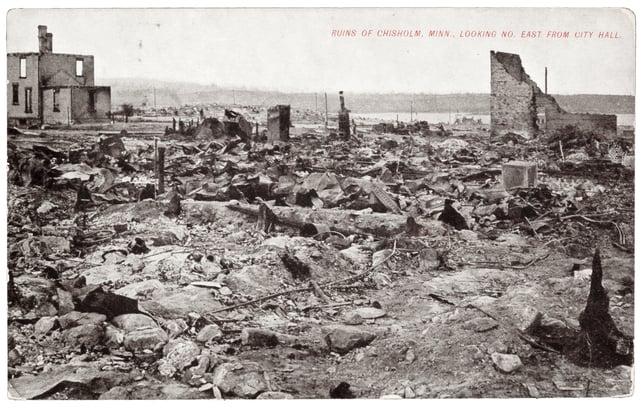
Rocks, charred tree stumps, and building ruins stretch to a distance horizon with a lake to the right. The walls of two burned buildings still stand.
Downtown Chisholm after the 1908 fire.
Indistinguishable, charred remains lie across a dirt landscape, with leafless trees in the background below a light-yellow sky.
Fire aftermath, Baudette, October 10, 1910.
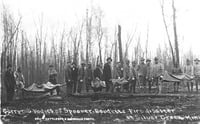
About twenty men, some wearing military uniforms, pose in front of burned, leafless trees. Some of them carry stretchers that lift up the bodies of three fire victims.
Relief workers retrieve the bodies of victims of the Baudette Fire at Silver Creek, Minnesota, 1910. Photograph by Haakon Bjornaas.
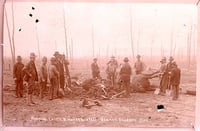
In a pink-toned image, men stand around the bodies of dead cows and horses, with charred earth around them and burned trees behind them.
Relief workers bury cattle and horses after the Baudette Fire, 1910. Photograph by J. A. Gjelhaug.
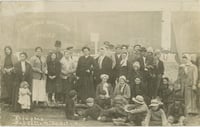
A crowd of people stands in front of a Canadian Northern train car. Women and children cluster in the front, with men closer to the back. They wear hats, kerchiefs, shawls, and coats.
Refugees from the Baudette Fire, 1910.
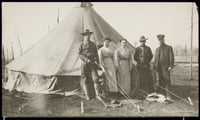
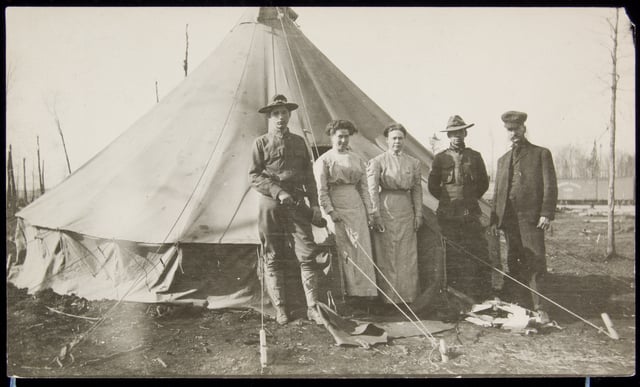
Three men (two of them in military uniform) and two women post in front of a round canvas tent, with the charred remains of trees to the right and left.
Rescue workers at Camp Baudette, set up after the forest fire of October 7, 1910.
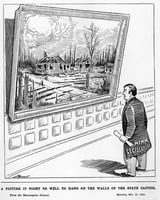
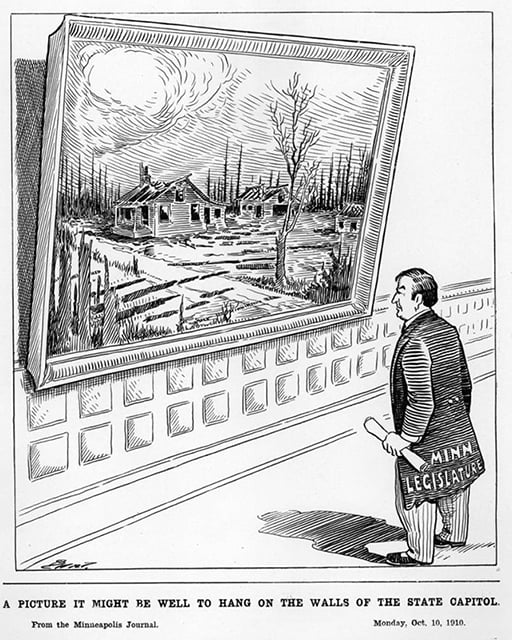
A figure with the words "Minn Legislature" on his coats, stands in front of a painting (hanging on a wall) of a burned group of buildings. Below him sits the caption, " the caption, “A Picture It Might Be Well to Hang on the Walls of the State Capitol.”
Cartoon by Charles Lewis Bartholomew with the caption, “A Picture It Might Be Well to Hang on the Walls of the State Capitol.” Printed in the Minneapolis Journal on October 10, 1910. The cartoon comments on the Baudette Fire, which had killed 250 people days earlier.
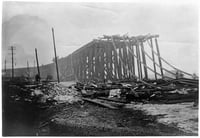
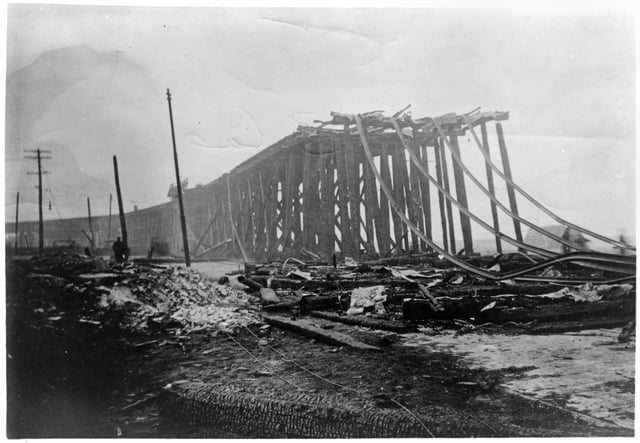
Railroad tracks above a trestle rise to the right and then stop abruptly where they've been burned. Fire damage is all around them.
The Soo Line Railroad trestle between Duluth and Superior after the Cloquet Fire, 1918.
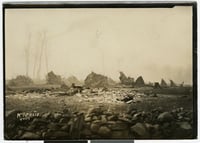
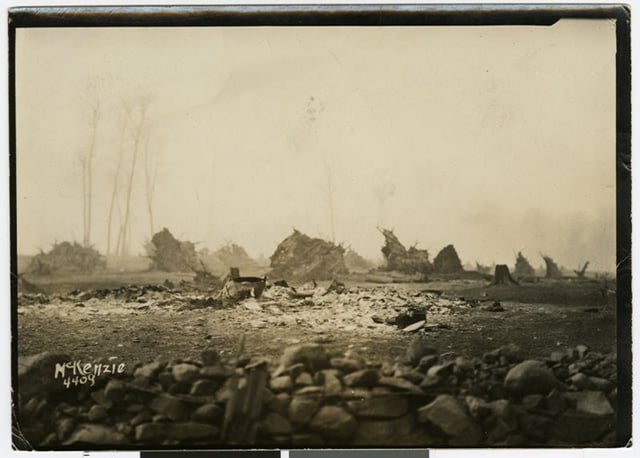
Piles of rocks sit close to the pictures plane. Behind them are more rocks and an ashy, barred landscape, with ghostly, leafless trees at center left.
Aftermath of the Cloquet Fire. Photo by Hugh McKenzie, October 1918.
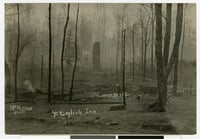
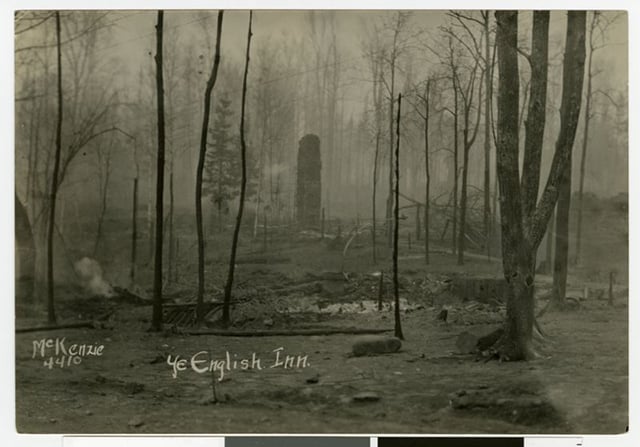
The charred remains of a forest, with a pillar (perhaps the remains of a wall of a building) rising in the center.
A charred treescape after the Cloquet Fire. Photograph by Hugh McKenzie, 1918.
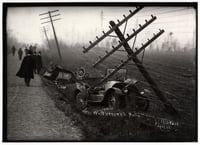
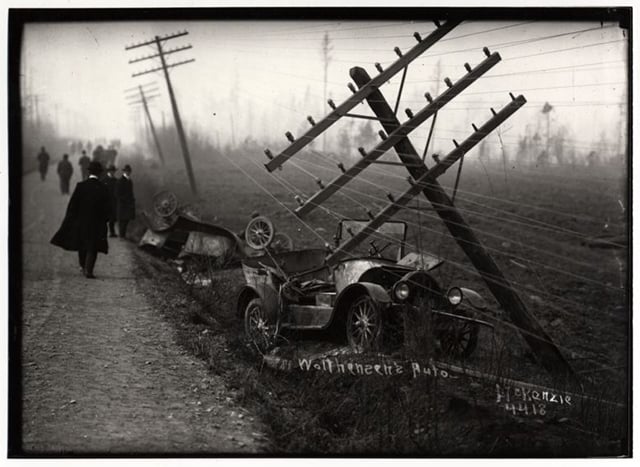
People in white collars, hats, and long coats walk along a road at right, with burned cars and leaning power lines at right.

Power lines after the Cloquet Fire, 1918. Photograph by Hugh McKenzie.

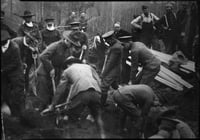
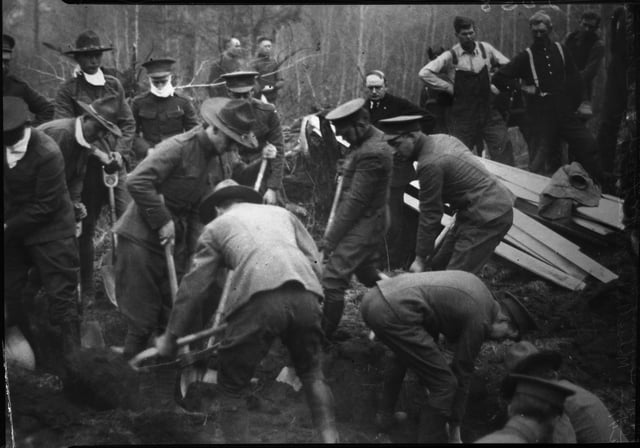
Men in military uniforms holding shovels stand around a circle of earth, with planks of wood to their right and more people and forest behind them.
Recovery workers dig graves for forest fire victims at Moose Lake, 1918.
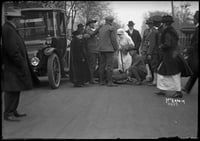
A man watches from the left foreground (an automobile stands behind him) watching a group of aid workers attending to a fire victim or victims.
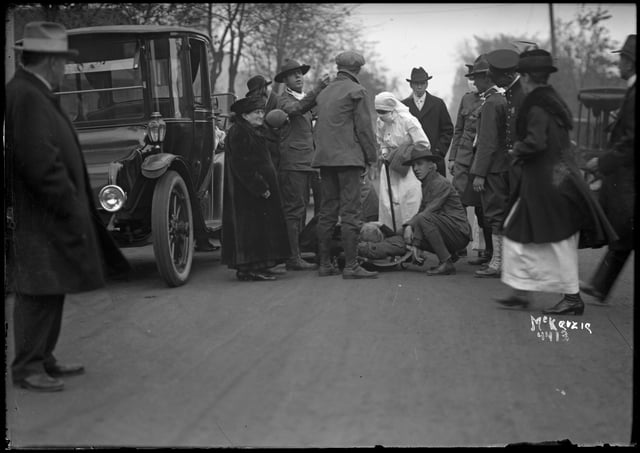
Red Cross workers and National Guard troops attend to a victim of the Cloquet Fire, 1918.
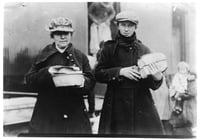
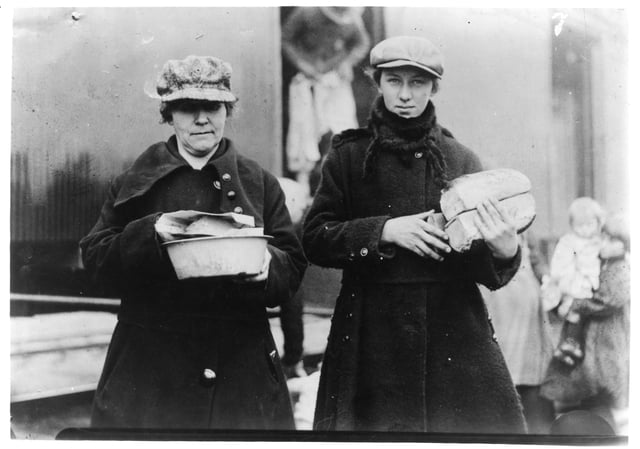
Two women wearing caps and long coats hold loaves of bread and other food rations in their hands as refugees disembark from a train behind them.
Fire refugees receive rations at Moose Lake, 1918.
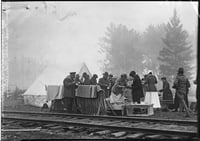
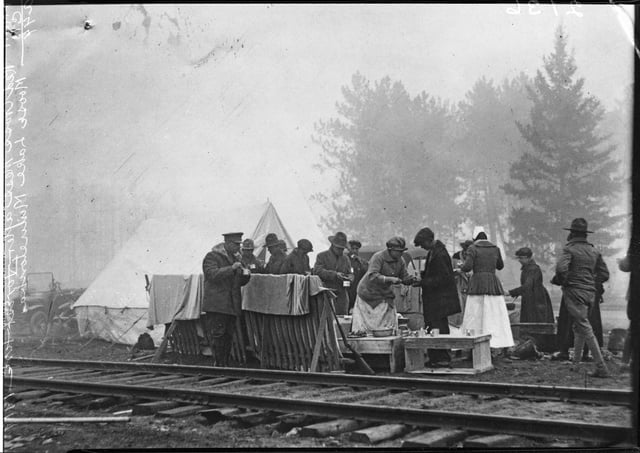
Behind a train track and in front of a stand of trees, workers distribute food and drinks to men in uniforms.
Red Cross workers serve a meal to National Guard troops and survivors of the Cloquet Fire, 1918.
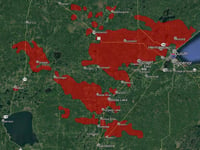
Splotches of red indicate the reach of foreset fires on top of a green background, with bodies of water visible in shades of blue, green, and indigo.
Map of areas affected by the Cloquet, Duluth, and Moose Lake Fires, 1918.
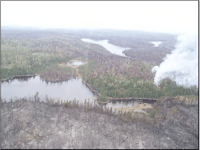
A bird's-eye view of a landscape shows areas charred by fire along a river, with unburned areas at center and at left. A plume of smoke rises from the ground at center right.
Bird’s-eye view of damage from the Ham Lake Fire in the Superior National Forest, 2007.
Flames and smoke rise above a mostly green treeline, with water in the foreground.

Pagami Creek Fire, 2011

The Pagami Creek Fire inside the Superior National Forest on September 12, 2011. Photo by the US Forest Service (USFS)—Superior National Forest.

Public domain

Holding Location

Flickr
A destroyed structure sits in the foreground next to a standing wooden pole, with charred buildings and fire survivors in the background.

Hinckley Fire aftermath, 1894

View of Hinckley’s Main Street on the morning after the fire, September 1894.
Four men wearing hats gathering around a hole in charred earth, with burnt tree stumps close to them as well as in the background.

Finding victims of the Hinckley fire, 1894

A search party finds victims in the ruins of the Hinckley fire, 1894.
The face of round pocketwatch destroyed by fire sits against a white background.

Pocket watch carried by victim of the Hinckley Fire, 1894

A pocket watch taken from the hand of a victim of the Hinckley Fire, 1894. The watch has a silver alloy case and a white porcelain face. Manufactured in 1884 by the Elgin National Watch Company of Elgin, Illinois.

Holding Location

Minnesota Historical Society
Rocks, charred tree stumps, and building ruins stretch to a distance horizon with a lake to the right. The walls of two burned buildings still stand.

Aftermath of the Chisholm Fire, 1908

Downtown Chisholm after the 1908 fire.
Indistinguishable, charred remains lie across a dirt landscape, with leafless trees in the background below a light-yellow sky.

Aftermath of the Baudette Fire, 1910

Fire aftermath, Baudette, October 10, 1910.
About twenty men, some wearing military uniforms, pose in front of burned, leafless trees. Some of them carry stretchers that lift up the bodies of three fire victims.

Relief workers retrieving bodies from the Baudette Fire, 1910

Relief workers retrieve the bodies of victims of the Baudette Fire at Silver Creek, Minnesota, 1910. Photograph by Haakon Bjornaas.

Holding Location

Minnesota Digital Library

Source

Northwest Minnesota Historical Center
In a pink-toned image, men stand around the bodies of dead cows and horses, with charred earth around them and burned trees behind them.

Relief workers burying cattle and horses after the Baudette Fire, 1910

Relief workers bury cattle and horses after the Baudette Fire, 1910. Photograph by J. A. Gjelhaug.

Holding Location

Minnesota Digital Library

Source

Lake of the Woods County Historical Society
A crowd of people stands in front of a Canadian Northern train car. Women and children cluster in the front, with men closer to the back. They wear hats, kerchiefs, shawls, and coats.

Refugees from the Baudette Fire, 1910

Refugees from the Baudette Fire, 1910.
Three men (two of them in military uniform) and two women post in front of a round canvas tent, with the charred remains of trees to the right and left.

Rescue workers after the Baudette Fire, 1910

Rescue workers at Camp Baudette, set up after the forest fire of October 7, 1910.
A figure with the words "Minn Legislature" on his coats, stands in front of a painting (hanging on a wall) of a burned group of buildings. Below him sits the caption, " the caption, “A Picture It Might Be Well to Hang on the Walls of the State Capitol.”

Cartoon reacting to the Baudette Fire, 1910

Cartoon by Charles Lewis Bartholomew with the caption, “A Picture It Might Be Well to Hang on the Walls of the State Capitol.” Printed in the Minneapolis Journal on October 10, 1910. The cartoon comments on the Baudette Fire, which had killed 250 people days earlier.

Holding Location

Hennepin County Library Digital Collections
Railroad tracks above a trestle rise to the right and then stop abruptly where they've been burned. Fire damage is all around them.

Destroyed Soo Line Railroad trestle, 1918

The Soo Line Railroad trestle between Duluth and Superior after the Cloquet Fire, 1918.
Piles of rocks sit close to the pictures plane. Behind them are more rocks and an ashy, barred landscape, with ghostly, leafless trees at center left.

Aftermath of the Cloquet Fire, 1918

Aftermath of the Cloquet Fire. Photo by Hugh McKenzie, October 1918.

Holding Location

Minnesota Digital Library

Source

University of Minnesota Duluth
The charred remains of a forest, with a pillar (perhaps the remains of a wall of a building) rising in the center.

Charred treescape after the Cloquet Fire, 1918

A charred treescape after the Cloquet Fire. Photograph by Hugh McKenzie, 1918.

Holding Location

Minnesota Digital Library

Source

University of Minnesota Duluth
People in white collars, hats, and long coats walk along a road at right, with burned cars and leaning power lines at right.

Power lines after the Cloquet Fire, 1918

Power lines after the Cloquet Fire, 1918. Photograph by Hugh McKenzie.

Holding Location

Minnesota Digital Library

Source

Carlton County Historical Society
Men in military uniforms holding shovels stand around a circle of earth, with planks of wood to their right and more people and forest behind them.

Digging graves after the fire at Moose Lake, 1918

Recovery workers dig graves for forest fire victims at Moose Lake, 1918.
A man watches from the left foreground (an automobile stands behind him) watching a group of aid workers attending to a fire victim or victims.

Red Cross workers and National Guard troops, 1918

Red Cross workers and National Guard troops attend to a victim of the Cloquet Fire, 1918.
Two women wearing caps and long coats hold loaves of bread and other food rations in their hands as refugees disembark from a train behind them.

Fire refugees at Moose Lake, 1918

Fire refugees receive rations at Moose Lake, 1918.
Behind a train track and in front of a stand of trees, workers distribute food and drinks to men in uniforms.

Red Cross workers serving a meal after the Cloquet Fire, 1918

Red Cross workers serve a meal to National Guard troops and survivors of the Cloquet Fire, 1918.
Splotches of red indicate the reach of foreset fires on top of a green background, with bodies of water visible in shades of blue, green, and indigo.

Map of areas affected by the Cloquet, Duluth, and Moose Lake Fires, 1918

Map of areas affected by the Cloquet, Duluth, and Moose Lake Fires, 1918.

Public domain

Holding Location

National Weather Service

A bird's-eye view of a landscape shows areas charred by fire along a river, with unburned areas at center and at left. A plume of smoke rises from the ground at center right.

Ham Lake Fire, 2007

Bird’s-eye view of damage from the Ham Lake Fire in the Superior National Forest, 2007.

Holding Location

National Weather Service

Turning Point

The Hinckley Fire (1894) provokes a state and national response. After his appointment in 1895, Minnesota Chief Fire Warden Christopher Columbus Andrews, like a growing number of white Americans, comes to regard fire as a danger that needs to be eliminated from the land. In response, state and national foresters slowly adopt fire-suppression policies that remain the rule in forestry for most of the twentieth century.

Chronology

1871
A series of fires strikes locations around Lake Michigan, including Chicago, Peshtigo, and Michigan’s Upper and Lower Peninsulas.
1880
Christopher Columbus Andrews unsuccessfully appeals to the US Congress for a grant of 300 sections (192,000 acres) of public land in St. Paul to establish a Minnesota School of Forestry.
1881
Michigan’s Thumb Region is ravaged by forest fires, providing the newly established American Red Cross with its first opportunity to organize a relief effort.
1880s–1890s
A blossoming iron industry in northeastern Minnesota supports a rush of settlement and the northward expansion of logging operations. Railroad infrastructure grows to transport those raw materials to smelters, sawmills, and distant markets.
1894
A fire erupts along the Minnesota–Wisconsin border, burning more than 200,000 acres and destroying Hinckley. It claims at least 413 lives in total, and searchers continue to find unidentified charred victims in the coming years.
1895
Minnesota appoints Christopher Columbus Andrews as its first chief fire warden.
1908
The Chisholm Fire burns 20,000 acres of forest on the Mesabi Range.
1910
An inferno bigger than both Hinckley and Cloquet burns more than 300,000 acres along the US–Canadian border, leveling the towns of Baudette and Spooner. The fire claims between twenty-nine and forty-two lives in spite of the region’s relatively sparse population.
1911
Minnesota Chief Forester C. C. Andrews estimates that approximately 1 million acres burned in Minnesota during 1910. Prompted by Andrews and other citizen activists, the state establishes the Minnesota State Forest Service.
1918
Dozens of small, independent fires converge into a handful of larger, more destructive blazes. The Cloquet fire burns approximately 250,000 acres, kills at least 453 people, and displaces an estimated 52,000 others.
1931
A Dust Bowl-era forest fire burns across nearly a million acres, from Red Lake to the Canadian border.
2007
A camp fire left unattended in the Superior National Forest starts the Ham Lake Fire. It grows into the second-largest forest fire in Minnesota history after the Cloquet Fire.
2011
The cost of extinguishing the Pagami Creek Fire, burning in the Boundary Waters Canoe Area Wilderness, climbs to $21.6 million.

Bibliography

A/.A565

C. C. Andrews and family papers, 1843–1930
Manuscripts Collection, Minnesota Historical Society, St. Paul
Description: Correspondence, diaries, and other papers of this Civil War general, United States minister to Norway and Sweden (1869–1877), consul general to Brazil (1882–1885), chief fire warden of Minnesota (1895–1905), state forestry commissioner (1905–1911), and member of the state forestry board (1905–1922).
https://storage.googleapis.com/mnhs-finding-aids-public/library/findaids/01568.html

Åkermark, Gudmund Emanuel. The Cyclone of Fire, or, The Hinckley Fire: A True Description of the Century’s Most Gruesome Catastrophe. Companion Publishing, 1894.
https://storage.googleapis.com/mnhs-finding-aids-public/library/findaids/lb00018/lb00018-000001.pdf

Andrews, Christopher Columbus. Christopher C. Andrews: Pioneer in Forestry in the United States. Edited by Alice E. Andrews. Arthur H. Clark, 1928.
https://babel.hathitrust.org/cgi/pt?id=mdp.39015068555427

Barzen, Mimi. “The Great Hinckley Fire–1894.” Minnesota Department of Natural Resources.
https://www.dnr.state.mn.us/forestry/history/hinckley-fire.html

Cardille, Jeffrey A., Stephen J. Ventura, and Monica G. Turner. “Environmental and Social Factors Influencing Wildfires in the Upper Midwest, United States.” Ecological Applications 11, no. 1 (February 2001): 111–127.
https://www.jstor.org/stable/3061060

Carroll, Francis M., and Franklin R. Raiter. "'At the Time of Our Misfortune': Relief Efforts Following the 1918 Cloquet Fire." Minnesota History 48, no. 7 (Fall 1983): 270–282.
https://storage.googleapis.com/mnhs-org-support/mn_history_articles/48/v48i07p270-282.pdf

Carroll, Francis M. The Fires of Autumn: The Cloquet–Moose Lake Disaster of 1918. Minnesota Historical Society Press, 1990.

——— . "The People Versus the Government: The 1918 Cloquet Fire and the Struggle for Compensation." Journal of Forest History 29, no. 1 (January 1985): 4–21.

Chisholm Fire relief records, 1908–1909
Manuscripts Collection, Minnesota Historical Society, St. Paul
Description: Reports, correspondence, and financial records of a committee that coordinated relief to sufferers from a forest fire that destroyed the town of Chisholm on September 5, 1908.
https://storage.googleapis.com/mnhs-finding-aids-public/library/findaids/gr01041.html

Cox, William T. Annual Report of the State Forestry Board of Minnesota for the Year Ending July 31, 1918. Minnesota Forestry Board, 1918.
https://collection.mndigital.org/catalog/p16022coll11:285

Larson, Esther E. Tales From the Minnesota Forest Fires: A Personal Experience of a Rural School Teacher. Webb Publishing, ca. 1912. Available at the Minnesota Historical Society library as F607 .L33 / SD421 .L33.

Fires of 1918 Archive files. Carlton County Historical Society, Cloquet.

Haase, Camela R. "Early Social Workers as Disaster Relief Workers: The Minnesota Fires of 1918 and the Work of the Red Cross." Minnesota History 65, no. 7 (Fall 2017): 248–259.
https://storage.googleapis.com/mnhs-org-support/mn_history_articles/65/v65i07p248-259.pdf

Hirst, Marlys, ed. The Great Minnesota Forest Fire of 1910. Lake of the Woods County Historical Society, 1910.

Interview with Ernest Wilbert Hallett, Crosby, Minnesota, 1937. WPA Oral History Collection, Crow Wing County Historical Society, Brainerd.
https://collection.mndigital.org/catalog/cwc:1842

Interview with Henry Oberbillig, Crow Wing County, Minnesota, 1939. WPA Oral History Collection, Crow Wing County Historical Society, Brainerd.
https://collection.mndigital.org/catalog/cwc:2453

Laine, Mary. "Great Hinckley Fire, 1894." MNopedia, Minnesota Historical Society, March 16, 2020.
https://www.mnhs.org/mnopedia/search/index/event/great-hinckley-fire-1894

Larson, Evan R., et al. “Indigenous Fire Stewardship Shaped North American Great Lakes Forests.” PNAS (Proceedings of the National Academy of Sciences of the United States of America) 122, no. 34 (August 2025).
https://www.pnas.org/doi/10.1073/pnas.2500024122

Magee, Rick. "Andrews, Christopher Columbus (1829–1922)." MNopedia, Minnesota Historical Society, November 18, 2024.

Minnesota National Guard administrative files, 1861–1948
Manuscripts Collection, Minnesota Historical Society, St. Paul
Description: Records documenting the activities and duties of the National Guard, including clothing and supplies, personnel, instruction, equipment and ordnance, court martial, enlistment, unit establishment and name changes, expeditions, finances, pensions, history, injuries and deaths, officer examinations, officer rosters, World War I casualties, US Military Code, and relationship with the US War Department.
https://storage.googleapis.com/mnhs-finding-aids-public/library/findaids/gr00859.html

Miscellaneous forest fire relief files, 1910–1921
Minnesota Governor’s Office
State Archives Collection, Minnesota Historical Society, St. Paul
Description: Correspondence, financial records, a report by C. C. Andrews, and miscellany document forest fires in Lake of the Woods County, relief provided to fire victims, and subsequent construction of a firebreak at Baudette (1910–1911).
https://storage.googleapis.com/mnhs-finding-aids-public/library/findaids/gr01043.html

Minnesota State Commission for the Relief of Fire Sufferers records, 1894–1895
State Archives Collection, Minnesota Historical Society, St. Paul
Description: Records of a commission created to provide relief for victims of the Hinckley fire, and of fires near New York Mills and Milaca, and in Carlton, Cass, Itasca, Kanabec, and Todd counties.
https://storage.googleapis.com/mnhs-finding-aids-public/library/findaids/gr01044.html

Native Americans Archives files. Carlton County Historical Society, Cloquet.

Nelson, Hayden L. “The Past, Present, and Future of Forest Fires.” NiCHE (Network in Canadian History & Environment), June 13, 2026.
https://niche-canada.org/2026/06/13/the-past-present-and-future-of-forest-fires

Nelson, Paul. "Cloquet, Duluth, and Moose Lake Fires, 1918." MNopedia, Minnesota Historical Society, June 8, 2015.
https://www.mnhs.org/mnopedia/search/index/event/cloquet-duluth-and-moose-lake-fires-1918

Norrgard, Chantal. "Welfare State, Settler State: Ojibwes, Social Citizenship, and Disaster Relief in the Great Fire of 1918." Journal of the Gilded Age and Progressive Era 14, no. 4 (October 2015): 521–530.

Larson, Martha. “The 1918 forest fire of Aitkin and Carlton Counties of Minnesota, circa 1965.” Available at the Minnesota Historical Society library as P1193-1.

Newman, May Gorman. “Death at my heels, 1953.” Available at the Minnesota Historical Society library as P1193-2.

Wilcox, Alice A. Nelson. “The Hinckley fire, circa 1954.” Available at the Minnesota Historical Society library as P1193-3.

Shearer, Helen Benson. "The 1918 Cloquet fire, 1980 March 29." Available at the Minnesota Historical Society library as P1193-4.

P1835
Frank Yetka legal files, 1926–1935
Manuscripts Collection, Minnesota Historical Society, St. Paul
Description: Correspondence, a petition, newspaper clippings, legal documents, brochures, service contracts, and stock certificates documenting a Cloquet lawyer's representation of claimants in two separate cases.

Proceedings of the Lake States Forest Fire Conference: Held at St. Paul, Minn., Dec. 6–7, 1910. The American Lumberman, 1911.
https://babel.hathitrust.org/cgi/pt?id=hvd.hnsrne&seq=11

Pyne, Stephen J. Fire in America: A Cultural History of Wildland and Rural Fire. Princeton University Press, 1982.

“Reported Cremated.” The Minneapolis Tribune, September 8, 1894.
https://www.mnhs.org/newspapers/lccn/sn83016771/1894-09-08/ed-1/seq-1

Rice, Anna M. "General Christopher C. Andrews: Leading the Minnesota Forestry Revolution." The History Teacher 36, no. 1 (November 2002): 91–115.

Richardson, H. W. "The Northeastern Minnesota Forest Fires of October 12, 1918." Geographical Review 7, no. 4 (April 1919): 220–232.

Minnesota Forest Fires Relief Commission. “Final report of Minnesota Forest Fires Relief Commission,” 1921. Available at the Minnesota Historical Society as SD421 .M66.

Searle, Newell. "Minnesota State Forestry Association: Seedbed of Forest Conservation." Minnesota History 44, no. 1 (Spring 1974): 16–29.
https://storage.googleapis.com/mnhs-org-support/mn_history_articles/44/v44i01p016-029.pdf

Searle, Newell R. “Minnesota Forestry Comes of Age: Christopher C. Andrews, 1895–1911.” Forest History Newsletter 17, no. 2 (July 1973): 14–25.

Williams, B. J., B. Song, and T. M. Williams. "Visualizing Mega-Fires of the Past: A Case Study of the 1894 Hinckley Fire, East-Central Minnesota, USA." Forest Ecology and Management 294 (2013): 107–119.

Related Resources

Primary

P1788
John W. Blair papers, 1867–1915
Manuscripts Collection, Minnesota Historical Society, St. Paul
Description: Papers collected by a Black St. Paul and Duluth Railway Company porter, mostly concerning his heroic rescue of train passengers and townspeople during the disastrous 1894 forest fire in Hinckley.

Secondary

Bramwell, Lincoln. Wilderburbs: Communities on Nature’s Edge. University of Washington Press, 2014.

Cronon, William. Nature’s Metropolis: Chicago and the Great West. W. W. Norton, 1992.

Holbrook, Stewart. "The Peshtigo Fire." American Scholar 13, no. 2 (Spring 1944): 201–209.

Hultquist, Tom. "The Great Midwest Fires of 1871." National Weather Service.
https://www.weather.gov/grb/peshtigofire2

Miller, Char, ed. Burn Scars: A Documentary History of Fire Suppression, from the Colonial Origins to the Resurgence of Cultural Burning. Oregon State University Press, 2024.

Nelson, Hayden L. "Smoke from Their Fires: Or, Environment and Region in Canada and the Upper Midwest." Middle West Review 11, no. 1 (Fall 2024): 89–111.

Schaefer, Joseph. "Great Fires of Seventy-One." Wisconsin Magazine of History 11, no. 1 (September 1927): 96–106.

Terrie, Philip G. "'The Necessities of the Case': The Response to the Thumb Fire of 1881." Michigan Historical Review 31, no. 2 (Fall 2005): 90–116.

Williams, Michael. Americans and Their Forests: A Historical Geography. Cambridge University Press, 1989.

Wills, Matthew. "Peshtigo: The Nation's Deadliest Fire." JStor Daily, October 8, 2023.
https://daily.jstor.org/peshtigo-the-nations-deadliest-fire

Web

Great Lakes Fire History Digital Archive, created and curated by Hayden L. Nelson.
https://firearchive.omeka.net