Commercial Logging, 1839–1949

Creator:
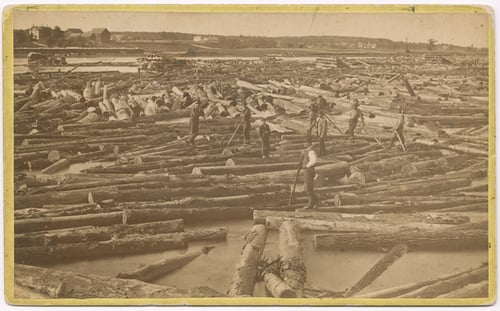
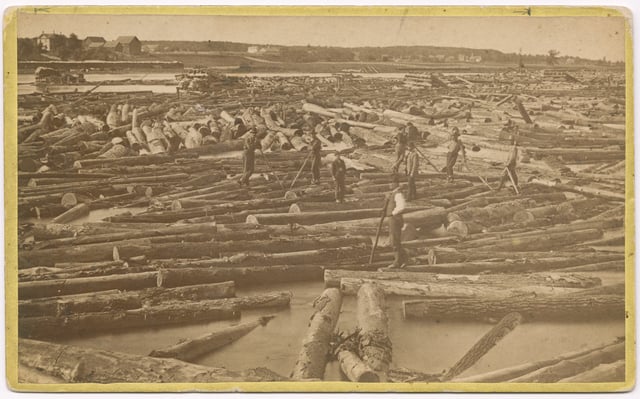
Laborers stand on logs floating in a river. The logs fill the river from the foreground to the shore in the background.
Log jam on the Mississippi River at Minneapolis, 1881.

For more than a century (1839–1949), commercial logging reshaped Minnesota’s environment, transforming its land and water as well as its people. Although logging boosted economic enterprise before statehood and helped form Minnesota’s cultural identity, the pursuit of old-growth forests drove the dispossession of Dakota and Ojibwe people from their lands between the 1830s and the early 1900s.

Logging in the western Great Lakes exploded after the Civil War, particularly due to the expansion of railroads into the North American West. Pine lumber from Wisconsin and Minnesota became the building materials for settlements throughout the wood-scarce Great Plains, from Texas into Canada.

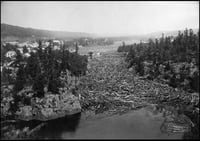
As the industry grew, it remained dependent on river transportation and followed the seasons. In winter, logging crews ventured into the woods to fell trees. They hauled logs via oxen and, later, horse-drawn sleds to frozen riverbanks. After the spring thaw, log drivers sent millions of board-feet downstream to sawmills. Log jams became spectacles, perhaps none more so than the 1886 St. Croix River jam, which one newspaper headline called “the jam of all jams.” Indigenous lumberjacks (particularly Ojibwe men) began working as wage laborers in the industry, often as river pilots on log drives. Some Ojibwe log drivers earned reputations for their skills, and by the early twentieth century, several Ojibwe men had won log-rolling contests.

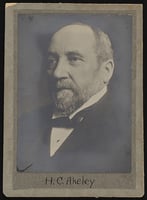
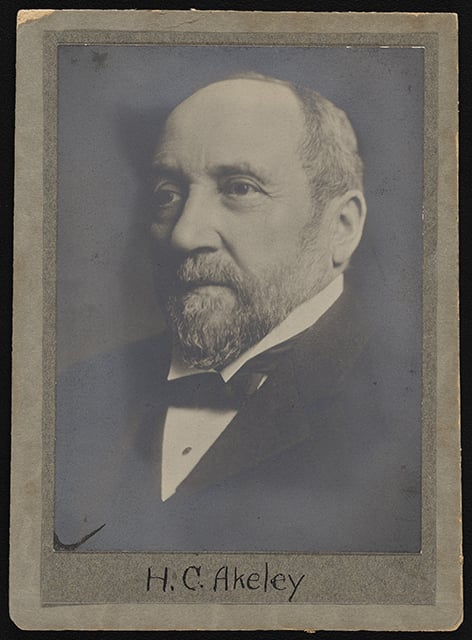
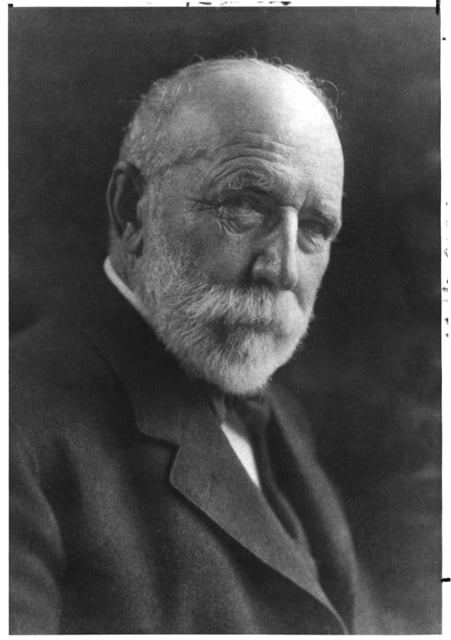
By the 1880s, most of the best pine had been taken from the Minnesota forests close to riverways like the St. Croix and the Mississippi. To capitalize on forests in the northern part of the state, however, they needed a new technology. They found it in railroads. Commercial interest in iron ore on the Iron Range spurred the region’s infrastructural development—particularly the extension of rail lines into formerly remote areas. Some lumber barons (Healey Cady Akeley and Thomas Barlow Walker, for example) built rail lines of their own.

The new northern railroads revolutionized logging in Minnesota. They carried wood that had been too remote or too heavy for water transport to new markets. They made the draft animals that had hauled logs to waterways obsolete. And they allowed logging companies to operate outside the winter months, freeing them from the rigid schedule of wintertime cutting and springtime log drives. Selective logging transformed into clearcutting as lumber barons hurried to profit from even the “waste” trees they had previously disregarded. They lowered their standards and took small trees that they’d passed over only a few years earlier. As the industry matured in Minnesota, however, only the largest, richest logging companies could draw upon the new rail networks to extract the ever-receding pine from the remote forests.

Industrial-scale production in Minnesota’s logging industry during the 1880s and 1890s produced prodigious amounts of waste. Without industry regulation or forestry policies to restrain them, sawmill operators dumped sawdust into rivers by the ton, channelizing stream beds and choking fish-spawning areas. Logging dams, constructed to regulate water flow for log drives, killed essential wild rice crops for Ojibwe people. Loggers left slash (narrowed tops of trees and branches) in the woods, adding fuel loads to drying-out forests.

The ecological degradation that came with logging culminated in devastating forest fires in the western Great Lakes, including at Hinckley (1894), Chisholm (1908), Baudette and Spooner (1910), and Cloquet (1918). These fires killed hundreds of people, burned millions of acres, and contributed to the cut-and-run practices of logging companies. In 1895, in the wake of the Hinckley Fire, Minnesota established the fire warden system, a precursor to the Minnesota Forest Service, appointing Christopher Columbus Andrews as chief fire warden.

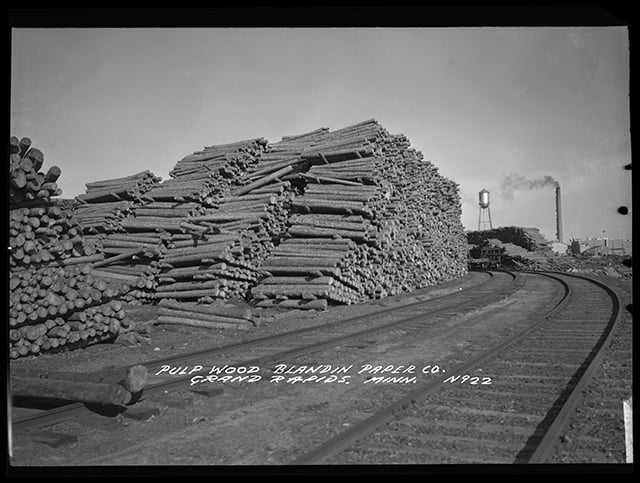
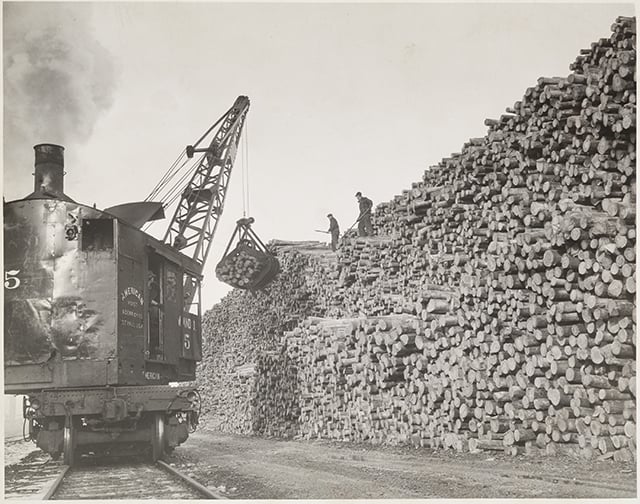
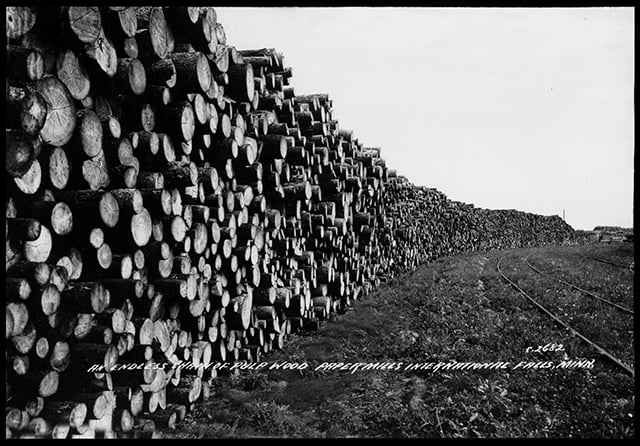
By the turn of the twentieth century, Minnesota’s white pine forests were nearing exhaustion. Overcutting had depleted the most accessible and valuable timber stands. Lumbermen like Walker and Frederick Weyerhaeuser increasingly shifted their operations to the yellow pine forests of the South, and to the Douglas fir forests of the Pacific Northwest. In Minnesota, deadhead logging, or raising sunken logs from riverbeds, became a profitable business. “The Mississippi River” from St. Cloud to Minneapolis, one 1904 newspaper article read, “is literally paved with money,” with millions of dollars' worth of sunken logs lining the riverbed. Preserved by water, old-growth white pine logs cut decades earlier were the most valuable and most accessible wood remaining. Loggers estimated that between five and ten percent of all logs that floated downriver sank along the way. As the industry looked for ways to capitalize on the state’s remaining forests, the wood-pulp paper industry developed, with paper companies increasingly taking spruce and aspen and younger, smaller trees for pulpwood.

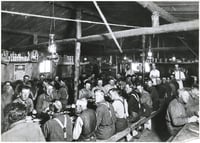
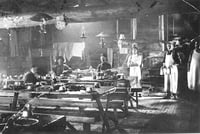
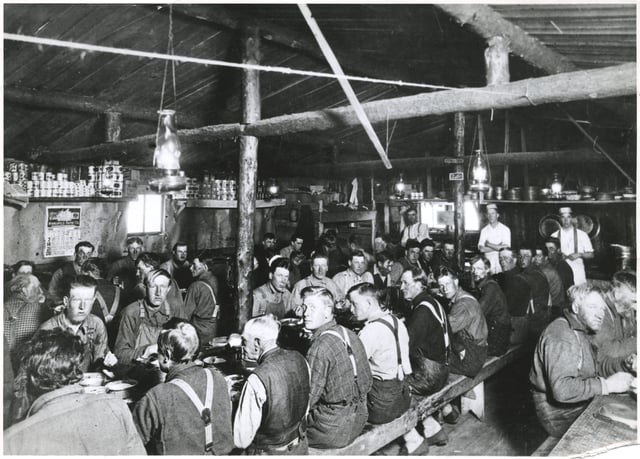
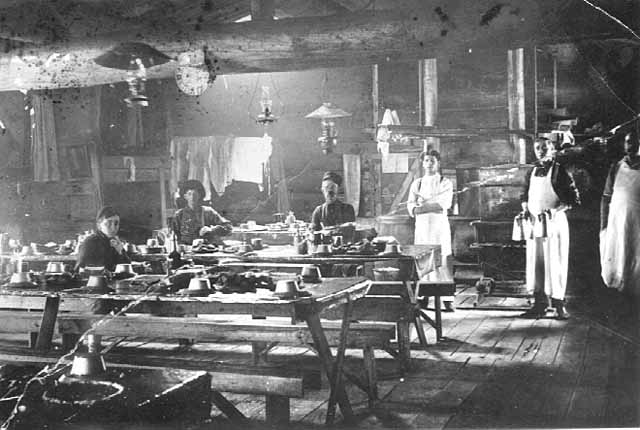
Outside the rosy mythology of Paul Bunyan, real lumberjacks lived hard lives marked by low wages, itinerant labor, and dangerous conditions that sometimes resulted in death. Many were immigrants, and a large number were Indigenous. Logging camps were thus hierarchical but socially and culturally diverse environments in often isolated forests, headed by a foreman or “boss.”

Labor organizing in the logging industry lagged behind other sectors, partly due to the transient nature of the workforce. By the early twentieth century, however, groups like the Industrial Workers of the World (IWW, established in 1905) were organizing lumber workers, advocating for better wages and working conditions. Under the “One Big Union” (or OBU, as the IWW was sometimes called), lumberjacks combined their voices with other exploited laborers, such as miners and railroad workers, to fight against corporate control. Strikes and labor unrest, particularly during the 1910s, reflected broader national trends in industrial labor conditions.

Although organizing helped lumberjacks wield their collective power, strikes during the winter, which remained the primary logging season, drove companies to log more heavily in the summer months to make up the lost profits. In 1917, for instance, the Virginia and Rainy Lake Company logged “practically forty-one million [board] feet” between May and October. Superintendent Frank H. Gillmor explained that the extra effort “offset this loss of feet and dollars” due to industry-wide strikes that had begun in January.

As timber supplies dwindled by the 1920s, many logging towns declined or disappeared altogether. Logging companies defaulted on their cutover lands, and tax-delinquent parcels fell into the hands of the state. At the same time, conservation movements gained momentum. State and federal authorities passed laws protecting Minnesota’s remnant forests and so-called “wilderness areas,” such as the Superior National Forest. The US Forest Service and Minnesota state agencies implemented policies aimed at sustainable forestry, fire prevention, and reforestation.

The Great Depression accelerated the decline of industrial logging in Minnesota. Reduced demand for lumber led to mill closures and widespread unemployment. New Deal programs helped reshape the state’s forests and rural economy. The Civilian Conservation Corps (CCC), established in 1933, employed thousands of young men in reforestation and park development projects across Minnesota’s cutover, tax-delinquent lands, leading to the creation of state parks and forests during the 1930s.

By 1937, the era of large-scale white pine logging had effectively ended. In that year, the International Logging Company completed the last log drive in Minnesota history on the Little Fork River, a tributary of the Rainy River. While timber harvesting continued, it no longer dominated the state’s economy as it had in previous decades. Instead, forestry evolved into a more regulated and sustainable industry, integrated with broader environmental and economic policies. Pulpwood harvesting for papermaking and recreation serve as the two primary economic drivers in Minnesota’s forests today.

 Editor's note: The fires that burned in northeastern Minnesota and northwestern Wisconsin in the late summer of 1894 were patchy, leading to disputes about the total acreage destroyed. Combined, the fires raged across an area of more than 2,000 square miles in the two states. Hinckley's fire was the deadliest, and burned an area of between 250 and 480 square miles. 

First Published: July 27, 2026
Last Modified: July 27, 2026

Bibliography

85538 Bb.2 2
Mitchell and McClure Lumber Company records, 1866–1928
Bentley Historical Library, University of Michigan, Ann Arbor
Description: Records of the Mitchell and McClure Lumber Company of Saginaw, Michigan and Duluth, Minnesota. Correspondence and financial papers concerning company land and lumbering enterprises, and later activities in home building, silo construction, and silage production; records of A.J. Stevens & Co. and McClure–Stevens Land Company of Gladwin, Michigan; and business files and diaries of company co-founder William C. McClure.
https://findingaids.lib.umich.edu/catalog/umich-bhl-85538

85639 Bb.2/2
Ruggles & Rademaker records, 1868–1931
Bentley Historical Library, University of Michigan, Ann Arbor
Description: Records of the Ruggles & Rademaker of Manistee, Michigan, and of the predecessor land and lumber enterprises of Charles Ruggles and Edward Buckley, including the Buckley and Douglas Lumber Co., the Manistee and Northeastern Railroad, and the Emeline Bath Co. of Chicago, Ill. Financial records and business correspondence of Edward Buckley, Charles Ruggles, and John Rademaker; also files concerning a lawsuit between Ruggles and Buckley.
https://findingaids.lib.umich.edu/catalog/umich-bhl-85639

American Immigration Company corporate records, 1894–1940
Manuscripts Collection, Minnesota Historical Society, St. Paul
Description: Correspondence, minutes, stock records, land contracts and deeds, land sale and tax records, maps and plats, financial records, and advertisements of this organization formed by lumber companies in Wisconsin and Minnesota to sell cutover lands. This company was a Weyerhaeuser affiliate.
https://storage.googleapis.com/mnhs-finding-aids-public/library/findaids/01183.html

Bovey-DeLaittre Lumber Company corporate records, 1870–1911
Manuscripts Collection, Minnesota Historical Society, St. Paul
Description: Ledgers, journals, cashbooks, and log, labor, and land records of this logging, lumber-milling, and (after 1888) lumber-sales company and its predecessor, Eastman, Bovey and Company. There is also a corporate minute book (1888–1905). Included are letters, receipts, statements, and other financial papers of the company and of the Charles A. Bovey family. At least five members of the DeLaittre family were associated with the firm—Albion J., Howard M., John, John L., and Louis.

Brown, Kevin C. “‘All That Country Will Be Taken Up by the Thrifty Settler’: Migration, Environment, and the Cutover Lands of Minnesota, USA from the 1890s to the 1930s.” Global Environment 5, no. 9 (2012): 160-180.
https://www.environmentandsociety.org/mml/all-country-will-be-taken-thrifty-settler-migration-environment-and-cutover-lands-minnesota-usa

Brown, Willa Hammitt. Gentlemen of the Woods: Manhood, Myth, and the American Lumberjack. University of Minnesota Press, 2024.

Cloquet Lumber Company records, 1883–1945
Manuscripts Collection, Minnesota Historical Society, St. Paul
Description: General accounting records, annual financial reports, and a few land records of the Cloquet Lumber Company, a Weyerhaeuser firm that operated a logging and lumbering business in Cloquet and northeastern Minnesota between 1884 and 1928. After this time the company maintained only a nominal existence, its property and operations having been conveyed to the Northwest Paper Company (Cloquet) in 1928. There are a few accounting records (1883–1884) of its predecessor, the Knife Falls Lumber Company.

Folsom, William H. C. Fifty Years in the Northwest: With an Introduction and Appendix Containing Reminiscences, Incidents and Notes. Pioneer Press Company, 1888.
https://www.gutenberg.org/ebooks/36375

Forester, Jeff. The Forest for the Trees: How Humans Shaped the North Woods. Minnesota Historical Society Press, 2009.

Glaser, Emma. “How Stillwater Came to Be.” Minnesota History 24, no. 3 (September 1943): 195–206.
https://storage.googleapis.com/mnhs-org-support/mn_history_articles/24/v24i03p195-206.pdf

Gregar, Courtney. “Weyerhaeuser, Frederick (1834–1914).” MNopedia, Minnesota Historical Society, April 10, 2017.
https://www.mnhs.org/mnopedia/search/index/person/weyerhaeuser-frederick-1834-1914

Hagg, Harold T. “The Beltrami County Logging Frontier.” Minnesota History 29, no. 2 (June 1948): 137–149.
https://storage.googleapis.com/mnhs-org-support/mn_history_articles/29/v29i02p137-149.pdf

——— . “Logging Line: A History of the Minneapolis, Red Lake and Manitoba.” Minnesota History 43, no. 4 (Winter 1972): 123-135.
https://storage.googleapis.com/mnhs-org-support/mn_history_articles/43/v43i04p123-135.pdf

Harris, Moira F. “Echoes from the Woods: Legacies of Logging in Minnesota.” Minnesota History 63, no. 5 (Spring 2013): 203–212.
https://storage.googleapis.com/mnhs-org-support/mn_history_articles/63/v63i05p203-p212.pdf

Haynes, John E. “Revolt of the ‘Timber Beasts’: IWW Lumber Strike in Minnesota.” Minnesota History 42, no. 5 (Spring 1971): 162–174.
https://storage.googleapis.com/mnhs-org-support/mn_history_articles/42/v42i05p162-174.pdf

HD9750–HD9774
Pamphlets relating to the forest products industry in Minnesota, 1881–
Pamphlets Collection, Minnesota Historical Society, St. Paul
Description: Contains pamphlets and printed ephemera relating to companies that produce boxes, beams, poles, wood interiors, dressed lumber, wood fiber products, wood furniture, barrels, and other forest products, and to the history of the lumber industry. Includes articles of incorporation of several barrel manufacturing companies (1880s).

Hidy, Ralph W., Frank Ernest Hill, and Allan Nevins. Timber and Men: The Weyerhaeuser Story. MacMillan, 1963.

Historical records of Northern Minnesota lumber companies, 1880–1967
Potlatch Corporation
Manuscripts Collection, Minnesota Historical Society, St. Paul
Description: Miscellaneous and sample records of about twelve northern Minnesota lumber companies, all of which were Weyerhaeuser affiliates or subsidiaries. The records were compiled and donated to the Carlton County Historical Society (Cloquet) by the Potlatch Corporation, the legal successor to the defunct Weyerhaeuser firms. Hotchkiss, George W. History of the Lumber and Forest Industry of the Northwest. G. W. Hotchkiss, 1898.

Interviews with pioneer lumbermen, 1953–1957
Forest History Center, compiler
Manuscripts Collection, Minnesota Historical Society, St. Paul
Description: Transcripts (typewritten carbon copies) of interviews between pioneer lumbermen and relatives of lumbermen of the Upper Midwest and members of the Forest History Society staff. The interviewees are: Paul Caplazi, Leonard Costley, Walter Ernest Dexter, Maud Mullen Calgren, George W. Dulany, Herman Heitman, Julius Joel, James Arthur Mathieu, Hope Garlick Mineau, Wirt Mineau, George Neils, Walter Neils, L. J. Olson, Margaret Orr O'Neill, Hugo Schlenk, Orrin W. Sinclair, and James Stevens.
https://storage.googleapis.com/mnhs-finding-aids-public/library/findaids/P2385.html

“The Jam of All Jams.” The St. Paul Globe, June 19, 1886.
https://www.mnhs.org/newspapers/lccn/sn90059522/1886-06-19/ed-1/seq-10

Johnson-Wentworth Company corporate records, 1894–1937
Manuscripts Collection, Minnesota Historical Society, St. Paul
Description: Minutes (1894–1914), stock and accounting records (1894–1937), annual financial and inventory reports (1903–1931), and land and timber descriptions (undated) of the Johnson-Wentworth Company, a Weyerhaeuser operation jointly owned by the Northern Lumber Company and the Cloquet Lumber Company. It engaged in logging and lumbering in the Cloquet area from its 1894 incorporation until the 1928 sale of its property and operations to the Northwest Paper Company, Cloquet.

Karamanski, Theodore J., and Eileen M. McMahon. North Woods River: The St. Croix River in Upper Midwest History. University of Wisconsin Press, 2009.

——— . Time and the River: A History of the Saint Croix. Midwest Regional Office of the National Park Service, 2002.

King, Frank A. Minnesota Logging Railroads. University of Minnesota Press, 2003.

——— . “Logging Railroads of Northern Minnesota.” Railway and Locomotive Historical Society Bulletin 93 (October 1955): 94–115.

Laird, Norton Company corporate records, 1855–1958
Manuscripts Collection, Minnesota Historical Society, St. Paul
Description: Records of, and information about, a family-owned, Winona-based lumber company. Includes records of more than seventy-five associated logging, lumber, land, colonization, and other companies active in states from Minnesota, Wisconsin, and Iowa to Louisiana and the Pacific Northwest.
https://storage.googleapis.com/mnhs-finding-aids-public/library/findaids/00331.html

“Large Northern Mill, Cut Out, Goes on Auction Block.” American Lumberman, October 13, 1934.

“Largest Pine Mills Saws Last Log.” American Lumberman, October 19, 1929.
https://babel.hathitrust.org/cgi/pt?id=mdp.39015080321436&seq=364

Larson, Agnes M. The White Pine Industry in Minnesota: A History. University of Minnesota Press, 2007 (reprint).

M534
T. B. Walker and family papers, 1856–2010 (bulk 1856–1988)
Manuscripts Collection, Minnesota Historical Society, St. Paul
Description: Personal papers and business records of a Minnesota lumber magnate and art collector, and of his descendants. Includes records of the Red River Lumber Company, a family-owned corporation that operated in both Minnesota and California. There are records of a variety of Walker's companies, business partnerships, and his art collection and gallery, as well as papers and business records of his children and grandchildren.
https://storage.googleapis.com/mnhs-finding-aids-public/library/findaids/00093.html

Millikan, William. “Destruction of Bois Forte Ojibwe Homeland, 1891–1929.” MNopedia, Minnesota Historical Society, December 4, 2019.
https://www.mnhs.org/mnopedia/search/index/event/destruction-bois-forte-ojibwe-homeland-1891-1929

Minnesota Department of Natural Resources. Minnesota’s Logging Railroads.
https://www.dnr.state.mn.us/forestry/history/logging-railroads.html

“Much Wealth in River’s Bed.” The Minneapolis Journal, March 8, 1904.
https://www.mnhs.org/newspapers/lccn/sn83045366/1904-03-08/ed-1/seq-7

Norrgard, Chantal. Seasons of Change: Labor, Treaty Rights, and Ojibwe Nationhood. University of North Carolina Press, 2014.

Northern Lumber Company and affiliated companies records, 1882–1967
Manuscripts Collection, Minnesota Historical Society, St. Paul
Description: This collection contains the records of several companies, all of which have been grouped together because of their close affiliations as Weyerhaeuser business interests operating in northern Minnesota. In addition to these companies, the researcher will find records of two other Cloquet Weyerhaeuser affiliates cataloged separately: the Cloquet Lumber Company and the Johnson–Wentworth Company. The following History of the Organization contains historical sketches of the Northern Lumber Company and the several affiliates whose records are included in the collection.
https://storage.googleapis.com/mnhs-finding-aids-public/library/findaids/01190.html

Northwest Paper Company records, 1883–1967
Manuscripts Collection, Minnesota Historical Society, St. Paul
Description: Correspondence and related papers (1910-1953); financial, tax, and production records (1888-1963); plat books (undated); maps (1890-1967); and photographs (undated and 1925) of a northern Minnesota paper company, one of many Weyerhaeuser family lumber business interests.
https://storage.googleapis.com/mnhs-finding-aids-public/library/findaids/00733.html

P905
Ann River Land Company records, 1875–1933
Manuscripts Collection, Minnesota Historical Society, St. Paul
Description: Correspondence, deeds, agreements, and land, taxation, and financial records (mainly 1901–1931) of a company organized to dispose of cutover land for various logging firms. This firm was a Weyerhaeuser affiliate.

P983
F. Weyerhaeuser and Company records, 1892–1955
Manuscripts Collection, Minnesota Historical Society, St. Paul
Description: Correspondence (1902–1934); agreements, contracts, and other land and legal papers (1895–1903); annual statements (1895–1934); log accounts (1892–1905); tax records (1923–1938); articles of incorporation (1901); and other papers of [Frederick] Weyerhaeuser and Company and associated lumbering and lumber products companies.
https://storage.googleapis.com/mnhs-finding-aids-public/library/findaids/01186.html

P2334
Frank H. Gillmor papers, 1910–1928, 1948
Manuscripts Collection, Minnesota Historical Society, St. Paul
Description: Business records and correspondence kept by Gillmor, who served as the superintendent of logging for the Virginia and Rainy Lake Lumber Company from 1910 through 1928. Also contains an interview transcript from 1948 with the Forest Products History Foundation.

Ryan, J. C. “Minnesota Logging Railroads.” Minnesota History 27, no. 4 (December 1946): 300–308.
https://storage.googleapis.com/mnhs-org-support/mn_history_articles/27/v27i04p300-308.pdf

Smith, Hampton. Confluence: A History of Fort Snelling. Minnesota Historical Society Press, 2021.

Treuer, Anton. The Assassination of Hole in the Day. Borealis Books, 2011.

——— . Warrior Nation: A History of the Red Lake Ojibwe. Minnesota Historical Society Press, 2015.

Virginia and Rainy Lake Company records, 1901–1965
Manuscripts Collection, Minnesota Historical Society, St. Paul
Description: Minutes (1905–1939), maps and platbooks, deeds, abstracts, and title and tax records of the Virginia and Rainy Lake Company.
https://storage.googleapis.com/mnhs-finding-aids-public/library/findaids/00268.html

Westerman, Gwen, and Bruce White. Mni Sota Makoce: The Land of the Dakota. Minnesota Historical Society Press, 2012.

Weyerhaeuser family papers, 1860-2003 (bulk 1900–1957)
Manuscripts Collection, Minnesota Historical Society, St. Paul
Description: Business and personal correspondence, financial records, diaries, and personal papers of Minnesota lumber magnate Frederick Weyerhaeuser (1834–1914) and his descendants. Includes information about family members' activities and business affairs, and annual reports and business records of more than sixty-five Weyerhaeuser companies.
https://storage.googleapis.com/mnhs-finding-aids-public/library/findaids/P930.html
Related Resources

Primary

American Immigration Company corporate records, 1894–1940
Manuscripts Collection, Minnesota Historical Society, St. Paul
Description: Correspondence, minutes, stock records, land contracts and deeds, land sale and tax records, maps and plats, financial records, and advertisements of this organization formed by lumber companies in Wisconsin and Minnesota to sell cutover lands. This company was a Weyerhaeuser affiliate.
https://storage.googleapis.com/mnhs-finding-aids-public/library/findaids/01183.html

North Wisconsin Lumber Company records, 1874–1933
Manuscripts Collection, Minnesota Historical Society, St. Paul
Description: Correspondence (mainly 1903–1908), agreements, financial miscellany, land records, and a property map of this company organized for the general manufacture of lumber.
https://storage.googleapis.com/mnhs-finding-aids-public/library/findaids/01189.html

P458
Chippewa Logging Company records, 1874–1937
Manuscript Collections, Minnesota Historical Society, St. Paul
Description: Articles of incorporation (1881), minutes (1881–1908), stock certificate book (1881-1903), land and tax records, annual statements (1891–1909), timber estimates, testimony on the flooding of dams, and logging records of this firm organized to purchase Wisconsin timberlands and conduct a general logging business. This firm was a Weyerhaeuser affiliate.

P474
Mississippi River Logging Company records, 1870–1931
Manuscripts Collection, Minnesota Historical Society, St. Paul
Description: Articles of incorporation, minutes, stock certificates, tax records, financial records, deeds, agreements, correspondence, annual statements, and related papers of this joint stock company organized by several Mississippi River sawmills to drive, buy, and sell logs and to buy timberlands in Iowa, Wisconsin, and elsewhere. This firm was a Weyerhaeuser affiliate.

Secondary

Cronon, William. Nature’s Metropolis: Chicago and the Great West. W. W. Norton, 1991.

Gates, Paul Wallace. The Wisconsin Pine Lands of Cornell University. Repr., 1943; Cornell University Press, 2011.

Gough, Robert J. Farming the Cutover: A Social History of Northern Wisconsin, 1900–1940. University Press of Kansas, 1997.

Hurst, James Willard. Law and Economic Growth: The Legal History of the Lumber Industry in Wisconsin, 1836–1915. University of Wisconsin Press, 1984.

Karamanski, Theodore J. Deep Woods Frontier: A History of Logging in Northern Michigan. Wayne State University Press, 1989.

Meyer, Melissa L. The White Earth Tragedy: Ethnicity and Dispossession at a Minnesota Anishinaabe Reservation, 1889–1920. University of Nebraska Press, 1999.

Newton, Jason L. Cutover Capitalism: The Industrialization of the Northern Forest. West Virginia University Press, 2024.

Rector, William G. Log Transportation in the Lake States Lumber Industry, 1840–1918. A. H. Clark, 1953.

Witgen, Michael John. Seeing Red: Indigenous Land, American Expansion, and the Political Economy of Plunder in North America. University of North Carolina Press, 2023.

Related Video

last_log_drive_screen_cap

The Last Log Drive in Minnesota

The last log drive in Minnesota was filmed by Carl H. Henrikson Jr. on the Little Fork River during the spring of 1937. In the mid-1970s, the Minnesota Historical Society hired TCR Productions to compile a documentary film using Henrikson's footage, along with recorded commentary and narration. This version is digitized from Henrikson's original 1937 reels and recut to match the completed film.

Holding Location

Minnesota Historical Society

Related Audio

MN90: The Mother of All Logjams | Details

MN90: The Mother of All Logjams

MN90 explains how a thunderstorm and a dyamited dam created an epic logjam at Taylors Falls in 1886.
© Ampers    

All rights reserved

Related Images
Laborers stand on logs floating in a river. The logs fill the river from the foreground to the shore in the background.
Log jam on the Mississippi River at Minneapolis, 1881.
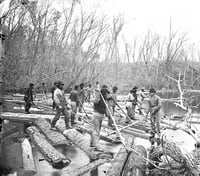
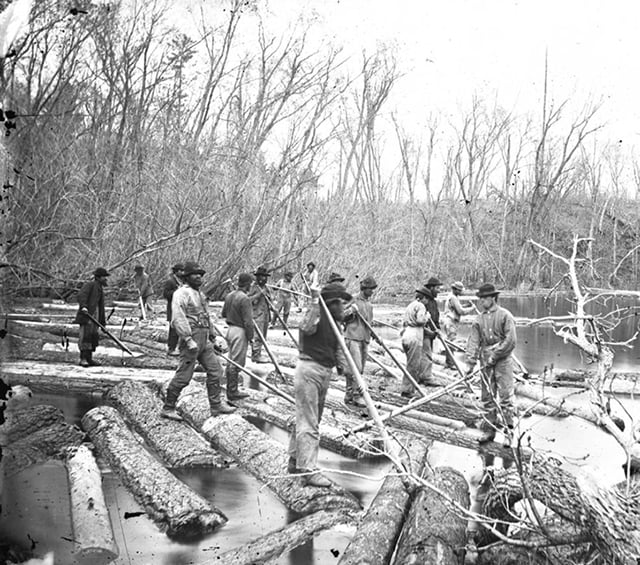
Laborers stand on floating logs in a river, holding sticks in their hands for balance. Leafless trees appear in the background.
The logging crew of Elias Moses on the Rum River, 1860. Photograph by Edward A. Bromley.
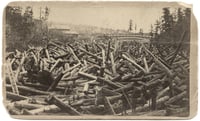
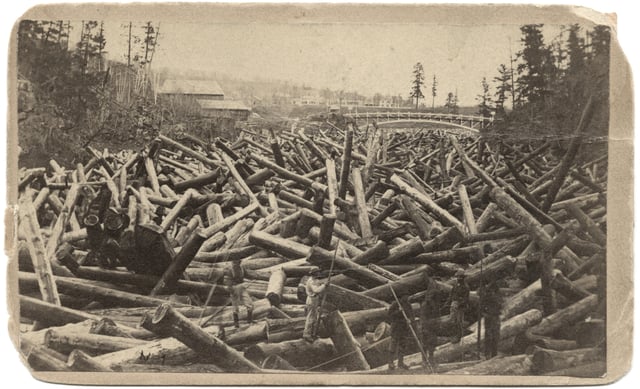
Laborers stand on jammed logs in the foreground, with logs continuing to a bridge in the background. Trees stand in the right and left background.
Log jam on the St. Croix River at Taylors Falls, ca. 1865.
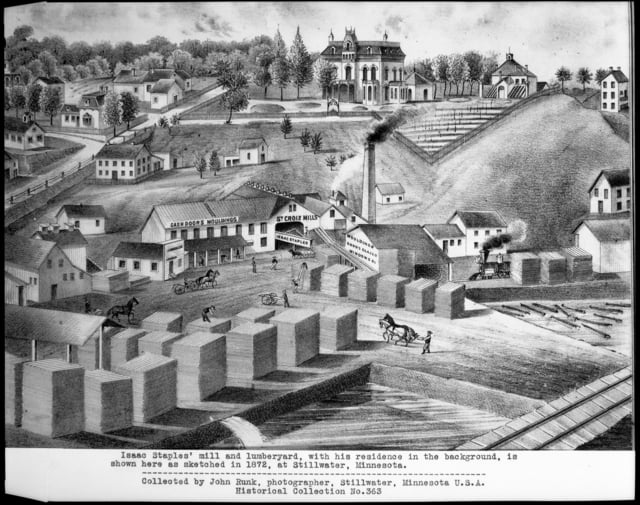
A black-and-white print showing a lumber mill in the foreground, with stacks of lumber, houses, horses, and workers, and a sawmill, and a mansion on top of a hill behind them.
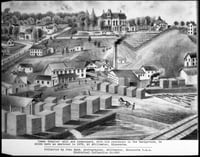
Isaac Staples’ mill and lumberyard in Stillwater with his residence in the background, 1874.
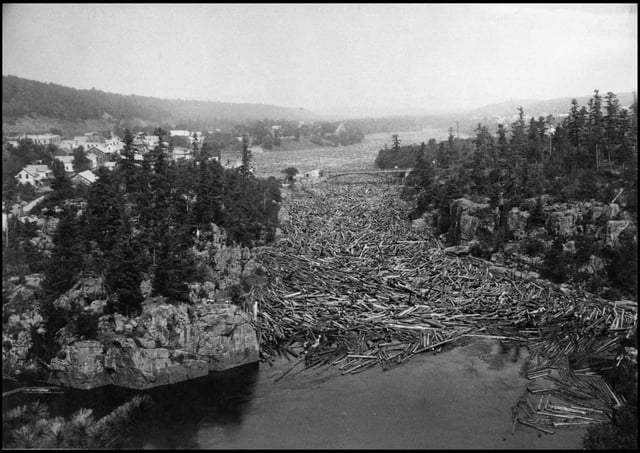
Bird's-eye view of a river passing through a channel choked by logs, with rocky outcrops and trees on either side.
Bird's-eye view of a log jam on the St. Croix River at Taylors Falls, ca. 1886.
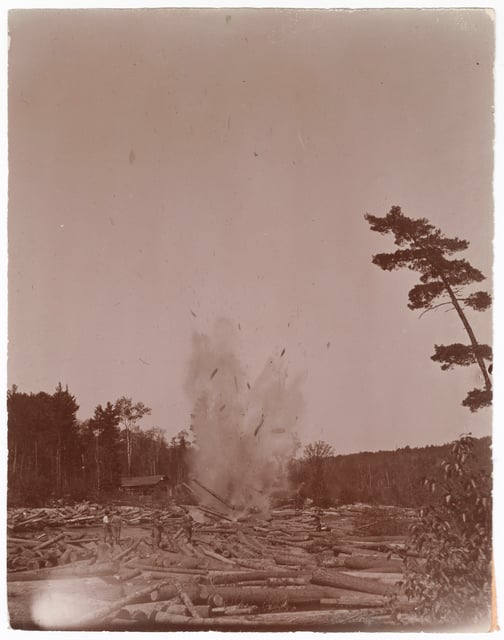
An explosion in a log-choked river throws up water and wood into the air.
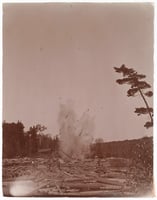
Breaking up a log jam with dynamite at Big Falls, ca. 1890.
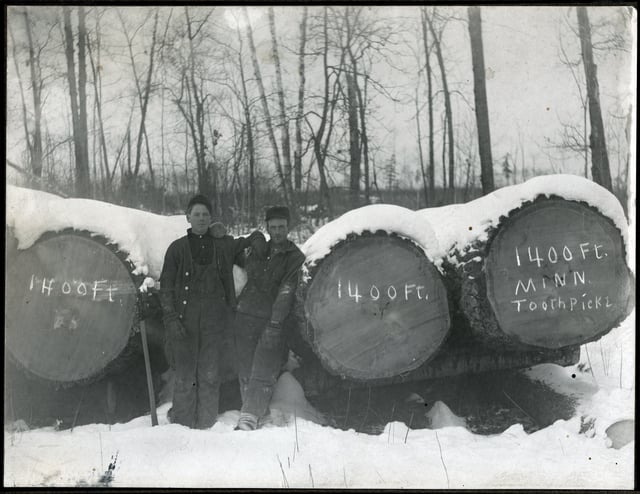
Two laborers pose between two giant felled trees resting on wooden supports on the ground, with a third fallen tree at right and leafless trees in the background.
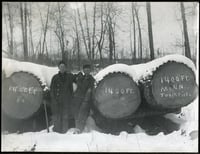
Lumberjacks with some of the largest logs cut at Nixon Lumber Camp near Akeley, ca. 1890.
Three-quarters view of a man's head and shoulders. He is partly bald, with a beard and moustache, and wears a suit jacket, tie, and white shirt.
Healy Cady (H. C.) Akeley, ca. 1890.
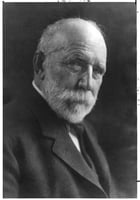
Three-quarters view of a man's head and shoulders. He is partly bald, with a beard and moustache, and wears a suit jacket, tie, and white shirt.
Frederick Weyerhaeuser, ca. 1900.
The interior of a lumber camp building showing three long tables with laborers sitting on benches. The building's rafters are visible above them.
Lumberjacks eating in a lumber camp near Blackduck (Beltrami County), ca. 1900.
Three people sit and three others, wearing aprons, stand inside a dining hall with tables, benches, and an exposed wooden rafter overhead.
A lumber camp dining hall near Burns Landing on the Mississippi River, ca. 1900.
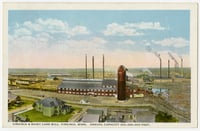
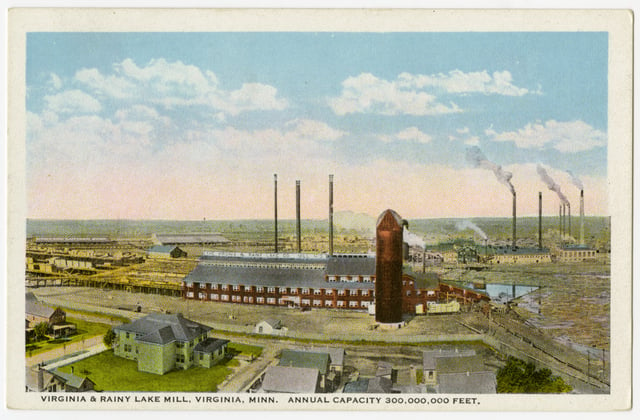
Bird's-eye view of a lumber mill showing a red multistory building with a red silo next to it, smaller buildings in the foreground, and smokestacks in the background, all under a blue sky with white clouds.
Virginia and Rainy Lake Company mill, Virginia, Minnesota, 1910.
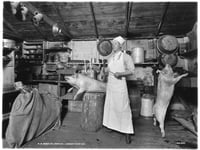
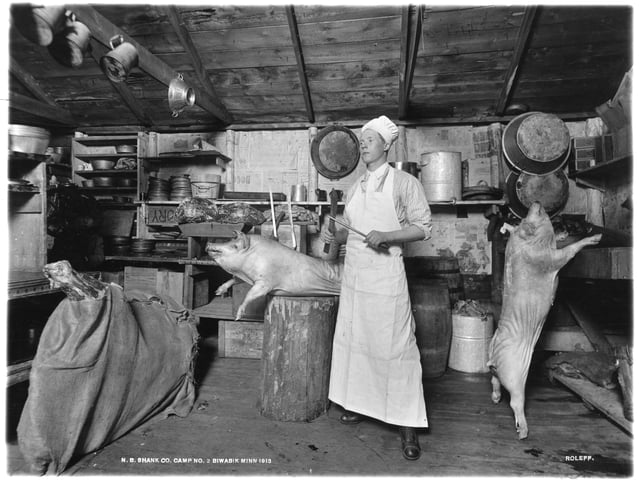
A man in a white apron and cook's hat stands between two slaughtered pigs with knives in his hands. He stands inside a kitchen with a wooden roof.
N. B. Shank Company Camp No. 2, Biwabik (St. Louis County), 1913.
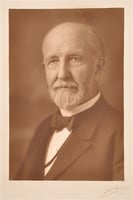
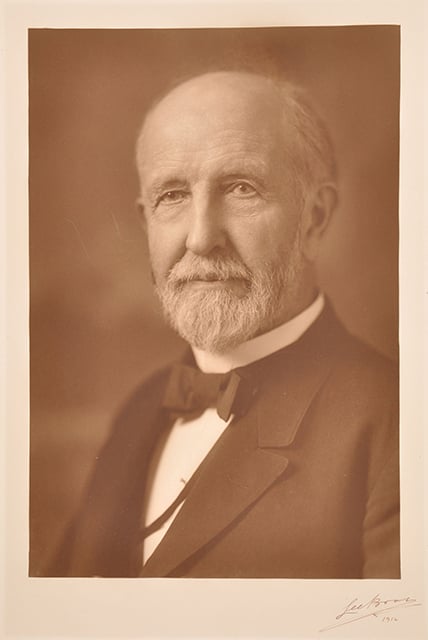
Three-quarters view of a man's head and shoulders. He is partly bald, with a beard and moustache, and wears a suit jacket, bow tie, and white shirt.
Thomas B. Walker, 1921. Photograph by the Lee Brothers.
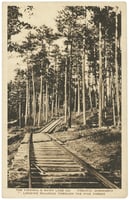
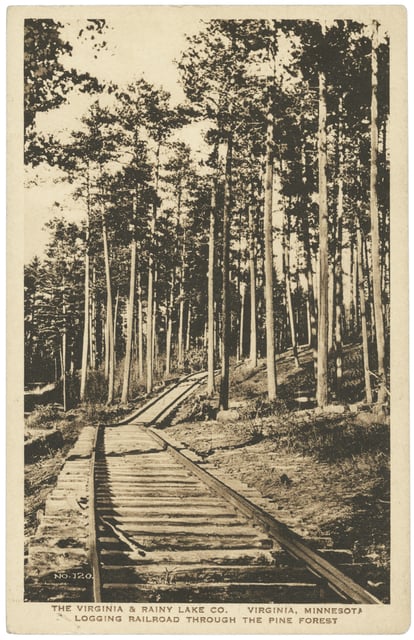
A railroad track begins in the foreground and continues into the background in the middle of trees, in leaf but with the leaves mostly at the canopy level.
Logging railroad through a pine forest operated by the Virginia and Rainy Lake Company, ca. 1928.
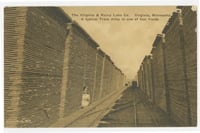
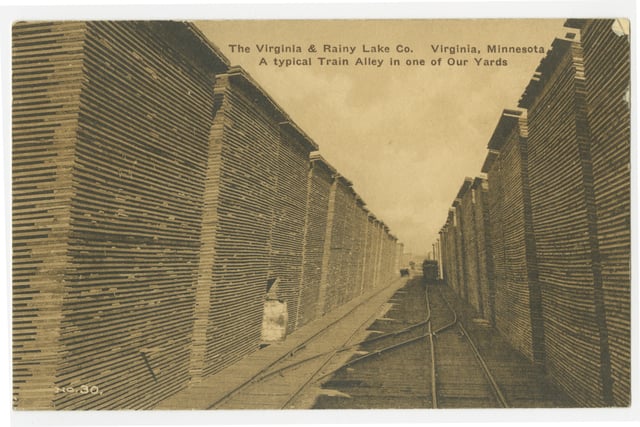
Railroad tracks run through an alley created by two rows of stacks wooden boards at the left and right, rising up to a sepia-colored sky.
A typical train alley in one of the yards of the Virginia and Rainy Lake Company, Virginia, Minnesota, ca. 1928.
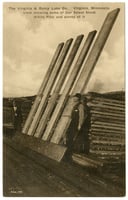
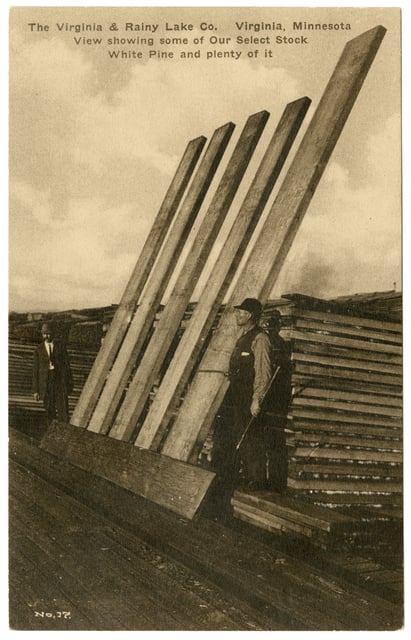
Five wooden boards lean against a wooden frame, flanked by two men.
Some of the Virginia and Rainy Lake Company’s select stock white pine at the mill, Virginia, Minnesota, ca. 1928.
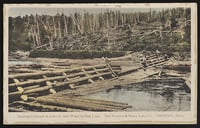
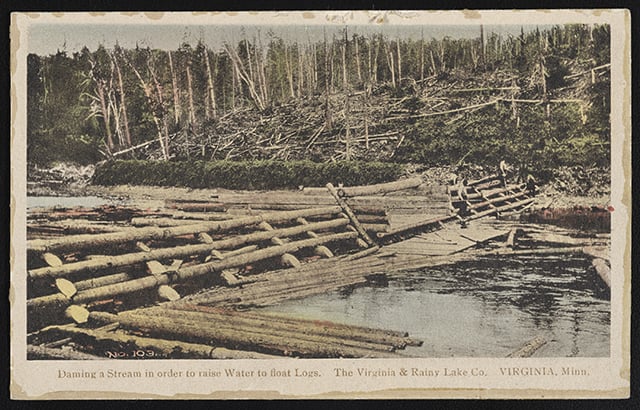
A dammed stream with logs and dam components covering most of the water. Leafless trees stand on the bank in the background.
A damn across a stream intended to raise water to allow logs to float past, Virginia and Rainy Lake Company, ca. 1928.
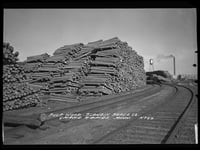
Two railroad tracks curve to the left of the image around stacks of logs, with a smokestack and water tower in the background.
Stacks of pulpwood piled by the Blanding Paper Company at Grand Rapids, ca. 1935.
A railroad car sits on a track next to a stack of logs that extends into an obscured vanishing point at the lower left.
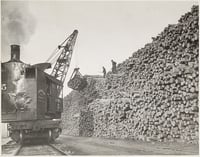
Pulpwood stacks at M and O Paper plant, International Falls, ca. 1940.
Stacks of wood fill the left-hand side of the image and extend across the picture plane to a vanishing point at right. Railroad tracks run through the grass at center right.
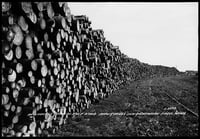
Stacks of pulpwood at a paper mill in International Falls, ca. 1950.
Laborers stand on logs floating in a river. The logs fill the river from the foreground to the shore in the background.

Log jam at Minneapolis, 1881

Log jam on the Mississippi River at Minneapolis, 1881.

Holding Location

Minnesota Historical Society
Laborers stand on floating logs in a river, holding sticks in their hands for balance. Leafless trees appear in the background.

Elias Moses’ logging crew on the Rum River, 1860

The logging crew of Elias Moses on the Rum River, 1860. Photograph by Edward A. Bromley.

Holding Location

Hennepin County Library Digital Collections
Laborers stand on jammed logs in the foreground, with logs continuing to a bridge in the background. Trees stand in the right and left background.

Log jam on the St Croix, ca. 1865

Log jam on the St. Croix River at Taylors Falls, ca. 1865.

Holding Location

Minnesota Historical Society
A black-and-white print showing a lumber mill in the foreground, with stacks of lumber, houses, horses, and workers, and a sawmill, and a mansion on top of a hill behind them.

Isaac Staples’ mill and lumberyard in Stillwater, 1874

Isaac Staples’ mill and lumberyard in Stillwater with his residence in the background, 1874.

Holding Location

Minnesota Historical Society
Bird's-eye view of a river passing through a channel choked by logs, with rocky outcrops and trees on either side.

Log jam on the St. Croix River, ca. 1886

Bird's-eye view of a log jam on the St. Croix River at Taylors Falls, ca. 1886.

Holding Location

Minnesota Historical Society
An explosion in a log-choked river throws up water and wood into the air.

Log jam at Big Falls, ca. 1890

Breaking up a log jam with dynamite at Big Falls, ca. 1890.

Holding Location

Minnesota Historical Society
Two laborers pose between two giant felled trees resting on wooden supports on the ground, with a third fallen tree at right and leafless trees in the background.

Lumberjacks at Nixon Lumber Camp near Akeley

Lumberjacks with some of the largest logs cut at Nixon Lumber Camp near Akeley, ca. 1890.

Holding Location

Minnesota Historical Society
Three-quarters view of a man's head and shoulders. He is partly bald, with a beard and moustache, and wears a suit jacket, tie, and white shirt.

Healy Cady (H. C.) Akeley, ca. 1890

Healy Cady (H. C.) Akeley, ca. 1890.

Holding Location

Minnesota Historical Society
Three-quarters view of a man's head and shoulders. He is partly bald, with a beard and moustache, and wears a suit jacket, tie, and white shirt.

Frederick Weyerhaeuser, ca. 1900

Frederick Weyerhaeuser, ca. 1900.

Holding Location

Minnesota Historical Society
The interior of a lumber camp building showing three long tables with laborers sitting on benches. The building's rafters are visible above them.

Lumberjacks eating in lumber camp near Blackduck, ca. 1900

Lumberjacks eating in a lumber camp near Blackduck (Beltrami County), ca. 1900.
Three people sit and three others, wearing aprons, stand inside a dining hall with tables, benches, and an exposed wooden rafter overhead.

Lumber camp dining hall, ca. 1900

A lumber camp dining hall near Burns Landing on the Mississippi River, ca. 1900.
Bird's-eye view of a lumber mill showing a red multistory building with a red silo next to it, smaller buildings in the foreground, and smokestacks in the background, all under a blue sky with white clouds.

Virginia and Rainy Lake Company mill, 1910

Virginia and Rainy Lake Company mill, Virginia, Minnesota, 1910.

Holding Location

Minnesota Historical Society
A man in a white apron and cook's hat stands between two slaughtered pigs with knives in his hands. He stands inside a kitchen with a wooden roof.

Cook in a lumber-camp kitchen, 1913

N. B. Shank Company Camp No. 2, Biwabik (St. Louis County), 1913.
Three-quarters view of a man's head and shoulders. He is partly bald, with a beard and moustache, and wears a suit jacket, bow tie, and white shirt.

Thomas B. Walker, 1921

Thomas B. Walker, 1921. Photograph by the Lee Brothers.
A railroad track begins in the foreground and continues into the background in the middle of trees, in leaf but with the leaves mostly at the canopy level.

Virginia and Rainy Lake Company railroad, 1928

Logging railroad through a pine forest operated by the Virginia and Rainy Lake Company, ca. 1928.

Holding Location

Minnesota Historical Society
Railroad tracks run through an alley created by two rows of stacks wooden boards at the left and right, rising up to a sepia-colored sky.

Virginia and Rainy Lake Company train alley, ca. 1928

A typical train alley in one of the yards of the Virginia and Rainy Lake Company, Virginia, Minnesota, ca. 1928.

Holding Location

Minnesota Historical Society
Five wooden boards lean against a wooden frame, flanked by two men.

White pine boards, ca. 1928

Some of the Virginia and Rainy Lake Company’s select stock white pine at the mill, Virginia, Minnesota, ca. 1928.

Holding Location

Minnesota Historical Society
A dammed stream with logs and dam components covering most of the water. Leafless trees stand on the bank in the background.

Stream dam at Virginia, Minnesota, ca. 1928

A damn across a stream intended to raise water to allow logs to float past, Virginia and Rainy Lake Company, ca. 1928.

Holding Location

Minnesota Historical Society
Two railroad tracks curve to the left of the image around stacks of logs, with a smokestack and water tower in the background.

Pulpwood at Grand Rapids, ca. 1935

Stacks of pulpwood piled by the Blanding Paper Company at Grand Rapids, ca. 1935.

Holding Location

Minnesota Historical Society

A railroad car sits on a track next to a stack of logs that extends into an obscured vanishing point at the lower left.

Pulpwood at International Falls, ca. 1940

Pulpwood stacks at M and O Paper plant, International Falls, ca. 1940.

Holding Location

Minnesota Historical Society
Stacks of wood fill the left-hand side of the image and extend across the picture plane to a vanishing point at right. Railroad tracks run through the grass at center right.

Pulpwood at International Falls, ca. 1950

Stacks of pulpwood at a paper mill in International Falls, ca. 1950.

Holding Location

Minnesota Historical Society

Turning Point

In the 1880s, technological advancements like hot ponds, railroads, and steampowered sawmills divorce the logging industry from its seasonal cycle. Logging becomes a year-round activity, with loggers transitioning from selectively cutting big white pine to clearing entire forests, including young growth and previously non-marketable tree species.

Chronology

1839
David Hone and Lewis Judd open a flutter-wheeled sawmill on the St. Croix River.
1844
John McCusick and business partners found the Stillwater Lumber Company in Stillwater.
1848
Franklin Steele builds a sawmill at St. Anthony Falls.
1850s
Alongside the Rum River, the St. Croix River emerges as a primary logging hub of Minnesota Territory. Timber from both locations feeds mills at Stillwater, Marine on St. Croix, Winona, and St. Anthony Falls.
1867
Rail lines connect the nascent Twin Cities with national markets through the railroad metropolis of Chicago.
1884
T. B. Walker incorporates the Red River Lumber Company to administer his lumber mills in Crookston.
1889
Minnesota’s production of white pine lumber surpasses one billion board feet for the first time.
1889
The US government passes the Nelson Act, intending to remove all Minnesota Ojibwe to the newly created White Earth Reservation (a violation of earlier treaties). The act is only partially successful. The Red Lake Ojibwe agree to cede close to three million acres of land but retain the southernmost portion of their reservation.
1890
H. C. Akeley builds a logging railroad from Lake Itasca to the Mesabi Range.
1892
The St. Anthony Lumber Company completes a rail line that connects Cross Lake with Leech Lake.
1894
The Hinckley Fire rips through the northern Minnesota–Wisconsin border region, burning an area of between 250 and 480 square miles in the North Star State and killing at least 418 people. At the time, it is the second-deadliest forest fire in US history.
1895
Horror-stricken by Hinckley, the Minnesota Legislature establishes the position of Chief Fire Warden and appoints Christopher Columbus Andrews to the role.
1899–1900
Minnesota lumber production reaches its peak, topping out at 2.3 billion board feet of white pine lumber in a single year.
ca. 1900
The Minnesota School of Forestry is established at the University of Minnesota.
1911
The Minnesota Forest Service begins operating, with William T. Cox as the state’s first chief forester.
1916–1917
The Industrial Workers of the World (IWW) lead strikes on behalf of laborers across the country from Wisconsin to Washington state, including Minnesota’s lumberjacks.
1918
The Cloquet, Duluth, and Moose Lake fires devastate a tract of forest spreading westward from Duluth. Nearly 400 square miles of forest burn, killing over 450 people. It is the second-deadliest forest fire in US history to date.
1937
The International Logging Company completes the last log drive in Minnesota history, on the Little Fork River, a tributary of the Rainy River.

Bibliography

85538 Bb.2 2
Mitchell and McClure Lumber Company records, 1866–1928
Bentley Historical Library, University of Michigan, Ann Arbor
Description: Records of the Mitchell and McClure Lumber Company of Saginaw, Michigan and Duluth, Minnesota. Correspondence and financial papers concerning company land and lumbering enterprises, and later activities in home building, silo construction, and silage production; records of A.J. Stevens & Co. and McClure–Stevens Land Company of Gladwin, Michigan; and business files and diaries of company co-founder William C. McClure.
https://findingaids.lib.umich.edu/catalog/umich-bhl-85538

85639 Bb.2/2
Ruggles & Rademaker records, 1868–1931
Bentley Historical Library, University of Michigan, Ann Arbor
Description: Records of the Ruggles & Rademaker of Manistee, Michigan, and of the predecessor land and lumber enterprises of Charles Ruggles and Edward Buckley, including the Buckley and Douglas Lumber Co., the Manistee and Northeastern Railroad, and the Emeline Bath Co. of Chicago, Ill. Financial records and business correspondence of Edward Buckley, Charles Ruggles, and John Rademaker; also files concerning a lawsuit between Ruggles and Buckley.
https://findingaids.lib.umich.edu/catalog/umich-bhl-85639

American Immigration Company corporate records, 1894–1940
Manuscripts Collection, Minnesota Historical Society, St. Paul
Description: Correspondence, minutes, stock records, land contracts and deeds, land sale and tax records, maps and plats, financial records, and advertisements of this organization formed by lumber companies in Wisconsin and Minnesota to sell cutover lands. This company was a Weyerhaeuser affiliate.
https://storage.googleapis.com/mnhs-finding-aids-public/library/findaids/01183.html

Bovey-DeLaittre Lumber Company corporate records, 1870–1911
Manuscripts Collection, Minnesota Historical Society, St. Paul
Description: Ledgers, journals, cashbooks, and log, labor, and land records of this logging, lumber-milling, and (after 1888) lumber-sales company and its predecessor, Eastman, Bovey and Company. There is also a corporate minute book (1888–1905). Included are letters, receipts, statements, and other financial papers of the company and of the Charles A. Bovey family. At least five members of the DeLaittre family were associated with the firm—Albion J., Howard M., John, John L., and Louis.

Brown, Kevin C. “‘All That Country Will Be Taken Up by the Thrifty Settler’: Migration, Environment, and the Cutover Lands of Minnesota, USA from the 1890s to the 1930s.” Global Environment 5, no. 9 (2012): 160-180.
https://www.environmentandsociety.org/mml/all-country-will-be-taken-thrifty-settler-migration-environment-and-cutover-lands-minnesota-usa

Brown, Willa Hammitt. Gentlemen of the Woods: Manhood, Myth, and the American Lumberjack. University of Minnesota Press, 2024.

Cloquet Lumber Company records, 1883–1945
Manuscripts Collection, Minnesota Historical Society, St. Paul
Description: General accounting records, annual financial reports, and a few land records of the Cloquet Lumber Company, a Weyerhaeuser firm that operated a logging and lumbering business in Cloquet and northeastern Minnesota between 1884 and 1928. After this time the company maintained only a nominal existence, its property and operations having been conveyed to the Northwest Paper Company (Cloquet) in 1928. There are a few accounting records (1883–1884) of its predecessor, the Knife Falls Lumber Company.

Folsom, William H. C. Fifty Years in the Northwest: With an Introduction and Appendix Containing Reminiscences, Incidents and Notes. Pioneer Press Company, 1888.
https://www.gutenberg.org/ebooks/36375

Forester, Jeff. The Forest for the Trees: How Humans Shaped the North Woods. Minnesota Historical Society Press, 2009.

Glaser, Emma. “How Stillwater Came to Be.” Minnesota History 24, no. 3 (September 1943): 195–206.
https://storage.googleapis.com/mnhs-org-support/mn_history_articles/24/v24i03p195-206.pdf

Gregar, Courtney. “Weyerhaeuser, Frederick (1834–1914).” MNopedia, Minnesota Historical Society, April 10, 2017.
https://www.mnhs.org/mnopedia/search/index/person/weyerhaeuser-frederick-1834-1914

Hagg, Harold T. “The Beltrami County Logging Frontier.” Minnesota History 29, no. 2 (June 1948): 137–149.
https://storage.googleapis.com/mnhs-org-support/mn_history_articles/29/v29i02p137-149.pdf

——— . “Logging Line: A History of the Minneapolis, Red Lake and Manitoba.” Minnesota History 43, no. 4 (Winter 1972): 123-135.
https://storage.googleapis.com/mnhs-org-support/mn_history_articles/43/v43i04p123-135.pdf

Harris, Moira F. “Echoes from the Woods: Legacies of Logging in Minnesota.” Minnesota History 63, no. 5 (Spring 2013): 203–212.
https://storage.googleapis.com/mnhs-org-support/mn_history_articles/63/v63i05p203-p212.pdf

Haynes, John E. “Revolt of the ‘Timber Beasts’: IWW Lumber Strike in Minnesota.” Minnesota History 42, no. 5 (Spring 1971): 162–174.
https://storage.googleapis.com/mnhs-org-support/mn_history_articles/42/v42i05p162-174.pdf

HD9750–HD9774
Pamphlets relating to the forest products industry in Minnesota, 1881–
Pamphlets Collection, Minnesota Historical Society, St. Paul
Description: Contains pamphlets and printed ephemera relating to companies that produce boxes, beams, poles, wood interiors, dressed lumber, wood fiber products, wood furniture, barrels, and other forest products, and to the history of the lumber industry. Includes articles of incorporation of several barrel manufacturing companies (1880s).

Hidy, Ralph W., Frank Ernest Hill, and Allan Nevins. Timber and Men: The Weyerhaeuser Story. MacMillan, 1963.

Historical records of Northern Minnesota lumber companies, 1880–1967
Potlatch Corporation
Manuscripts Collection, Minnesota Historical Society, St. Paul
Description: Miscellaneous and sample records of about twelve northern Minnesota lumber companies, all of which were Weyerhaeuser affiliates or subsidiaries. The records were compiled and donated to the Carlton County Historical Society (Cloquet) by the Potlatch Corporation, the legal successor to the defunct Weyerhaeuser firms. Hotchkiss, George W. History of the Lumber and Forest Industry of the Northwest. G. W. Hotchkiss, 1898.

Interviews with pioneer lumbermen, 1953–1957
Forest History Center, compiler
Manuscripts Collection, Minnesota Historical Society, St. Paul
Description: Transcripts (typewritten carbon copies) of interviews between pioneer lumbermen and relatives of lumbermen of the Upper Midwest and members of the Forest History Society staff. The interviewees are: Paul Caplazi, Leonard Costley, Walter Ernest Dexter, Maud Mullen Calgren, George W. Dulany, Herman Heitman, Julius Joel, James Arthur Mathieu, Hope Garlick Mineau, Wirt Mineau, George Neils, Walter Neils, L. J. Olson, Margaret Orr O'Neill, Hugo Schlenk, Orrin W. Sinclair, and James Stevens.
https://storage.googleapis.com/mnhs-finding-aids-public/library/findaids/P2385.html

“The Jam of All Jams.” The St. Paul Globe, June 19, 1886.
https://www.mnhs.org/newspapers/lccn/sn90059522/1886-06-19/ed-1/seq-10

Johnson-Wentworth Company corporate records, 1894–1937
Manuscripts Collection, Minnesota Historical Society, St. Paul
Description: Minutes (1894–1914), stock and accounting records (1894–1937), annual financial and inventory reports (1903–1931), and land and timber descriptions (undated) of the Johnson-Wentworth Company, a Weyerhaeuser operation jointly owned by the Northern Lumber Company and the Cloquet Lumber Company. It engaged in logging and lumbering in the Cloquet area from its 1894 incorporation until the 1928 sale of its property and operations to the Northwest Paper Company, Cloquet.

Karamanski, Theodore J., and Eileen M. McMahon. North Woods River: The St. Croix River in Upper Midwest History. University of Wisconsin Press, 2009.

——— . Time and the River: A History of the Saint Croix. Midwest Regional Office of the National Park Service, 2002.

King, Frank A. Minnesota Logging Railroads. University of Minnesota Press, 2003.

——— . “Logging Railroads of Northern Minnesota.” Railway and Locomotive Historical Society Bulletin 93 (October 1955): 94–115.

Laird, Norton Company corporate records, 1855–1958
Manuscripts Collection, Minnesota Historical Society, St. Paul
Description: Records of, and information about, a family-owned, Winona-based lumber company. Includes records of more than seventy-five associated logging, lumber, land, colonization, and other companies active in states from Minnesota, Wisconsin, and Iowa to Louisiana and the Pacific Northwest.
https://storage.googleapis.com/mnhs-finding-aids-public/library/findaids/00331.html

“Large Northern Mill, Cut Out, Goes on Auction Block.” American Lumberman, October 13, 1934.

“Largest Pine Mills Saws Last Log.” American Lumberman, October 19, 1929.
https://babel.hathitrust.org/cgi/pt?id=mdp.39015080321436&seq=364

Larson, Agnes M. The White Pine Industry in Minnesota: A History. University of Minnesota Press, 2007 (reprint).

M534
T. B. Walker and family papers, 1856–2010 (bulk 1856–1988)
Manuscripts Collection, Minnesota Historical Society, St. Paul
Description: Personal papers and business records of a Minnesota lumber magnate and art collector, and of his descendants. Includes records of the Red River Lumber Company, a family-owned corporation that operated in both Minnesota and California. There are records of a variety of Walker's companies, business partnerships, and his art collection and gallery, as well as papers and business records of his children and grandchildren.
https://storage.googleapis.com/mnhs-finding-aids-public/library/findaids/00093.html

Millikan, William. “Destruction of Bois Forte Ojibwe Homeland, 1891–1929.” MNopedia, Minnesota Historical Society, December 4, 2019.
https://www.mnhs.org/mnopedia/search/index/event/destruction-bois-forte-ojibwe-homeland-1891-1929

Minnesota Department of Natural Resources. Minnesota’s Logging Railroads.
https://www.dnr.state.mn.us/forestry/history/logging-railroads.html

“Much Wealth in River’s Bed.” The Minneapolis Journal, March 8, 1904.
https://www.mnhs.org/newspapers/lccn/sn83045366/1904-03-08/ed-1/seq-7

Norrgard, Chantal. Seasons of Change: Labor, Treaty Rights, and Ojibwe Nationhood. University of North Carolina Press, 2014.

Northern Lumber Company and affiliated companies records, 1882–1967
Manuscripts Collection, Minnesota Historical Society, St. Paul
Description: This collection contains the records of several companies, all of which have been grouped together because of their close affiliations as Weyerhaeuser business interests operating in northern Minnesota. In addition to these companies, the researcher will find records of two other Cloquet Weyerhaeuser affiliates cataloged separately: the Cloquet Lumber Company and the Johnson–Wentworth Company. The following History of the Organization contains historical sketches of the Northern Lumber Company and the several affiliates whose records are included in the collection.
https://storage.googleapis.com/mnhs-finding-aids-public/library/findaids/01190.html

Northwest Paper Company records, 1883–1967
Manuscripts Collection, Minnesota Historical Society, St. Paul
Description: Correspondence and related papers (1910-1953); financial, tax, and production records (1888-1963); plat books (undated); maps (1890-1967); and photographs (undated and 1925) of a northern Minnesota paper company, one of many Weyerhaeuser family lumber business interests.
https://storage.googleapis.com/mnhs-finding-aids-public/library/findaids/00733.html

P905
Ann River Land Company records, 1875–1933
Manuscripts Collection, Minnesota Historical Society, St. Paul
Description: Correspondence, deeds, agreements, and land, taxation, and financial records (mainly 1901–1931) of a company organized to dispose of cutover land for various logging firms. This firm was a Weyerhaeuser affiliate.

P983
F. Weyerhaeuser and Company records, 1892–1955
Manuscripts Collection, Minnesota Historical Society, St. Paul
Description: Correspondence (1902–1934); agreements, contracts, and other land and legal papers (1895–1903); annual statements (1895–1934); log accounts (1892–1905); tax records (1923–1938); articles of incorporation (1901); and other papers of [Frederick] Weyerhaeuser and Company and associated lumbering and lumber products companies.
https://storage.googleapis.com/mnhs-finding-aids-public/library/findaids/01186.html

P2334
Frank H. Gillmor papers, 1910–1928, 1948
Manuscripts Collection, Minnesota Historical Society, St. Paul
Description: Business records and correspondence kept by Gillmor, who served as the superintendent of logging for the Virginia and Rainy Lake Lumber Company from 1910 through 1928. Also contains an interview transcript from 1948 with the Forest Products History Foundation.

Ryan, J. C. “Minnesota Logging Railroads.” Minnesota History 27, no. 4 (December 1946): 300–308.
https://storage.googleapis.com/mnhs-org-support/mn_history_articles/27/v27i04p300-308.pdf

Smith, Hampton. Confluence: A History of Fort Snelling. Minnesota Historical Society Press, 2021.

Treuer, Anton. The Assassination of Hole in the Day. Borealis Books, 2011.

——— . Warrior Nation: A History of the Red Lake Ojibwe. Minnesota Historical Society Press, 2015.

Virginia and Rainy Lake Company records, 1901–1965
Manuscripts Collection, Minnesota Historical Society, St. Paul
Description: Minutes (1905–1939), maps and platbooks, deeds, abstracts, and title and tax records of the Virginia and Rainy Lake Company.
https://storage.googleapis.com/mnhs-finding-aids-public/library/findaids/00268.html

Westerman, Gwen, and Bruce White. Mni Sota Makoce: The Land of the Dakota. Minnesota Historical Society Press, 2012.

Weyerhaeuser family papers, 1860-2003 (bulk 1900–1957)
Manuscripts Collection, Minnesota Historical Society, St. Paul
Description: Business and personal correspondence, financial records, diaries, and personal papers of Minnesota lumber magnate Frederick Weyerhaeuser (1834–1914) and his descendants. Includes information about family members' activities and business affairs, and annual reports and business records of more than sixty-five Weyerhaeuser companies.
https://storage.googleapis.com/mnhs-finding-aids-public/library/findaids/P930.html

Related Resources

Primary

American Immigration Company corporate records, 1894–1940
Manuscripts Collection, Minnesota Historical Society, St. Paul
Description: Correspondence, minutes, stock records, land contracts and deeds, land sale and tax records, maps and plats, financial records, and advertisements of this organization formed by lumber companies in Wisconsin and Minnesota to sell cutover lands. This company was a Weyerhaeuser affiliate.
https://storage.googleapis.com/mnhs-finding-aids-public/library/findaids/01183.html

North Wisconsin Lumber Company records, 1874–1933
Manuscripts Collection, Minnesota Historical Society, St. Paul
Description: Correspondence (mainly 1903–1908), agreements, financial miscellany, land records, and a property map of this company organized for the general manufacture of lumber.
https://storage.googleapis.com/mnhs-finding-aids-public/library/findaids/01189.html

P458
Chippewa Logging Company records, 1874–1937
Manuscript Collections, Minnesota Historical Society, St. Paul
Description: Articles of incorporation (1881), minutes (1881–1908), stock certificate book (1881-1903), land and tax records, annual statements (1891–1909), timber estimates, testimony on the flooding of dams, and logging records of this firm organized to purchase Wisconsin timberlands and conduct a general logging business. This firm was a Weyerhaeuser affiliate.

P474
Mississippi River Logging Company records, 1870–1931
Manuscripts Collection, Minnesota Historical Society, St. Paul
Description: Articles of incorporation, minutes, stock certificates, tax records, financial records, deeds, agreements, correspondence, annual statements, and related papers of this joint stock company organized by several Mississippi River sawmills to drive, buy, and sell logs and to buy timberlands in Iowa, Wisconsin, and elsewhere. This firm was a Weyerhaeuser affiliate.

Secondary

Cronon, William. Nature’s Metropolis: Chicago and the Great West. W. W. Norton, 1991.

Gates, Paul Wallace. The Wisconsin Pine Lands of Cornell University. Repr., 1943; Cornell University Press, 2011.

Gough, Robert J. Farming the Cutover: A Social History of Northern Wisconsin, 1900–1940. University Press of Kansas, 1997.

Hurst, James Willard. Law and Economic Growth: The Legal History of the Lumber Industry in Wisconsin, 1836–1915. University of Wisconsin Press, 1984.

Karamanski, Theodore J. Deep Woods Frontier: A History of Logging in Northern Michigan. Wayne State University Press, 1989.

Meyer, Melissa L. The White Earth Tragedy: Ethnicity and Dispossession at a Minnesota Anishinaabe Reservation, 1889–1920. University of Nebraska Press, 1999.

Newton, Jason L. Cutover Capitalism: The Industrialization of the Northern Forest. West Virginia University Press, 2024.

Rector, William G. Log Transportation in the Lake States Lumber Industry, 1840–1918. A. H. Clark, 1953.

Witgen, Michael John. Seeing Red: Indigenous Land, American Expansion, and the Political Economy of Plunder in North America. University of North Carolina Press, 2023.