Hotdish

Creator:
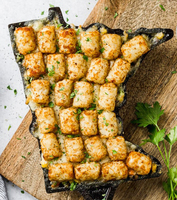
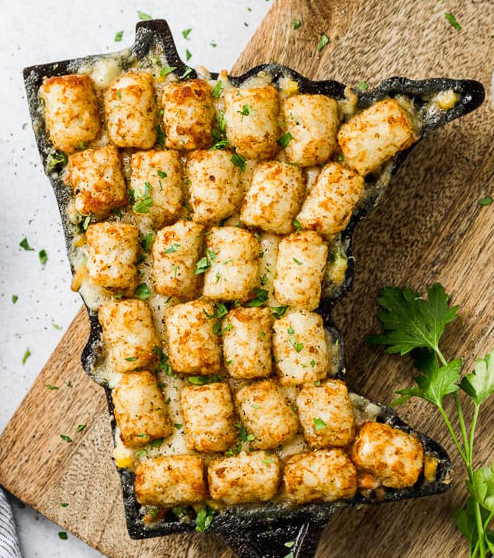
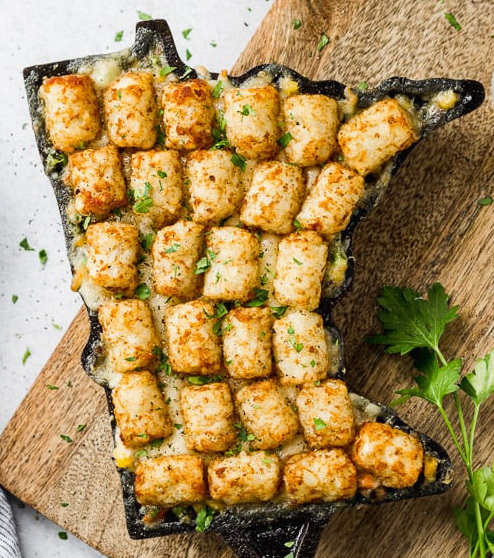
A baking dish shaped like the state of Minnesota filled with browned tater tots, with filling visible below them, against a cutting-board background.
A vegetarian tater tot hotdish featured in Fork in the Kitchen on September 6, 2015. Used with the permission of Becca Mills.

Hotdish is a Minnesota culinary institution. A traditional recipe typically consists of ground meat, a creamed soup, and a vegetable (usually canned), topped with tater tots and baked in an oven. Hotdish, however, is much more than a food: it is a cultural touchstone in the Upper Midwest, and an important part of how Minnesotans gather.

Every Minnesotan will tell you that hotdish is not a casserole—it just has casserole-like qualities. Inventive chefs and home cooks have adapted it over the years to suit different cuisines and preferences. In the 1930s and 1940s, they developed many of the elements we know and love today. Early hotdish recipes contained a meat; a starch such as noodles or rice; cheese; a vegetable; and soup cooked in an oven. It was a dish served at large gatherings (especially church luncheons) because it was cheap and easy to make.

The earliest known hotdish recipe comes from the 1930 cookbook of the Ladies Aid Society of the Grace Lutheran Church in Mankato, Minnesota. Contributed by C. W. Anderson, it calls for ground beef, tomato soup, Creamette pasta, and canned peas, baked in the oven at moderate heat. Other recipes from the period largely follow suit, but the type of meat, cheese, and soup can vary, highlighting the adaptive quality of the dish.

There is a misconception that hotdish originated among Swedish immigrants. The truth is more complicated. Some of the earliest hotdish recipes do come from the Swedish community, but the dish was also popular among other groups. All that can be said for certain is that hotdish comes from western Wisconsin, Minnesota, northern Iowa, and the eastern Dakotas—an area now christened Hotdish Country.

Hotdish was an easy, cost-effective meal to feed a large crowd, and in the midst of the Great Depression (1929–1940), these qualities were essential. Even for Americans who remained employed, cost was a major consideration in food choices. During this period, many cheap dishes—hotdish, creamed chipped beef, tuna noodle casserole, and peanut butter sandwiches—became part of the American diet.

After World War II, hotdish moved out of the church rec room and into Minnesotans’ kitchens and dining rooms. It served an important cultural purpose, not only as a dish served at social gatherings to express care, but as a recipe to be exchanged with both friends and strangers. Minnesotans served hotdish at bridal showers, funerals, political rallies, ethnic society events, dances, and, of course, church functions. Women exchanged hotdish recipes they found in cookbooks and newspapers, creating new connections and community.>

In the 1950s, hotdish acquired its iconic topping: tater tots. The Ore-Ida company first developed tater tots in 1953, and the product hit supermarkets in 1956. Tots were slow to connect with buyers but eventually developed a following, and by the 1960s, they were the go-to topping for hotdish. Some argue that a true hotdish must have tater tots.

In the twenty-first century, hotdish remained a beloved (though misunderstood by the uninitiated) piece of Minnesota culture. It maintained its cultural relevancy by remaining cheap, easy to prepare, and capable of feeding a large crowd. It is also proved adaptable—able to incorporate new cuisines and tastes as the demographics of Minnesota changed.

In 2011, Senator Al Franken instituted a hotdish cooking competition for the Minnesota congressional delegation. Starting in 2014, all ten members of the delegation participated. Senator Amy Klobuchar, Representative Tim Walz, and Representative Tom Emmer won the competition in 2011, 2016, and 2018, respectively. Representative Ilhan Omar won praise (and second place) for her “Little Moga-Hot-dishu” in 2019.

Recently, prominent Minnesota chefs have taken to making hotdish more in line with contemporary taste as well as more representative of the state. Food Network star and East Grand Forks resident Molly Yeh featured hotdish recipes in her blog and in her cookbook Molly on the Range, published in 2016. And in 2021, Chef Yia Vang contributed a Hmong hotdish recipe to the Food Network. Interviewed in 2020, Yang said, “Hotdish was created out of necessity. How do I feed a family of ten with one pound of meat? That is also the Hmong narrative....Hotdish tells the story of struggle and poverty, and that makes it soul food.”

First Published: October 15, 2026
Last Modified: October 15, 2026

Bibliography

Johnson, Patrice M. Land of 10,000 Plates: Stories and Recipes from Minnesota. Minnesota Historical Society Press, 2020.

Heffelfinger, Julia. “The History of Hot Dish.” Food & Wine, December 30, 2015.

“It’s More Than A Dish: A Conversation with Chef Yia Vang.” Hmong American Farmers Association, October 28, 2016.
https://www.hmongfarmers.com/2016/10/28/its-more-than-a-dish-a-conversation-with-chef-yia-vang

Miriam Society of Augustana Lutheran Church. Miriam Cook Book. Miriam Society of Augustana Lutheran Church, 1937.
https://americaate.org/object/164-590-3130

Roufs, Tim. “Hot Dish.” In We Eat What?: A Cultural Encyclopedia of Unusual Foods in the United States, edited by Jonathan Deutsch. Bloomsbury, 2018.

Smith, Andrew F. Food and Drink in American History: A Full Course Encyclopedia. Bloomsbury, 2013.

Swanson, Ulysses. “A Comparative History of Casseroles and Hot Dishes in American Foodways, 1912–1952.” Poster, Metro State University, St. Paul, April 10, 2025.
https://hotdishpasp.carrd.co

Wise, Michael D, and Jennifer Jensen Wallach, eds. The Routledge History of American Foodways. Routledge, 2016.

Related Resources

Primary

“The Annual Bible Vacation School.” Le Sueur News-Herald, May 26, 1943.
https://www.mnhs.org/newspapers/lccn/sn89064064/1943-05-26/ed-1/seq-1

“Bangor Farmers Club to Hear Report on Farm Bureau Convention.” Pelican Rapids Press, January 16, 1941.
https://www.mnhs.org/newspapers/lccn/sn89064364/1941-01-16/ed-1/seq-1

Burckhardt, Ann L. Hot Dish Heaven: Classic Casseroles from Midwest Kitchens. Minnesota Historical Society Press, 2006.

“Church News.” Duluth Herald, April 11, 1933.
https://www.mnhs.org/newspapers/lccn/sn83016458/1933-04-11/ed-1/seq-1

“Church News.” The St. Cloud Daily Times, October 7, 1944.
https://www.mnhs.org/newspapers/lccn/sn83016817/1944-10-07/ed-1/seq-1

“Household Forum.” St. Paul Pioneer Press, December 20, 1958.
https://newspaperhub.mnhs.org/?a=d&d=sppp19581220.1.1

“Household Forum.” St. Paul Pioneer Press, January 14, 1957.
https://newspaperhub.mnhs.org/?a=d&d=sppp19570114.1.1

“In Our Churches.” The Atwater Herald, September 21, 1950.
https://www.mnhs.org/newspapers/lccn/sn89064877/1950-09-21/ed-1/seq-1

“Mom and Dad and Daughter Party Planned.” The Duluth Herald, May 2, 1940.
https://www.mnhs.org/newspapers/lccn/sn83016458/1940-05-02/ed-1/seq-1

“Proctor Notes.” The Duluth Herald, May 17, 1949.
https://www.mnhs.org/newspapers/lccn/sn83016458/1949-05-17/ed-1/seq-1

“Seniors’ Problems to Be Discussed.” St. Paul Pioneer Press, February 1, 1959.
https://newspaperhub.mnhs.org/?a=d&d=sppp19590201.1.1

“Today’s Date Book.” St. Paul Pioneer Press, October 1, 1953.
https://newspaperhub.mnhs.org/?a=d&d=sppp19590201.1.1

Secondary

Mohr, Howard. How to Talk Minnesotan. Penguin Books, 2013.

Related Audio

MN90: Milestones in Minnesota Hotdish | Details

MN90: Milestones in Minnesota Hotdish

In 1930, hotdish got its print debut in a Mankato cookbook. Here’s MN90 producer Britt Aamodt with milestones in Minnesota hotdish history. 
© AMPERS    

All rights reserved

Related Images

A baking dish shaped like the state of Minnesota filled with browned tater tots, with filling visible below them, against a cutting-board background.
A vegetarian tater tot hotdish featured in Fork in the Kitchen on September 6, 2015. Used with the permission of Becca Mills.
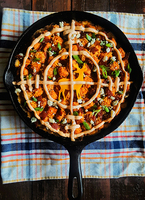
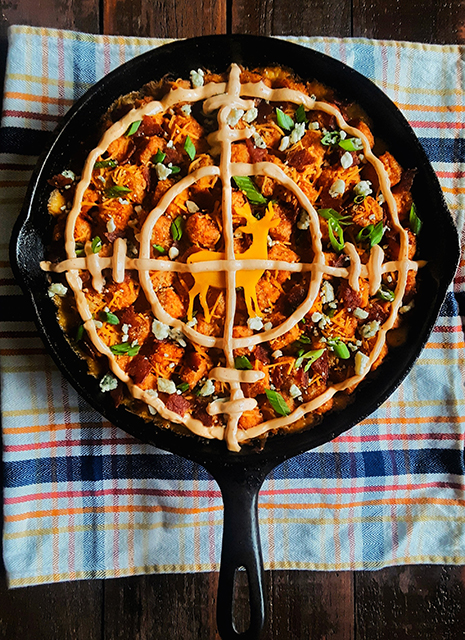
Lines of light-orange condiment arranged in the design of gun cross-hairs sit atop a hotdish in a black cast-iron skillet on top of a checkered cloth.
Blaze Orange buffalo turkey hotdish with loaded sweet potato tots. Photograph by Crystal Schlueter. From Schlueter's End of the Road Cookbook (Minnesota Historical Society Press, 2026), 124.
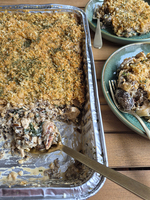
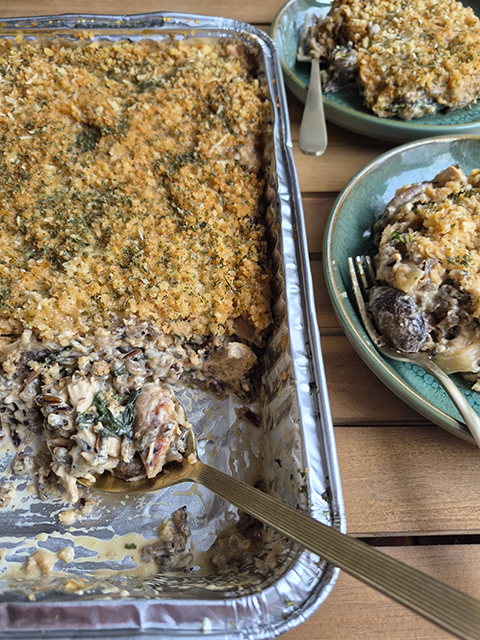
A metal tray of hotdish with a spoonful at left, and two plates of the food at right.

Photograph by Crystal Schlueter. From Schlueter's End of the Road Cookbook (Minnesota Historical Society Press, 2026), 126.

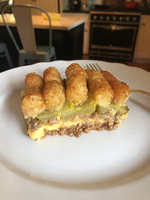
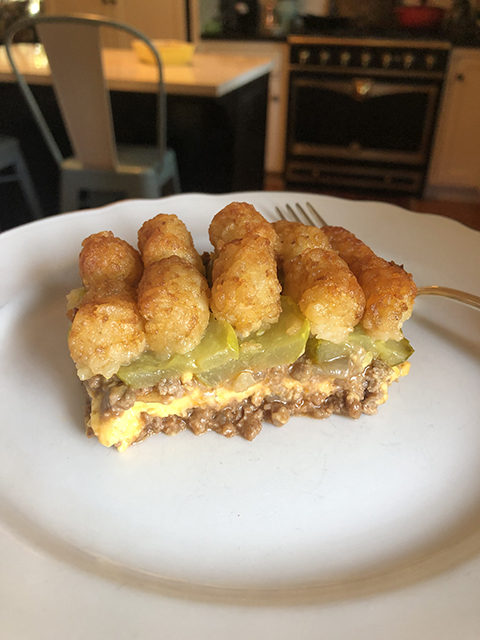
A serving of tater tot hotdish (showing its layers of ground meat, cheese, pickles, and tater tots) sits atop a white plate, with a kitchen scene in the background.
A serving of Juicy Lucy Tater Tot Hotdish showing layers of tater tots, pickles, ground beef, and cheese. Photograph by Sarah Peterson, 2021. From Peterson's Dish and Tell (Minnesota Historical Society Press), 64.
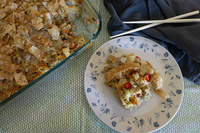
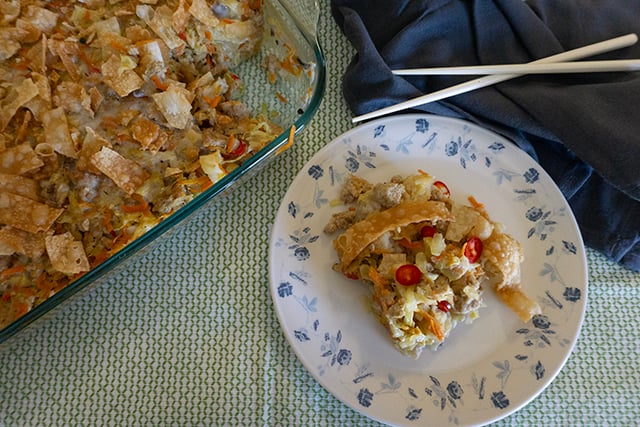
A serving of hot dish sits on a white, flower-sprigged plate next to a baking dish with more hotdish inside.
Minnesota State Representative Betty McCollum’s Hotdish A-Hmong Us. From Land of 10,000 Plates (Minnesota Historical Society Press, 2020), 26. Photo by Patrice M. Johnson.
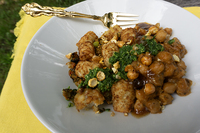
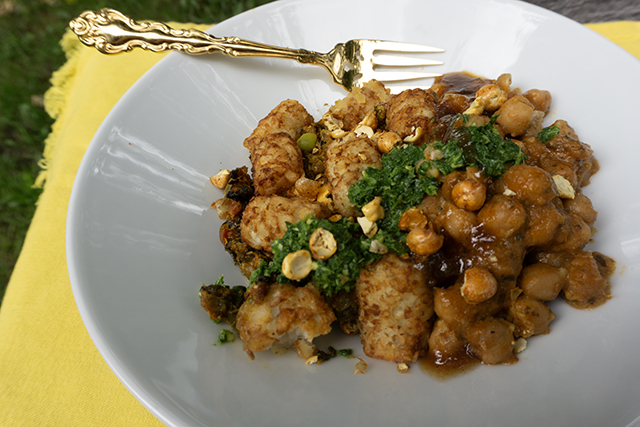
A serving of hot dish and a green sauce sit on top of a white plate, with a metal fork at the top left.
Ilhan Omar’s Little Moga-Hot-dishu. From Land of 10,000 Plates (Minnesota Historical Society Press, 2020), 27. Photo by Patrice M. Johnson.
A baking dish shaped like the state of Minnesota filled with browned tater tots, with filling visible below them, against a cutting-board background.

Vegetarian tater tot hotdish

A vegetarian tater tot hotdish featured in Fork in the Kitchen on September 6, 2015. Used with the permission of Becca Mills.
© Becca Mills    

All rights reserved

Holding Location

Fork in the Kitchen (blog)
Lines of light-orange condiment arranged in the design of gun cross-hairs sit atop a hotdish in a black cast-iron skillet on top of a checkered cloth.

Blaze Orange buffalo turkey hotdish

Blaze Orange buffalo turkey hotdish with loaded sweet potato tots. Photograph by Crystal Schlueter. From Schlueter's End of the Road Cookbook (Minnesota Historical Society Press, 2026), 124.
© Crystal Schlueter    

All rights reserved

A metal tray of hotdish with a spoonful at left, and two plates of the food at right.

Chicken Alfredo Wild Rice Hotdish

Photograph by Crystal Schlueter. From Schlueter's End of the Road Cookbook (Minnesota Historical Society Press, 2026), 126.

© Crystal Schlueter    

All rights reserved

A serving of tater tot hotdish (showing its layers of ground meat, cheese, pickles, and tater tots) sits atop a white plate, with a kitchen scene in the background.

Juicy Lucy Tater Tot Hotdish

A serving of Juicy Lucy Tater Tot Hotdish showing layers of tater tots, pickles, ground beef, and cheese. Photograph by Sarah Peterson, 2021. From Peterson's Dish and Tell (Minnesota Historical Society Press), 64.
© Sarah Peterson    

All rights reserved

A serving of hot dish sits on a white, flower-sprigged plate next to a baking dish with more hotdish inside.

Hotdish A-Hmong Us

Minnesota State Representative Betty McCollum’s Hotdish A-Hmong Us. From Land of 10,000 Plates (Minnesota Historical Society Press, 2020), 26. Photo by Patrice M. Johnson.
© Patrice M. Johnson    

All rights reserved

A serving of hot dish and a green sauce sit on top of a white plate, with a metal fork at the top left.

Little Moga-Hot-dishu

Ilhan Omar’s Little Moga-Hot-dishu. From Land of 10,000 Plates (Minnesota Historical Society Press, 2020), 27. Photo by Patrice M. Johnson.
© Patrice M. Johnson    

All rights reserved

Chronology

1930
The earliest known hotdish recipe is published in the Ladies Aid Society of the Grace Lutheran Church in Mankato, Minnesota Cookbook. The recipe calls for ground beef, tomato soup, Creamette pasta, and canned peas.
1930–1945
Hotdish is a niche recipe in western Wisconsin, Minnesota, northern Iowa, and the eastern Dakotas. It grows in popularity because it is cheap to make and feeds a large crowd.
1945 onward
Hotdish becomes more widespread in the Upper Midwest. It is an important part of social gatherings.
1956
The Ore-Ida company introduces tater-tots. Cooks across the Upper-Midwest adopt it as a crunchy topping for hotdish.
2011
Senator Al Franken institutes an annual hotdish cooking competition for the MInnesota congressional delegation.
2016
Food Network chef Molly Yeh features a hotdish recipe in her cookbook Molly on the Range.
2016
Chef Yia Vang demonstrates how to make a Hmong hotdish during a presentation at the Minnesota State Fair.
2019
State Representative Ilhan Omar wins second place in the congressional competition for her “Little Moga-Hot-dishu,” which uses cumin, turmeric, garam masala, and ground beef or lamb.
2021
Chef Vang debuts his recipe for Hmong hotdish during an appearance on the Food Network.

Bibliography

Johnson, Patrice M. Land of 10,000 Plates: Stories and Recipes from Minnesota. Minnesota Historical Society Press, 2020.

Heffelfinger, Julia. “The History of Hot Dish.” Food & Wine, December 30, 2015.

“It’s More Than A Dish: A Conversation with Chef Yia Vang.” Hmong American Farmers Association, October 28, 2016.
https://www.hmongfarmers.com/2016/10/28/its-more-than-a-dish-a-conversation-with-chef-yia-vang

Miriam Society of Augustana Lutheran Church. Miriam Cook Book. Miriam Society of Augustana Lutheran Church, 1937.
https://americaate.org/object/164-590-3130

Roufs, Tim. “Hot Dish.” In We Eat What?: A Cultural Encyclopedia of Unusual Foods in the United States, edited by Jonathan Deutsch. Bloomsbury, 2018.

Smith, Andrew F. Food and Drink in American History: A Full Course Encyclopedia. Bloomsbury, 2013.

Swanson, Ulysses. “A Comparative History of Casseroles and Hot Dishes in American Foodways, 1912–1952.” Poster, Metro State University, St. Paul, April 10, 2025.
https://hotdishpasp.carrd.co

Wise, Michael D, and Jennifer Jensen Wallach, eds. The Routledge History of American Foodways. Routledge, 2016.

Related Resources

Primary

“The Annual Bible Vacation School.” Le Sueur News-Herald, May 26, 1943.
https://www.mnhs.org/newspapers/lccn/sn89064064/1943-05-26/ed-1/seq-1

“Bangor Farmers Club to Hear Report on Farm Bureau Convention.” Pelican Rapids Press, January 16, 1941.
https://www.mnhs.org/newspapers/lccn/sn89064364/1941-01-16/ed-1/seq-1

Burckhardt, Ann L. Hot Dish Heaven: Classic Casseroles from Midwest Kitchens. Minnesota Historical Society Press, 2006.

“Church News.” Duluth Herald, April 11, 1933.
https://www.mnhs.org/newspapers/lccn/sn83016458/1933-04-11/ed-1/seq-1

“Church News.” The St. Cloud Daily Times, October 7, 1944.
https://www.mnhs.org/newspapers/lccn/sn83016817/1944-10-07/ed-1/seq-1

“Household Forum.” St. Paul Pioneer Press, December 20, 1958.
https://newspaperhub.mnhs.org/?a=d&d=sppp19581220.1.1

“Household Forum.” St. Paul Pioneer Press, January 14, 1957.
https://newspaperhub.mnhs.org/?a=d&d=sppp19570114.1.1

“In Our Churches.” The Atwater Herald, September 21, 1950.
https://www.mnhs.org/newspapers/lccn/sn89064877/1950-09-21/ed-1/seq-1

“Mom and Dad and Daughter Party Planned.” The Duluth Herald, May 2, 1940.
https://www.mnhs.org/newspapers/lccn/sn83016458/1940-05-02/ed-1/seq-1

“Proctor Notes.” The Duluth Herald, May 17, 1949.
https://www.mnhs.org/newspapers/lccn/sn83016458/1949-05-17/ed-1/seq-1

“Seniors’ Problems to Be Discussed.” St. Paul Pioneer Press, February 1, 1959.
https://newspaperhub.mnhs.org/?a=d&d=sppp19590201.1.1

“Today’s Date Book.” St. Paul Pioneer Press, October 1, 1953.
https://newspaperhub.mnhs.org/?a=d&d=sppp19590201.1.1

Secondary

Mohr, Howard. How to Talk Minnesotan. Penguin Books, 2013.