Red Wing Pottery

Creator:
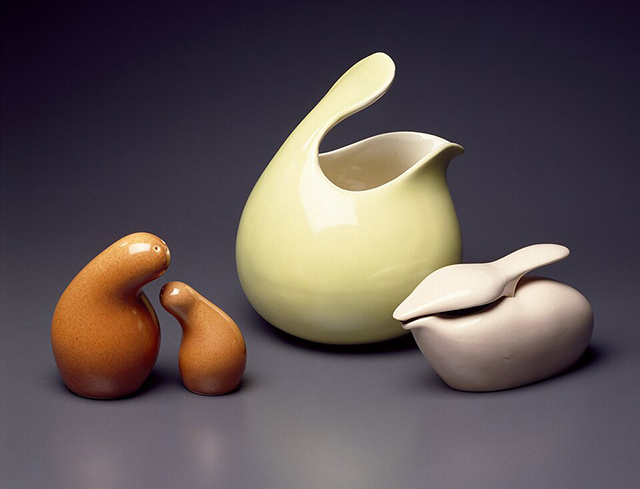
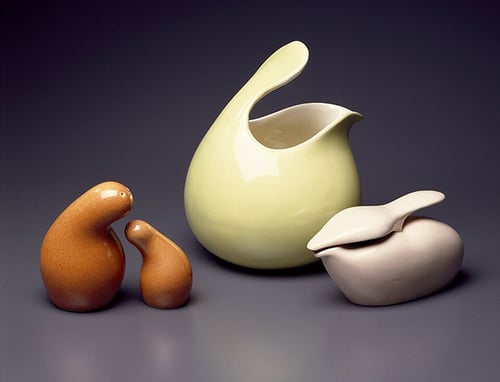
Orange salt-and-pepper shakers, a yellow pitcher, and a taupe oil pourer in fluid, round shapes sit against an indigo background.
Samples of Eva Zeisel’s “Town and Country” collection for Red Wing Pottery, 1945.

The pottery produced in Red Wing is a tangible, material record of Minnesota’s history. In the late nineteenth century, Red Wing stoneware supported agriculture. In the early twentieth century, Red Wing ceramic art decorated houses and apartments. And after World War II, Red Wing dinnerware fueled the domestic imaginations of postwar families. In this way, the pottery influenced how Minnesotans lived, worked, and created the idea of “home.” It endures in museum archives and private collections in the twenty-first century and remains popular as everyday vintage dinnerware and decor.


Red Wing pottery is literally Minnesota. Indigenous people have used the clay of the Upper Mississippi River to make ceramic vessels since at least the Late Woodland period, 500 BCE–1000 CE. Settlers in the region (many of them English and German immigrants) began using clay soil on their properties to make stoneware in the 1860s. The first commercial pottery workshop, the Red Wing Terra Cotta Works, opened in 1868, moving to St. Paul in 1880.

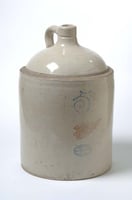
In 1877, the Red Wing Stoneware Company was formed to mass-produce pottery. The new company made an array of durable stoneware that found numerous uses in agriculture: crocks for storage, laundry, or dyeing; jugs for keeping liquids; jars for preserving food; butter churns; spittoons; water coolers; and feeders for poultry. The successful business inspired competitors. Within fifteen years, two rival enterprises (Minnesota Stoneware and North Star Stoneware) emerged in Red Wing, then joined forces as Union Stoneware in 1894. In 1906, the two remaining firms merged to form the Red Wing Union Stoneware Company and cultivated a national market by shipping their goods on trains around the country.

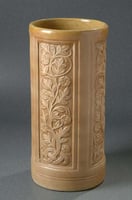
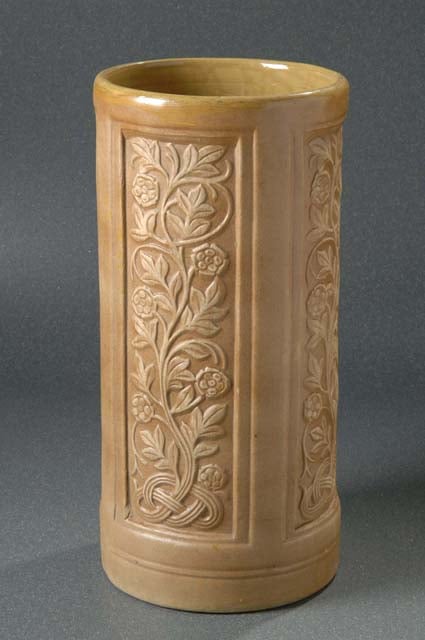
The potters of Red Wing showed a remarkable ability to change with the times. After World War I, more people than ever lived in cities, decreasing demand for agricultural stoneware. In response, Red Wing potters joined the art pottery movement, making objects that were decorative, functional, and beautiful all at once: colorful vases, ornate jardinières, sculpted planters, brushware umbrella stands, and whimsical sculptures. Neutral-colored glazes coated most early Red Wing stoneware, but as art pottery swept the nation, potters applied vibrant and exuberant glazes to their new designs.

Red Wing Potteries, Inc., the company’s new and final name after 1936, worked with three leading midcentury designers to diversify their offerings: Charles Murphy, Belle Kogan, and Eva Zeisel. Each designer’s unique creations—particularly Zeisel’s flowing and whimsical dinnerware—shaped the company’s product lines and created lasting impressions with consumers.

In the 1930s and 1940s, the company introduced hand-painted lines of dinnerware. In 1947, however, it discontinued agricultural stoneware. For the next two decades, hundreds of employees created dinnerware (plates, cups, salt and pepper shakers, pitchers) and art pottery. Red Wing produced dozens of patterns of dinnerware in several price ranges, helping families serve meals across the country. By the 1960s, Red Wing produced more than a million pieces of dinnerware and art pottery per year.

In the late 1940s, the company became an all-union shop. Most of the workers shaping, throwing, and firing the pieces were men. Women, meanwhile, worked mainly in administration and as painters and designers, hand-painting the final flourishes on pottery before firing. Some even went off book and added their own flair to patterns, like a worm emerging from an apple.

In the decades after World War II, Red Wing Potteries faced numerous headwinds. First, imported ceramics, especially lower-priced Japanese dinnerware, eroded Red Wing's market share. Second, sales of Red Wing pottery in department stores sagged throughout the 1950s and 1960s, creating lean years for the company. Third, management doubled down on popular dinnerware sets, especially the Pepe and Bob White lines, by commencing riskier sales in supermarkets, where customers bought fewer pieces, expected lower prices, and were unfamiliar with Red Wing. Finally, new management tried to shrink the workforce and cut costs.

Red Wing Potteries, Inc. closed permanently in 1967 during a labor strike over wages, health insurance, and benefits. Management had previously lambasted the union, including in a full-page newspaper ad in 1950. While the labor disagreement proved an acute crisis, declining sales, an aging factory, and the loss of market share also likely doomed the company in the long term.

Major museums around the world showcase Red Wing pottery, including the Minnesota Historical Society, the British Museum, the Metroplitan Museum of Art, the Museum of Modern Art, the Brooklyn Museum, and the Cooper Hewitt, Smithsonian Design Museum.

First Published: September 18, 2026
Last Modified: September 18, 2026

Bibliography

Albrecht, Arlin. “Potteries Is Dead.” Daily Republican Eagle (Red Wing), August 25, 1967.

Austin, G. S. “Geology of Clay Deposits Red Wing Area, Goodhue and Wabasha Counties, Minnesota.” Minnesota Geological Survey, 1963.

“Crockery” [advertisement]. The Commonwealth (Warroad), March 6, 1903.

“Desperate Final Bid Fails.” Daily Republican Eagle (Red Wing), August 25, 1967.

Freeberg, Ron. “Forecast of Doom Came in 1957.” Daily Republican Eagle (Red Wing), August 25, 1967.

——— . “Strikers Unsure of Next Move.” Daily Republican Eagle (Red Wing), August 25, 1967.

Gibbon, Guy. Archaeology of Minnesota: The Prehistory of the Upper Mississippi River Region. University of Minnesota Press, 2012.

Gillmer, Richard S. Red Wing Potteries: Death of a Business. Ross & Haines, Inc., 1968.

Grout, Frank F. “Clays and Shales of Minnesota.” United States Geological Survey Bulletin 678, 1919.

“Local News.” The Advance Sun (Red Wing), January 18, 1893.

“Local News.” Red Wing Republican, May 22, 1895.

“Mineral Future of Minnesota.” St. Paul Daily Globe, November 26, 1891.

Northern Natural Gas Company. “Pottery by Red Wing.” Transmission no. 1 (1964): 16–19.

Rasmussen, Christian A. A History of the City of Red Wing, Minnesota. Red Wing Advertising Company, 1933.

Red Wing Potteries records, 1894–1978
Manuscripts Collection, Minnesota Historical Society, St. Paul
Description: Financial and legal records alongside advertising and art materials.
https://storage.googleapis.com/mnhs-finding-aids-public/library/findaids/p0629.html

“Red Wing Potteries.” Zumbrota News, September 7, 1967.

“Red Wing Pottery at Chicago Exhibit.” The Organized Farmer, January 19, 1922.

“Red Wing Pottery Strike Averted.” St. Paul Pioneer Press, May 8, 1948.

Schmeckebier, Lawrence. Art in Red Wing. University of Minnesota Press, 1946.

Schouweiler, Sarah Mellinger. “Red Wing, Haven of Beautiful Pottery.” Golfer and Sportsman including Northwestern Life 19, no. 11 (November 1946): 16–17, 27.

Smalley, Alton. “Chalking Up More Longevity Records.” The Atwater Herald, February 12, 1953.

Smith, G. Hubert. "Minnesota Potteries: From Pioneer Craft to Modern Factory." Minnesota History 33, no. 6 (Summer 1953): 231–232.
https://www.collections.mnhs.org/MNHistoryMagazine/articles/33/v33i06p229-235.pdf

“The Red Wing Union Stoneware Company.” The Minneapolis Morning Tribune, April 30, 1918.

“Violinist in City Symphony to Head Red Wing Potteries.” Rochester Post–Bulletin, September 30, 1955.

Vincent, Stephanie. “‘A Bull in Our China Shop:’ Japanese Imports and the American Pottery Industry.” Enterprise & Society 19, no. 2 (2018): 430–68.

Related Resources

Secondary

Zeisel, Eva. On Design: The Magic Language of Things. Overlook Press, 2004.

Collector and Hobbyist Writings

Moran, Mark. Warman’s Red Wing Pottery Identification and Price Guide. KP Books, 2005.

Reiss, Ray. Red Wing Dinnerware: Price and Identification Guide. Property Publishing, 1997.

——— . Red Wing Art Pottery: Classic American Pottery from the 30s, 40s, 50s, and 60s: Including Pottery Made for Rum Rill. Property Publishing, 1996.

——— . Red Wing Art Pottery Two. Property Publishing, 1999.

Viel, Lyndon C. The Clay Giants: The Stoneware of Red Wing, Goodhue County, Minnesota, Book I. Wallace–Homestead Book Company, 1977.

——— . The Clay Giants: The Stoneware of Red Wing, Goodhue County, Minnesota, Book II. Wallace–Homestead Book Company, 1980.

——— . The Clay Giants: The Stoneware of Red Wing, Goodhue County, Minnesota, Book III. Wallace-Homestead Book Company, 1987.

Related Images
Orange salt-and-pepper shakers, a yellow pitcher, and a taupe oil pourer in fluid, round shapes sit against an indigo background.
Samples of Eva Zeisel’s “Town and Country” collection for Red Wing Pottery, 1945.
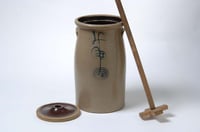
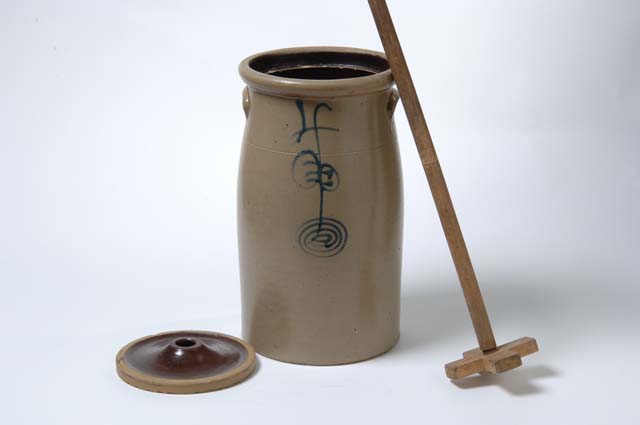
A cylindrical, narrow-lipped vessel stands against a gray background with a lid to the left and a wooden stick to the right.
Minnesota Stoneware Company four-gallon, salt-glazed butter churn, ca. 1883–1906.
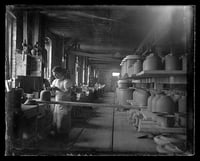
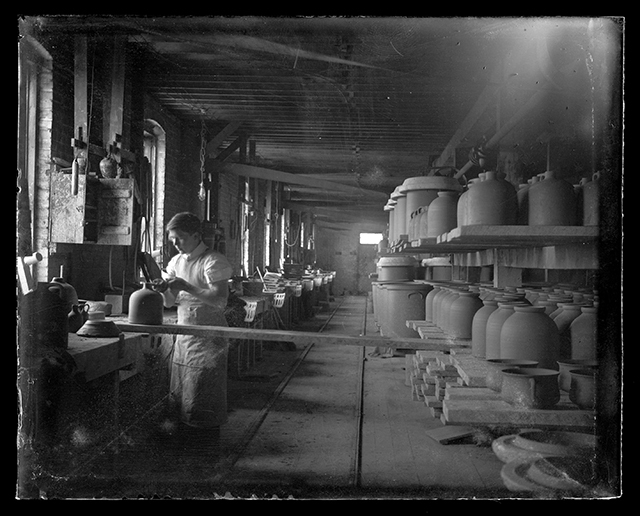
A worker stands inside a pottery storage room with windows on the left and ceramic vessels on the right, and a track leading through the center of the image into the backgroundd.
A worker inside North Star Stoneware Company, Red Wing, 1896. 
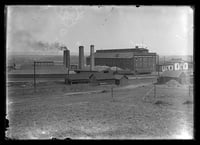
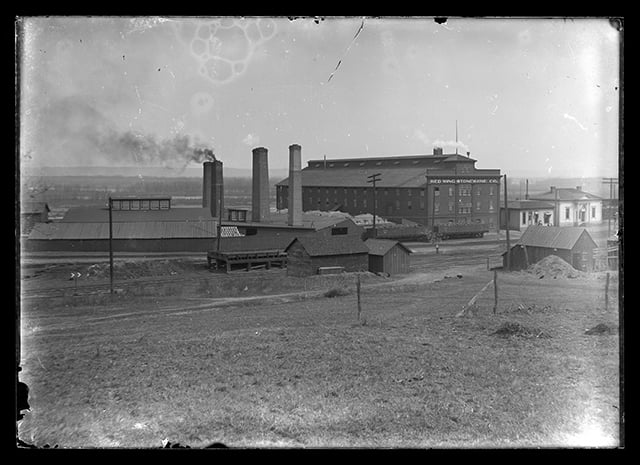
A five-story brick building sits at center with utility buildings to the right and smokestacks to the left.
The factory of the Red Wing Stoneware Company, ca. 1905.
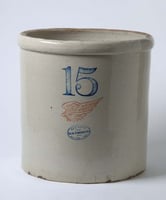
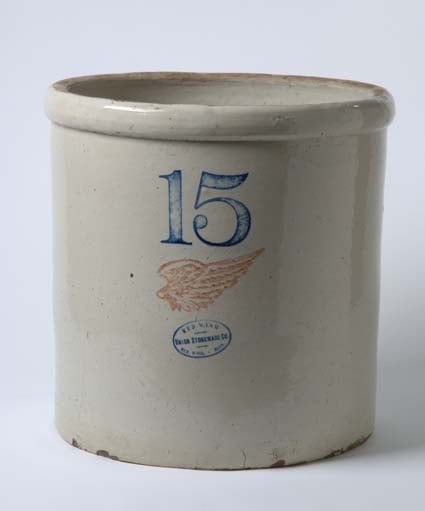
A dove-gray ceramic cylinder with the numeral 15 and a red wing image stamped on it sits in front of a lighter gray background.
A fifteen-gallon crock produced by Red Wing Union Stoneware Company, ca. 1908–1936.
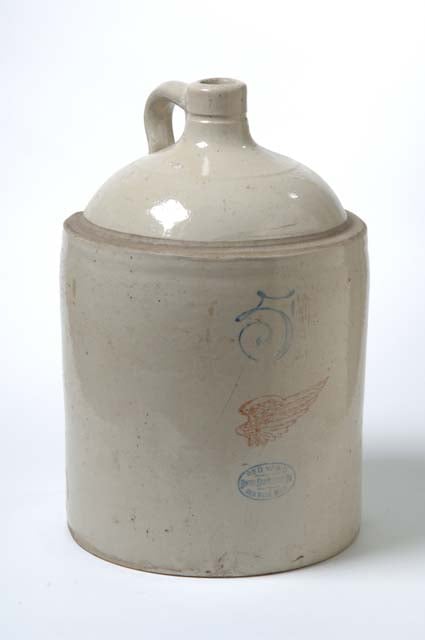
A cylindrical jug with a round top leading to a grooved spout and a handle.
Red Wing Union Stoneware Company five-gallon, white, glazed shoulder jug with trademark red wing decoration, ca. 1908–1936.
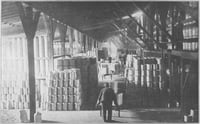
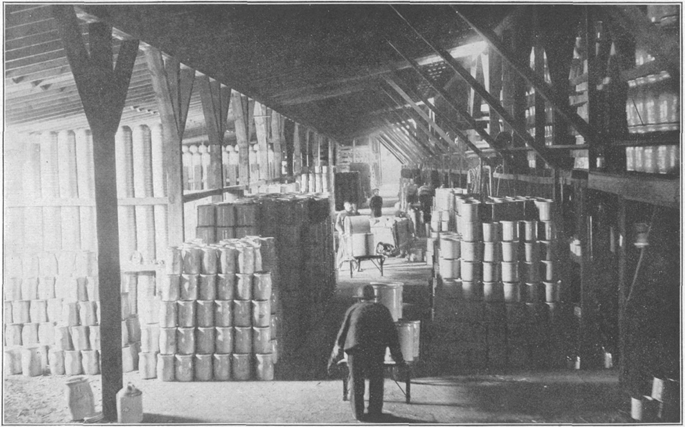
A worker in the foreground pushes a wheelbarrow down an aisle that leads between pyramidal stacks of ceramic containers.
A multitudes of crocks, butter churns, lids, and other stoneware stacked inside Red Wing Union Stoneware Company, 1919. From Frank F. Grout, “Clays and Shales of Minnesota,” United States Geological Survey Bulletin 678, 1919, plate XV.
Tan ceramic cylinder with panels of relief carvings of vines.
Red Wing Union Stoneware Company ceramic umbrella stand in bronze-tan brushedware glaze, ca. 1920s–1930s.
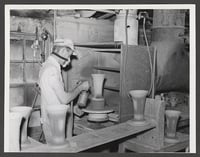
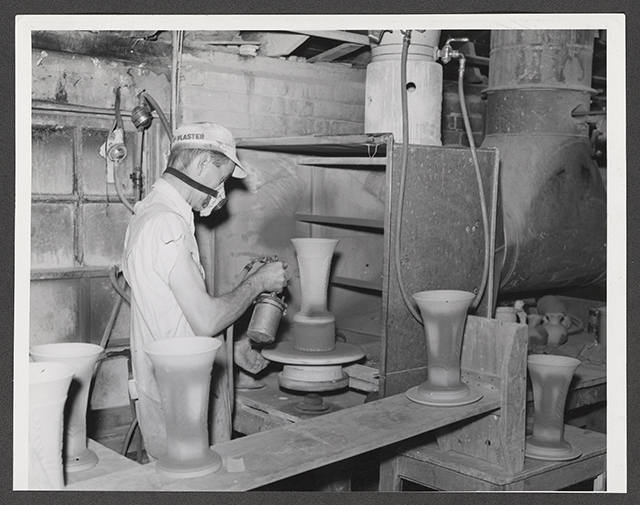
A worker wearing a brimmed cap and a respirator mask sprays glaze on a ceramic vase.
A Red Wing Potteries worker sprays glaze onto a ceramic vase, ca. 1940.
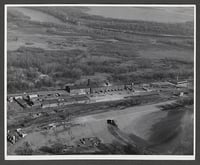
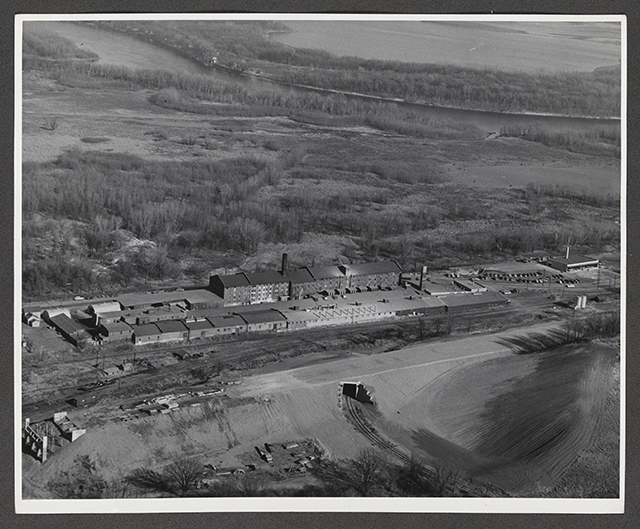
A bird's-eye view of a sprawling factory with buildings arranged into a narrow rectangle, with wooded land in the background.
An aerial view of the Red Wing Potteries factory, ca. 1940.
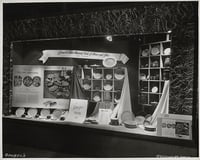
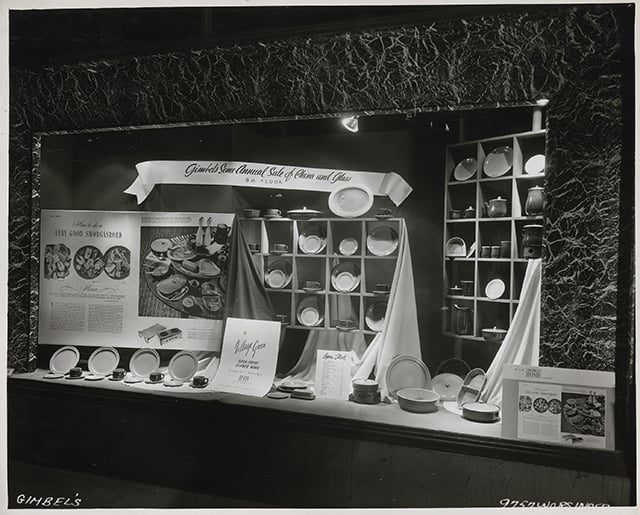
Ceramic plates in recessed boxes and on a lower shelf sit behind a pane of glass.
Red Wing Potteries' window display in Gimbel's department store in New York City, ca 1942.
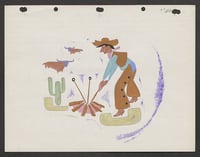
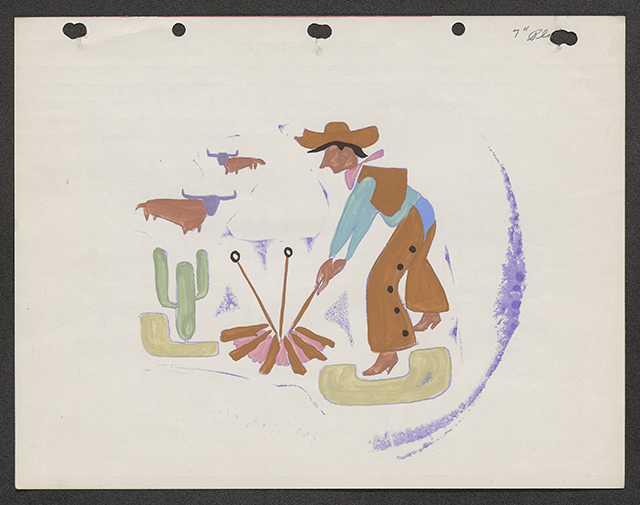
Watercolor painting of a cowboy in hat, vest, boots, and spurs tending a fire beside a cactus and two horned bulls.
Watercolor painting of a design for a seven-inch plate with the Round Up pattern. From box 14 of Red Wing Potteries records, 1894–1978. Manuscripts Collection, Minnesota Historical Society.
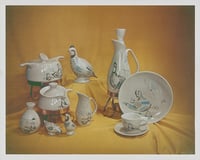
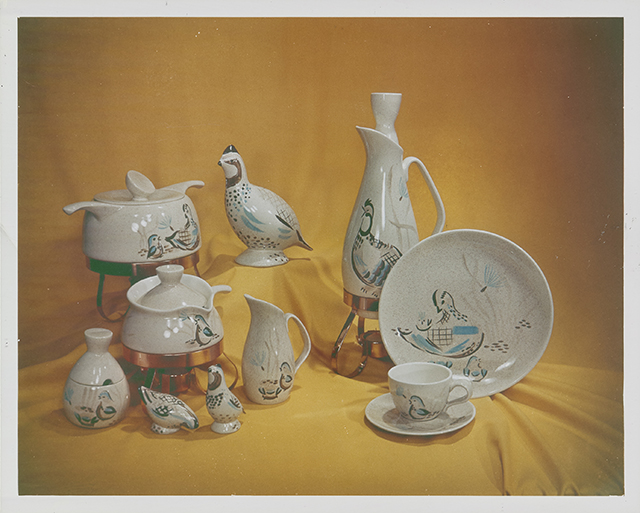
White ceramic items sit staged against a yellow cloth backdrop.
An advertising photograph of the Bob White pattern against a yellow backdrop. From box 14 of Red Wing Potteries records, 1894–1978. Manuscripts Collection, Minnesota Historical Society.
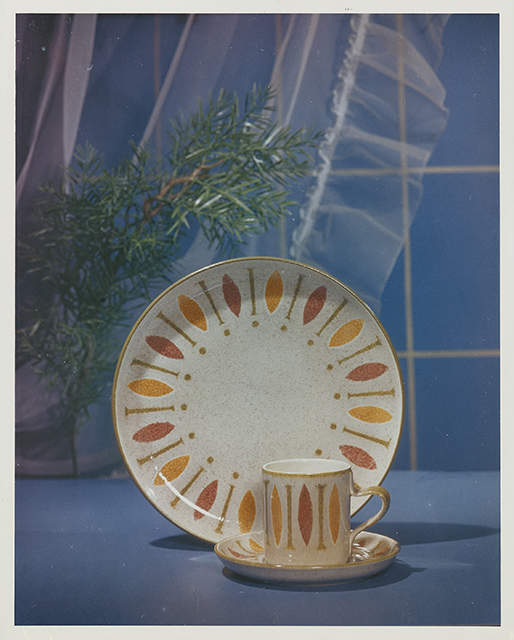
Ceramic plate and mug on a saucer with red and orange ovals on a blue surface with a white drape and green foliage in the background.
An advertising photograph of a plate, cup, and saucer in the Pepe pattern. From box 14 of Red Wing Potteries records, 1894–1978. Manuscripts Collection, Minnesota Historical Society.
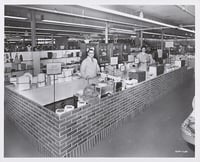
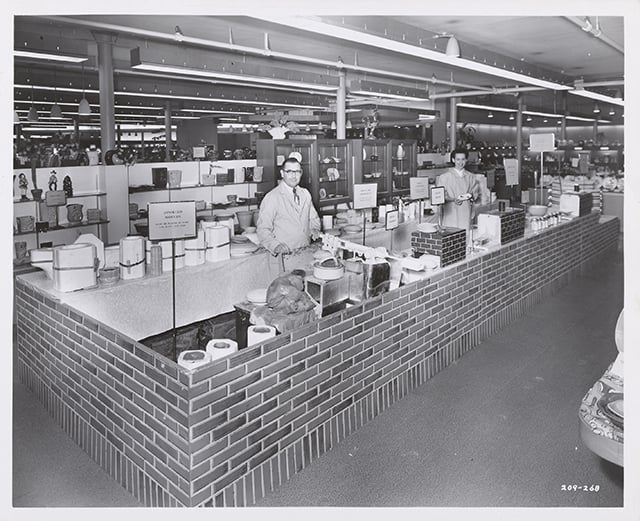
Two workers stand at sales counters behind a faux-brick wall.
Red Wing Potteries display and exhibit at Dayton's department store, Minneapolis, ca. 1950.
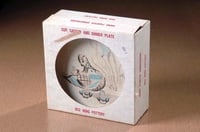
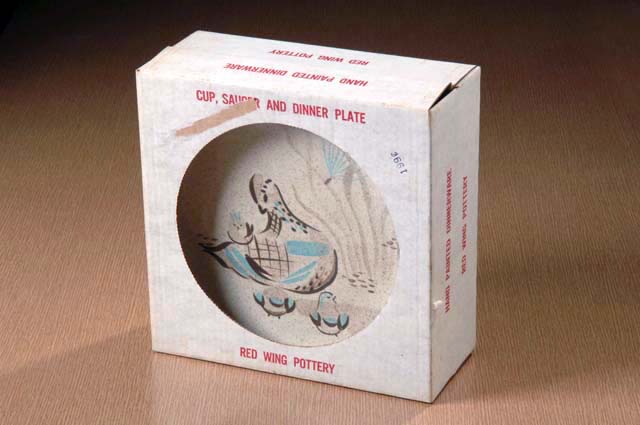
A ceramic plate is visible through an opening in a white box with red lettering against a coral background.
A partial place setting of Red Wing’s hand-painted Bob White pattern. Designed by Charles Murphy and manufactured between 1956 and 1967.
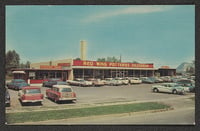
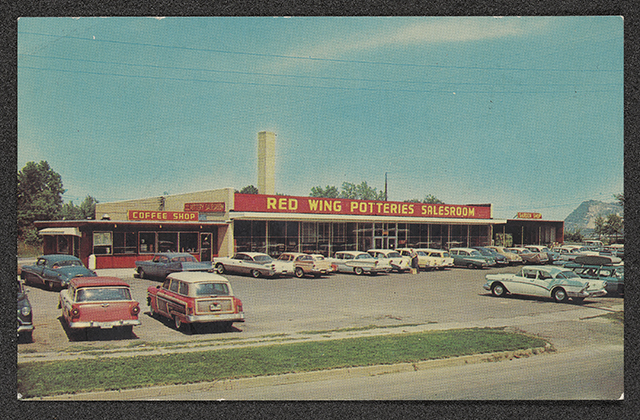
1950s-style cars sit in a parking lot in front of a single-story building with the words "Red Wing Potteries Salesroom" painted on the front facade.
The Red Wing Potteries Salesroom in Red Wing, Minnesota, ca. 1958. The company also had stores in Rapid City, South Dakota, and Chicago.
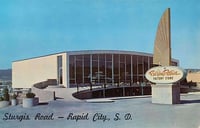
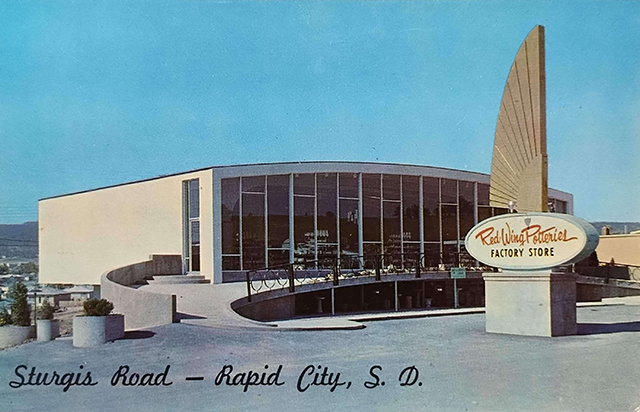
A building in a mid-twentieth-century modern style with floor-to-ceiling windows in front of a blue sky.
Color postcard showing the Red Wing Potteries factory store in Rapid City, South Dakota, ca. 1960s.
Orange salt-and-pepper shakers, a yellow pitcher, and a taupe oil pourer in fluid, round shapes sit against an indigo background.

Red Wing Pottery ceramics by Eva Zeisel

Samples of Eva Zeisel’s “Town and Country” collection for Red Wing Pottery, 1945.

Holding Location

Wikimedia Commons

Source

Brooklyn Museum
A cylindrical, narrow-lipped vessel stands against a gray background with a lid to the left and a wooden stick to the right.

Butter churn

Minnesota Stoneware Company four-gallon, salt-glazed butter churn, ca. 1883–1906.

Holding Location

Minnesota Historical Society
A worker stands inside a pottery storage room with windows on the left and ceramic vessels on the right, and a track leading through the center of the image into the backgroundd.

Interior of North Star Stoneware Company

A worker inside North Star Stoneware Company, Red Wing, 1896. 

Holding Location

Minnesota Historical Society
A five-story brick building sits at center with utility buildings to the right and smokestacks to the left.

Red Wing Stoneware Company

The factory of the Red Wing Stoneware Company, ca. 1905.

Holding Location

Minnesota Historical Society
A dove-gray ceramic cylinder with the numeral 15 and a red wing image stamped on it sits in front of a lighter gray background.

Fifteen-gallon crock

A fifteen-gallon crock produced by Red Wing Union Stoneware Company, ca. 1908–1936.

Holding Location

Minnesota Historical Society
A cylindrical jug with a round top leading to a grooved spout and a handle.

Five-gallon jug

Red Wing Union Stoneware Company five-gallon, white, glazed shoulder jug with trademark red wing decoration, ca. 1908–1936.

Holding Location

Minnesota Historical Society
A worker in the foreground pushes a wheelbarrow down an aisle that leads between pyramidal stacks of ceramic containers.

Interior of Red Wing Union Stoneware Company

A multitudes of crocks, butter churns, lids, and other stoneware stacked inside Red Wing Union Stoneware Company, 1919. From Frank F. Grout, “Clays and Shales of Minnesota,” United States Geological Survey Bulletin 678, 1919, plate XV.

Holding Location

USGS Publications Warehouse
Tan ceramic cylinder with panels of relief carvings of vines.

Ceramic umbrella stand

Red Wing Union Stoneware Company ceramic umbrella stand in bronze-tan brushedware glaze, ca. 1920s–1930s.

Holding Location

Minnesota Historical Society
A worker wearing a brimmed cap and a respirator mask sprays glaze on a ceramic vase.

Worker applying glaze to a ceramic vase

A Red Wing Potteries worker sprays glaze onto a ceramic vase, ca. 1940.

Holding Location

Minnesota Historical Society
A bird's-eye view of a sprawling factory with buildings arranged into a narrow rectangle, with wooded land in the background.

Aerial view of Red Wing Potteries

An aerial view of the Red Wing Potteries factory, ca. 1940.

Holding Location

Minnesota Historical Society
Ceramic plates in recessed boxes and on a lower shelf sit behind a pane of glass.

Red Wing Potteries' window display

Red Wing Potteries' window display in Gimbel's department store in New York City, ca 1942.

Holding Location

Minnesota Historical Society
Watercolor painting of a cowboy in hat, vest, boots, and spurs tending a fire beside a cactus and two horned bulls.

Design sketch for Round Up pattern

Watercolor painting of a design for a seven-inch plate with the Round Up pattern. From box 14 of Red Wing Potteries records, 1894–1978. Manuscripts Collection, Minnesota Historical Society.

Holding Location

Minnesota Historical Society
White ceramic items sit staged against a yellow cloth backdrop.

Ceramics set in the Bob White pattern

An advertising photograph of the Bob White pattern against a yellow backdrop. From box 14 of Red Wing Potteries records, 1894–1978. Manuscripts Collection, Minnesota Historical Society.

Holding Location

Minnesota Historical Society
Ceramic plate and mug on a saucer with red and orange ovals on a blue surface with a white drape and green foliage in the background.

Ceramics set in the Pepe pattern

An advertising photograph of a plate, cup, and saucer in the Pepe pattern. From box 14 of Red Wing Potteries records, 1894–1978. Manuscripts Collection, Minnesota Historical Society.

Holding Location

Minnesota Historical Society
Two workers stand at sales counters behind a faux-brick wall.

Red Wing Potteries display in Dayton’s

Red Wing Potteries display and exhibit at Dayton's department store, Minneapolis, ca. 1950.

Holding Location

Minnesota Historical Society
A ceramic plate is visible through an opening in a white box with red lettering against a coral background.

Partial place setting in Bob White pattern

A partial place setting of Red Wing’s hand-painted Bob White pattern. Designed by Charles Murphy and manufactured between 1956 and 1967.

Holding Location

Minnesota Historical Society
1950s-style cars sit in a parking lot in front of a single-story building with the words "Red Wing Potteries Salesroom" painted on the front facade.

Red Wing Potteries salesroom

The Red Wing Potteries Salesroom in Red Wing, Minnesota, ca. 1958. The company also had stores in Rapid City, South Dakota, and Chicago.

Holding Location

Minnesota Historical Society
A building in a mid-twentieth-century modern style with floor-to-ceiling windows in front of a blue sky.

Red Wing Potteries factory store in Rapid City

Color postcard showing the Red Wing Potteries factory store in Rapid City, South Dakota, ca. 1960s.

Holding Location

Personal collection of Alex Magnolia

Turning Point

Facing market headwinds in 1967, the management of Red Wing Potteries, Inc. and its labor union are unable to agree to terms. The company closes its doors for good after nearly a century in operation.

Chronology

Cretaceous period
Between 145 and 66 million years ago, ancient seas and lakes deposit fine clay sediment across what would become Minnesota.
500 BCE–1000 CE
During the Late Woodland period, Indigenous people (including the ancestors of Dakota people) use the rich clay of the Mississippi River valley to make pottery.
1851
Dakota and US leaders sign two treaties that transfer about 24,000,000 acres of Dakota homeland to the US, including the area that later became the city of Red Wing.
1860s
Settlers begin digging clay from the soils of their farms around Goodhue County. The clay is shaped and fired into ceramic for farm use.
1877
Red Wing Stoneware Company is organized in Red Wing.
1880s–1890s
Multiple competing stoneware companies operate side-by-side in Red Wing. They make ceramic goods for farm life, sewer pipes, and more.
1894
Rivals of Red Wing Stoneware Company begin collaborating for sales and distribution as Union Stoneware Company.
1906
Red Wing Stoneware Company and Union Stoneware Company merge into the Red Wing Union Stoneware Company.
1900
Fires damage or destroy pottery factories in Red Wing.
1930s
Red Wing potters begin selling hand-painted dinnerware.
1936
Red Wing Union Stoneware Company changes its name to Red Wing Potteries, Inc.
1947
Red Wing Potteries, Inc. ceases production of agricultural stoneware (e.g., jugs and crocks).
1947
Renowned designer Eva Zeisel creates the “Town and Country” line of dinnerware for Red Wing.
1967
Red Wing Potteries, Inc. permanently closes.
1982
The vacant Red Wing pottery factory is refurbished and renovated after fifteen years of closure.

Bibliography

Albrecht, Arlin. “Potteries Is Dead.” Daily Republican Eagle (Red Wing), August 25, 1967.

Austin, G. S. “Geology of Clay Deposits Red Wing Area, Goodhue and Wabasha Counties, Minnesota.” Minnesota Geological Survey, 1963.

“Crockery” [advertisement]. The Commonwealth (Warroad), March 6, 1903.

“Desperate Final Bid Fails.” Daily Republican Eagle (Red Wing), August 25, 1967.

Freeberg, Ron. “Forecast of Doom Came in 1957.” Daily Republican Eagle (Red Wing), August 25, 1967.

——— . “Strikers Unsure of Next Move.” Daily Republican Eagle (Red Wing), August 25, 1967.

Gibbon, Guy. Archaeology of Minnesota: The Prehistory of the Upper Mississippi River Region. University of Minnesota Press, 2012.

Gillmer, Richard S. Red Wing Potteries: Death of a Business. Ross & Haines, Inc., 1968.

Grout, Frank F. “Clays and Shales of Minnesota.” United States Geological Survey Bulletin 678, 1919.

“Local News.” The Advance Sun (Red Wing), January 18, 1893.

“Local News.” Red Wing Republican, May 22, 1895.

“Mineral Future of Minnesota.” St. Paul Daily Globe, November 26, 1891.

Northern Natural Gas Company. “Pottery by Red Wing.” Transmission no. 1 (1964): 16–19.

Rasmussen, Christian A. A History of the City of Red Wing, Minnesota. Red Wing Advertising Company, 1933.

Red Wing Potteries records, 1894–1978
Manuscripts Collection, Minnesota Historical Society, St. Paul
Description: Financial and legal records alongside advertising and art materials.
https://storage.googleapis.com/mnhs-finding-aids-public/library/findaids/p0629.html

“Red Wing Potteries.” Zumbrota News, September 7, 1967.

“Red Wing Pottery at Chicago Exhibit.” The Organized Farmer, January 19, 1922.

“Red Wing Pottery Strike Averted.” St. Paul Pioneer Press, May 8, 1948.

Schmeckebier, Lawrence. Art in Red Wing. University of Minnesota Press, 1946.

Schouweiler, Sarah Mellinger. “Red Wing, Haven of Beautiful Pottery.” Golfer and Sportsman including Northwestern Life 19, no. 11 (November 1946): 16–17, 27.

Smalley, Alton. “Chalking Up More Longevity Records.” The Atwater Herald, February 12, 1953.

Smith, G. Hubert. "Minnesota Potteries: From Pioneer Craft to Modern Factory." Minnesota History 33, no. 6 (Summer 1953): 231–232.
https://www.collections.mnhs.org/MNHistoryMagazine/articles/33/v33i06p229-235.pdf

“The Red Wing Union Stoneware Company.” The Minneapolis Morning Tribune, April 30, 1918.

“Violinist in City Symphony to Head Red Wing Potteries.” Rochester Post–Bulletin, September 30, 1955.

Vincent, Stephanie. “‘A Bull in Our China Shop:’ Japanese Imports and the American Pottery Industry.” Enterprise & Society 19, no. 2 (2018): 430–68.

Related Resources

Secondary

Zeisel, Eva. On Design: The Magic Language of Things. Overlook Press, 2004.

Collector and Hobbyist Writings

Moran, Mark. Warman’s Red Wing Pottery Identification and Price Guide. KP Books, 2005.

Reiss, Ray. Red Wing Dinnerware: Price and Identification Guide. Property Publishing, 1997.

——— . Red Wing Art Pottery: Classic American Pottery from the 30s, 40s, 50s, and 60s: Including Pottery Made for Rum Rill. Property Publishing, 1996.

——— . Red Wing Art Pottery Two. Property Publishing, 1999.

Viel, Lyndon C. The Clay Giants: The Stoneware of Red Wing, Goodhue County, Minnesota, Book I. Wallace–Homestead Book Company, 1977.

——— . The Clay Giants: The Stoneware of Red Wing, Goodhue County, Minnesota, Book II. Wallace–Homestead Book Company, 1980.

——— . The Clay Giants: The Stoneware of Red Wing, Goodhue County, Minnesota, Book III. Wallace-Homestead Book Company, 1987.