Minneapolis-Moline Company

Creator:
Three-wheeled tractor with a yellow body sitting on green grass in front of a blue sky in the background.
A restored Minneapolis-Moline Universal tractor, model Z. Photo by Wikimedia Commons user Mobilus in Mobili, May 31, 2015.

Minneapolis-Moline Power Implement Company was created in 1929 by a merger of Minneapolis Steel and Machinery Company, Minneapolis Threshing Company, and Moline Implement Company. Together they formed what was called a “whole line” farm equipment company, one whose products served the planting, harvesting, and processing of grain crops. At the time of the merger it was the fifth-biggest farm equipment company in the country and one of the biggest employers in Minneapolis.

Minneapolis-Moline dates back to the Candee & Swan Plow Company of Moline, Illinois, founded in 1865. It became Moline Plow Company (later, Moline Implement Company), a major Midwestern producer of tilling equipment: plows, harrows, and other tools for sowing grain crops.

The Minneapolis Threshing Company began in Fond du Lac, Wisconsin, in 1874, and settled in Hopkins, Minnesota, in 1887. It concentrated on equipment for the last stage of small grain production: threshing.

Minneapolis Steel and Machinery Company, founded in 1902, began by making heavy construction equipment and steam engines, then moved into vehicles, including tractors (the Twin City line, 1912) and buses. Its chief executive, Warren C. MacFarlane, engineered the 1929 merger of the three companies and became president.

The merger produced a company that served farming tasks year-round: tilling, planting, weeding, harvesting, and processing. Such integration was needed to compete with industrial giants like John Deere and International Harvester. All three of the constituent companies made, or had made, tractors. After the merger the company trimmed tractors to a single line, Twin City, made in Minneapolis. Harvesters and, later, combines, were built in Hopkins, also the company’s headquarters; tilling equipment was made in Moline.

In its first full year of operation, 1930, Minneapolis-Moline earned a profit of slightly more than one million dollars on sales of about $13,500,000. Then two catastrophes struck. The Depression devastated farm country; farmers stopped buying equipment. Then, in September 1932, Warren MacFarlane was seriously injured in a car crash. He spent five months hospitalized, partially paralyzed. By 1933, sales had fallen to $2,336,000, producing losses of over $1,500,000 and a reduction of employees from over 3,000 to just 672. Losses grew to over $2,000,000 in 1934.

The optimistic MacFarlane predicted a rebound in 1935, achieved through improved farm conditions, aggressive price-cutting, and innovation. Minneapolis-Moline’s new line of combines, called Harvestor and built in Hopkins, captured 20 percent of a reviving market and helped produce a profit of $170,000. Sales grew steadily over the next five years, from $9,000,000 in 1935 to over $16,000,000 in 1940. During World War II the company made artillery shells, naval winches, and construction machines for the Army and Navy, in addition to its regular agricultural line; sales and profits grew.

The post-war years were even better. The company’s best-ever profit year was 1950, when it made over $7,000,000. Minneapolis-Moline did business in all forty-eight states and across Canada, in Argentina and Mexico; it had over 2,000 dealers. Sales once reached $100 million. At home its employees, whose numbers may have reached 6,500, competed in company baseball, volleyball, bowling, and sharpshooting leagues. But trouble lay ahead.

In 1951, looking to strengthen its position in the American southeast, Minneapolis-Moline acquired the B. F. Avery Company of Kentucky. The hoped-for benefits did not come. Meanwhile, the number of farms in the United States continued to fall, while M-M’s competitors—chiefly International Harvester, Allis-Chalmers, John Deere, and J.I. Case—got stronger. M-M fell from fifth place among implement makers to eighth. Losses began in 1954, the same year it opened a factory in Turkey. Over the next five years losses exceeded $6,500,000.

In 1955 a hostile takeover ousted most of the Minnesota directors; MacFarlane retired in January of 1957. His successor, J. Russell Duncan, returned the firm to profitability through cost-cutting and diversification, but he was ousted in 1960. That year the company changed its name to Motec, short for Moline Technology. In 1963 Motec was taken over by White Motor Company of Cleveland, with another new president and a return to the Minneapolis-Moline name. In 1972 White closed both the Hopkins and Minneapolis factories, putting over 1500 Minnesotans out of work. No physical trace of these enormous installations survives. By 1981, White Motors was out of business.

.
First Published: May 22, 2026
Last Modified: May 22, 2026

Bibliography

Annual Reports, Minneapolis-Moline Company, 1950?–1960. Available at the Minnesota Historical Society library as HD9486.U54 M6132.

Minneapolis-Moline Power Implement Company.“Can a Company Outgrow Its Name?” Advertisement. Minneapolis Star, June 8, 1961.

Gunter, Ray. “Hopkins Plant Was Once Hub of Activity.” Minneapolis Star, April 4, 1963.

Hobart, Randall. “Moline Chief Cites Gains, Optimism.” Minneapolis Star, March 4, 1958.

Hobart, Randall. “‘Mr. Mac’ of Moline Takes a Breather.” Minneapolis Star, January 28, 1958.

Howe, Richard. “Three Factors Are Sighted in Motec Presidential Changes.” Minneapolis Tribune, March 25, 1962, F9.

Inskip, Leonard. “Chicagoan Elected President of Moline.” Minneapolis Tribune, November 16, 1957.

——— . “Motec Says It Will Sell to White.” Minneapolis Tribune, October 19, 1962.

Letourneau, P. A., ed. Twin City Tractor Photo Archive: Photographs from the Minneapolis-Moline Company Records. Iconografix, 1993.

Mason, Ralph. “Reorganized Moline Forging New Ideas.” Minneapolis Star, February 10, 1961.

McCarty, Pat. “Motec is Moline Again; Loss Reported.” Minneapolis Tribune, January 30, 1963.

“Minneapolis-Moline—A Leader in Its Field of Industry.” Minneapolis Tribune, November 26, 1939.

“Minneapolis-Moline Observes 75th Anniversary.” Minneapolis Star, April 7, 1940.

“Moline Firm Plans Output of $750,000.” Minneapolis Journal, December 2, 1934.

“Moline Plant Hums, Nears 1929 Record.” Minneapolis Journal, June 5, 1936.

Petersen Jr, Chester, and Rob Beemer. Minneapolis-Moline Farm Tractors. MBI Publishing Company, 2000.

“The Romance of ‘Harvestor.’” Implement and Tractor, April 4, 1936, 24–25.

Schaefer, Ed. “Management Miracle at Minneapolis-Moline.” Minneapolis Star, August 7, 1959.

Thomas, Norman F. Minneapolis-Moline: A History of Its Formation and Operations. Arno Press, 1976.

“We Are Hard At Work.” Minneapolis Tribune, January 1, 1930.

“Where the Velvet Begins.” TIME 35, no. 1 (January 1, 1940): 37–38.

Wendel, C. H. Minneapolis-Moline Tractors 1870–1969. Motorbooks International, 1990.

Wickland, John A. “At 15 He Built a Tractor—and It Worked!” Minneapolis Tribune, June 24, 1956.

——— . “Moline Tractors Take On New Look.” Minneapolis Morning Tribune, January 15, 1956.

Youngblood, Dick. “2 Twin Cities Plants to Close, Idling 1,300.” Minneapolis Tribune, January 7, 1972.

Related Resources

Primary

M/A 0208
Collection on Minneapolis Moline Power Implement Company, 1915-2001 1915-1979
Manuscripts Collection, Hennepin County Library Special Collections, Minneapolis
Description: The collection contains clippings, advertisements, photographs, reports, and correspondence, machinery catalogs, and scrapbooks. A number of papers and correspondence detail the 1929 merger of the company. Machinery catalogs are arranged by machine type. The scrapbooks consist of newspaper clippings from local and national papers. The four scrapbooks cover the following years: 1916–1954, 1929–1932, 1932–1944, and 1943–1954.
https://archives.hclib.org/repositories/2/resources/121

Minneapolis-Moline Power Implement Company. “Our Policy is Progress” Advertisement. Minneapolis Star, January 9, 1966.

Secondary

Leffingwell, Randy. America’s Classic Farm Tractors. MBI Publishing, 1999.

Wendel, C. H. Encyclopedia of American Farm Tractors. Crestline Publishing, 1979.

Related Images

Three-wheeled tractor with a yellow body sitting on green grass in front of a blue sky in the background.
A restored Minneapolis-Moline Universal tractor, model Z. Photo by Wikimedia Commons user Mobilus in Mobili, May 31, 2015.
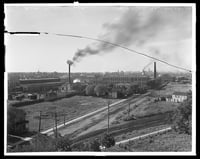
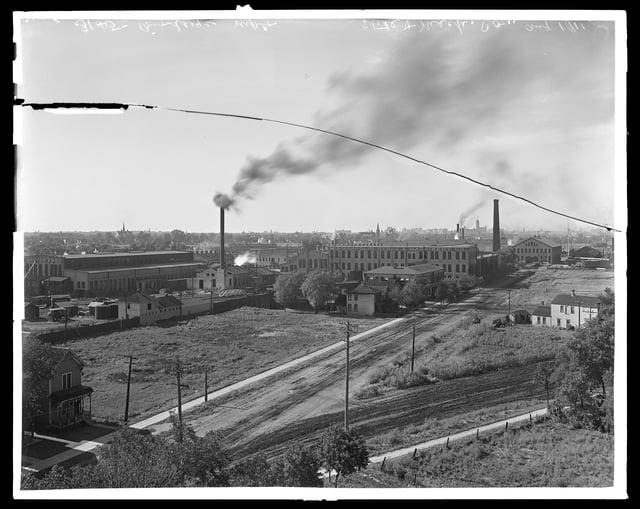
Bird's eye view of a factory, in the middle ground, with smoke billowing from a stack and a grey sky above them in the background.
Minneapolis Steel and Manufacturing Company, East 29th Street and Minnehaha Avenue. Photo by C. J. Hibbard, 1904–1911.
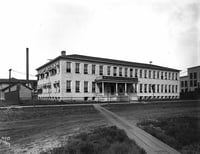
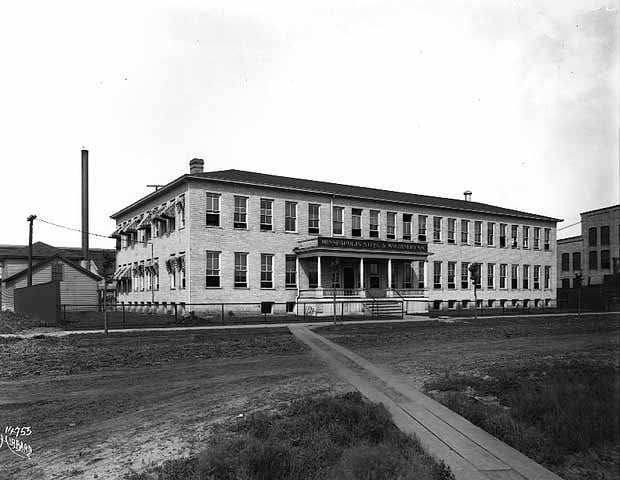
Rectangular two-story building with a columned front porch under white sky.
Minneapolis Steel and Machinery Company, East 29th Street and Minnehaha Avenue, Minneapolis. Photo by C. J. Hibbard, 1904–1911.
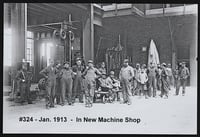
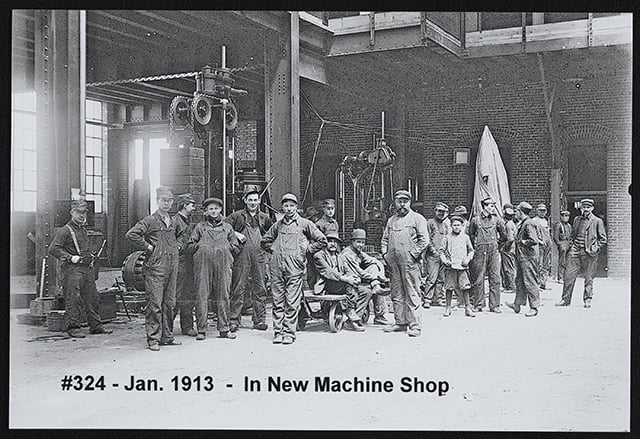
Adults and children stand in an open space in front of a factory building.
Machine-shop employees of the Minneapolis Threshing Company, Hopkins, January 1913.
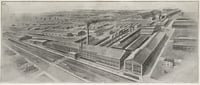
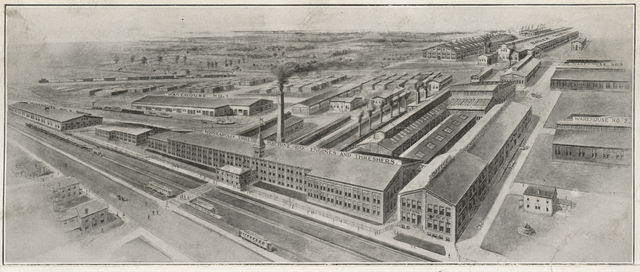
Drawing of a factory complex and nearby roads, with smoke coming from a smokestack at center.
The Minneapolis Threshing Company in Hopkins, ca. 1915.
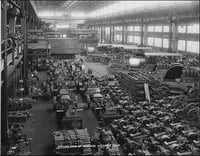
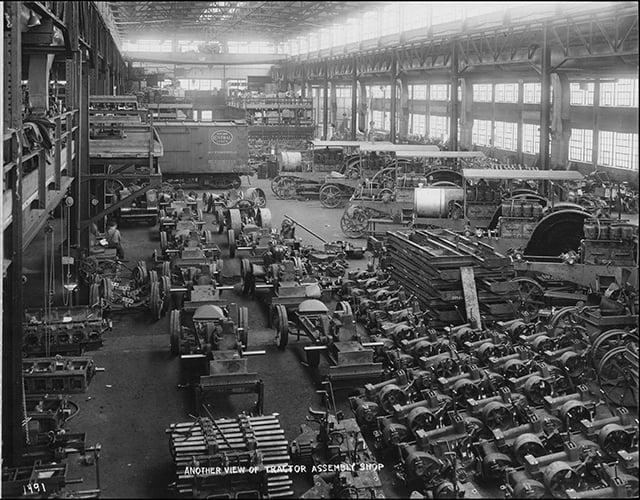
Interior view of a factory floor with dozens of tractors and machines stretching to a point in the background, with windows emitting light at the back and at the sides.
Interior view of the Minneapolis Steel and Machinery Company’s tractor assembly warehouse, Minneapolis, 1917.
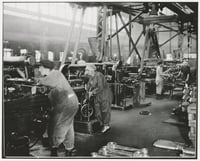
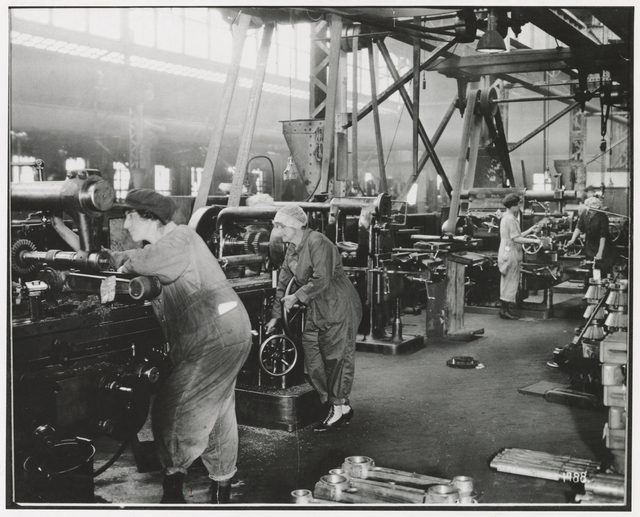
Two women in overalls stand in the left foreground, working with machines; two other women workers stand at right in the middle ground. Line shafts branch out above their heads.
Women making parts for the Twin City tractor assembly line at Minneapolis Steel and Machinery Company, Minneapolis, ca. 1917.
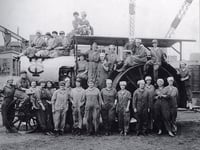
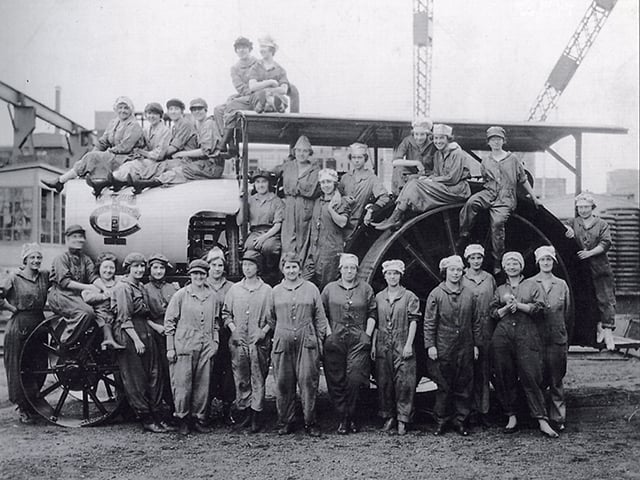
Women workers waring hats and overalls pose in front of a tractor.
Minneapolis Steel and Machinery Company employees, ca. 1910s. From P. A. Letourneau, Twin City Tractor Photo Archive (Voyageur Press, 1993), page 11.
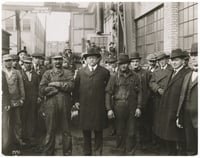
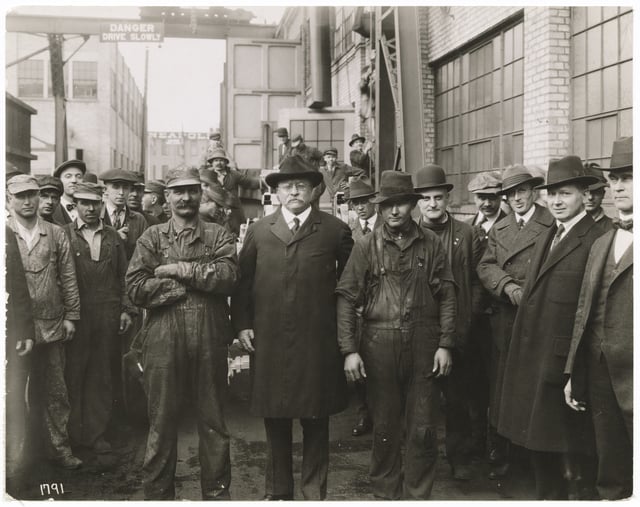
Men wearing caps and brimmed hats pose in front of factory buildings.
Theodore Roosevelt (center) with workers at Minneapolis Steel and Machinery Company, October 7, 1918.
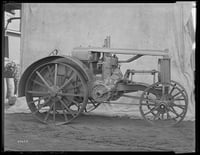
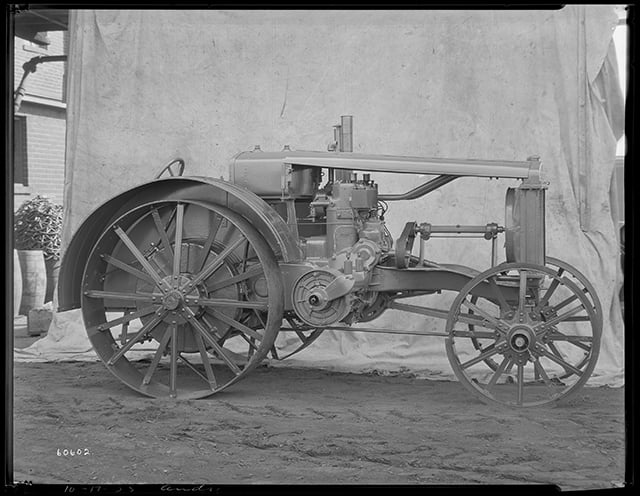
A four-wheeled 1920s tractor in front of a cloth backdrop.
A Minneapolis Threshing Machine Company tractor. Photograph by Hibbard Studio, 1925.
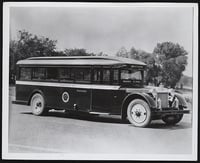
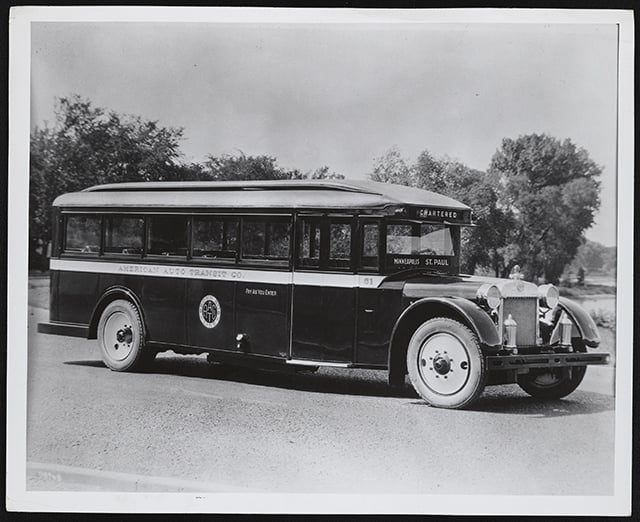
1920s-era bus viewed at a shallow three-quarter angle in front of a tree line with sky in the background
A Twin City DW model bus, manufactured by the Minneapolis Steel and Machinery Company, ca. 1925.
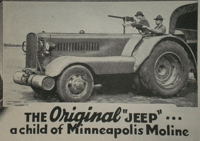
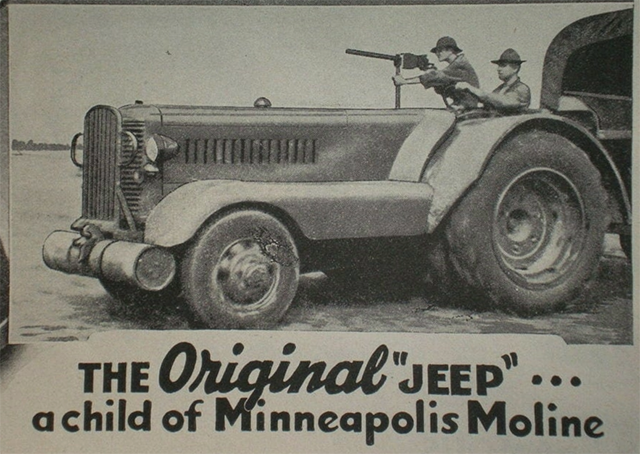
Newsprint add with two men sitting in a Jeep, with one handling a machine gun or other automatic weapon.
Advertisement for a vehicle promoted as “the original Jeep.” From the periodical FLYING, February 1944, page 8.
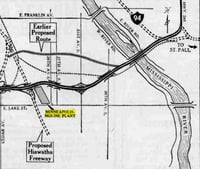
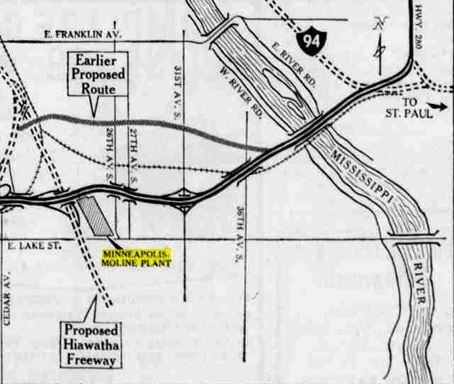
Map of Minneapolis south of Franklin Avenue, with the Mississippi RIver at right.
The footprint of the Minneapolis-Moline factory complex in the Longfellow neighborhood of South Minneapolis before the construction of Hiawatha Avenue, part of Minnesota State Highway 55. Map by Warner Nelson for the Minneapolis Star, July 21, 1964, 33.
A yellow tractors with four tires with red rims inside a warehouse space.
A 1938 Minneapolis Moline tractor in Saskatchewan, Canada. Photo by Wikimedia Commons user Trekphiler, February 8, 2009.
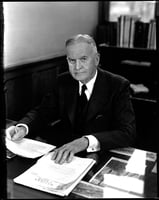
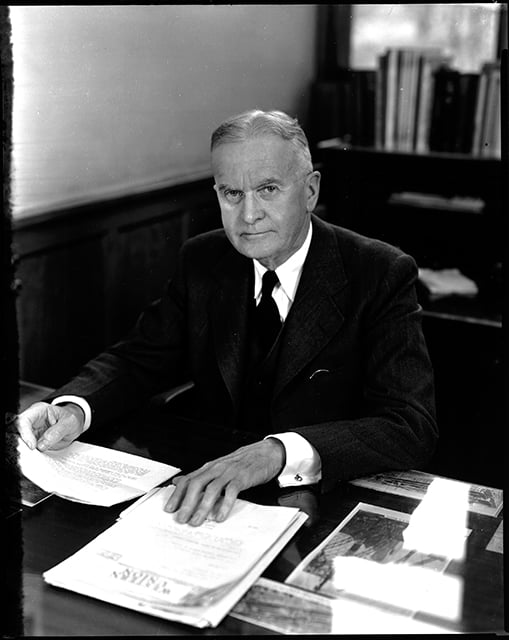
Man in a white dress shirt, tie, and suit jacket sitting at a desk with papers.
Warren MacFarlane, president of Minneapolis-Moline. Photograph by Arthur H. Jensen, undated but ca. 1940s.
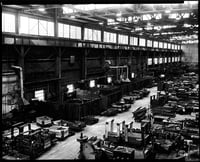
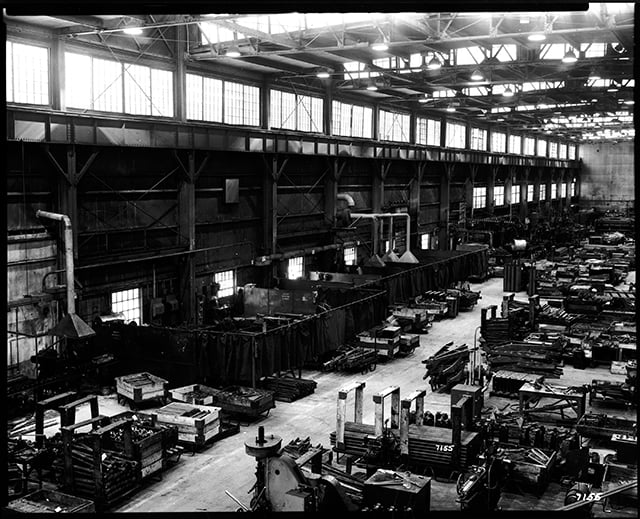
Multiple-story factory interior with dozens of vehicles on the floor.
The factory floor at Minneapolis-Moline. Photograph by Arthur H. Jensen between 1935 and 1965.
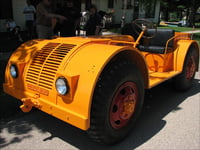
A four-wheeled orange jeep parked outside a building.
Minneapolis-Moline Jeep model NTX, used during World War II. Photo by Flickr user Observe the Banana, CC BY-NC 2.0.
Tricycle-tired tractor with clam shell fenders parked inside a building.
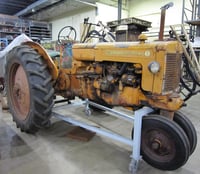
An unrestored Minneapolis-Moline model ZAU tractor manufactured between 1949 and 1952 in Minneapolis. The tractor has a four-cylinder gasoline engine and features clam shell fenders and narrow tricycle front tires. The tractor was used for farming corn, soybeans and hay in Renville County near Bird Island and later to cultivate corn in McLeod County near Winsted. Photographed on July 18, 2012.
Three-wheeled tractor with a yellow body sitting on green grass in front of a blue sky in the background.

Restored Minneapolis-Moline Universal tractor, model Z

A restored Minneapolis-Moline Universal tractor, model Z. Photo by Wikimedia Commons user Mobilus in Mobili, May 31, 2015.
Bird's eye view of a factory, in the middle ground, with smoke billowing from a stack and a grey sky above them in the background.

Minneapolis Steel and Manufacturing Company, 1904–1911

Minneapolis Steel and Manufacturing Company, East 29th Street and Minnehaha Avenue. Photo by C. J. Hibbard, 1904–1911.
Rectangular two-story building with a columned front porch under white sky.

Minneapolis Steel and Machinery Company, 1904–1911

Minneapolis Steel and Machinery Company, East 29th Street and Minnehaha Avenue, Minneapolis. Photo by C. J. Hibbard, 1904–1911.
Adults and children stand in an open space in front of a factory building.

Minneapolis Threshing Company employees

Machine-shop employees of the Minneapolis Threshing Company, Hopkins, January 1913.
Drawing of a factory complex and nearby roads, with smoke coming from a smokestack at center.

Minneapolis Threshing Company, ca. 1915

The Minneapolis Threshing Company in Hopkins, ca. 1915.
Interior view of a factory floor with dozens of tractors and machines stretching to a point in the background, with windows emitting light at the back and at the sides.

Minneapolis Steel and Machinery Company "Z" Shop

Interior view of the Minneapolis Steel and Machinery Company’s tractor assembly warehouse, Minneapolis, 1917.
Two women in overalls stand in the left foreground, working with machines; two other women workers stand at right in the middle ground. Line shafts branch out above their heads.

Women workers at Minneapolis Steel and Machinery Company, ca. 1917

Women making parts for the Twin City tractor assembly line at Minneapolis Steel and Machinery Company, Minneapolis, ca. 1917.
Women workers waring hats and overalls pose in front of a tractor.

Minneapolis Steel and Machinery Company employees, ca. 1910s

Minneapolis Steel and Machinery Company employees, ca. 1910s. From P. A. Letourneau, Twin City Tractor Photo Archive (Voyageur Press, 1993), page 11.
Men wearing caps and brimmed hats pose in front of factory buildings.

Theodore Roosevelt at Minneapolis Steel and Machinery Company, 1918

Theodore Roosevelt (center) with workers at Minneapolis Steel and Machinery Company, October 7, 1918.

Holding Location

Minnesota Historical Society
A four-wheeled 1920s tractor in front of a cloth backdrop.

Minneapolis Threshing Machine Company tractor

A Minneapolis Threshing Machine Company tractor. Photograph by Hibbard Studio, 1925.
1920s-era bus viewed at a shallow three-quarter angle in front of a tree line with sky in the background

Bus manufactured by the Minneapolis Steel and Machinery Company, ca. 1925

A Twin City DW model bus, manufactured by the Minneapolis Steel and Machinery Company, ca. 1925.

Holding Location

Minnesota Historical Society
Newsprint add with two men sitting in a Jeep, with one handling a machine gun or other automatic weapon.

Advertisement for “the original Jeep”

Advertisement for a vehicle promoted as “the original Jeep.” From the periodical FLYING, February 1944, page 8.
Map of Minneapolis south of Franklin Avenue, with the Mississippi RIver at right.

Footprint of the Minneapolis-Moline factory complex

The footprint of the Minneapolis-Moline factory complex in the Longfellow neighborhood of South Minneapolis before the construction of Hiawatha Avenue, part of Minnesota State Highway 55. Map by Warner Nelson for the Minneapolis Star, July 21, 1964, 33.
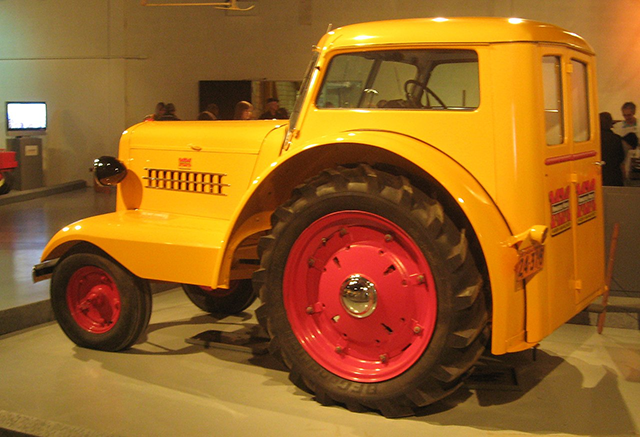
A yellow tractors with four tires with red rims inside a warehouse space.

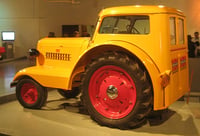
1938 UDLX tractor

A 1938 Minneapolis Moline tractor in Saskatchewan, Canada. Photo by Wikimedia Commons user Trekphiler, February 8, 2009.
Man in a white dress shirt, tie, and suit jacket sitting at a desk with papers.

Warren MacFarlane

Warren MacFarlane, president of Minneapolis-Moline. Photograph by Arthur H. Jensen, undated but ca. 1940s.
Multiple-story factory interior with dozens of vehicles on the floor.

Factory floor at Minneapolis-Moline

The factory floor at Minneapolis-Moline. Photograph by Arthur H. Jensen between 1935 and 1965.
A four-wheeled orange jeep parked outside a building.

Minneapolis-Moline NTX

Minneapolis-Moline Jeep model NTX, used during World War II. Photo by Flickr user Observe the Banana, CC BY-NC 2.0.
Tricycle-tired tractor with clam shell fenders parked inside a building.

Minneapolis-Moline model ZAU tractor

An unrestored Minneapolis-Moline model ZAU tractor manufactured between 1949 and 1952 in Minneapolis. The tractor has a four-cylinder gasoline engine and features clam shell fenders and narrow tricycle front tires. The tractor was used for farming corn, soybeans and hay in Renville County near Bird Island and later to cultivate corn in McLeod County near Winsted. Photographed on July 18, 2012.
© Minnesota Historical Society    

All rights reserved

Turning Point

In 1935, after years of heavy losses, Minneapolis-Moline turns a small ($170,000) profit. Seventeen consecutive years of profits follow.

Chronology

1929
Minneapolis–Moline (M-M) is founded in Minneapolis by the merger of Minneapolis Steel and Manufacturing of Minneapolis, Minneapolis Threshing Company of Hopkins, and Moline Implement Company of Moline, Illinois.
1930
M-M records a profit of $1,043,940 on sales of $13,487,558. This is somewhat less than the sales-and-profit figures of the three independent companies in 1928.
1932
Company president Warren MacFarlane is partially paralyzed in a car accident.
1933
M-M loses over $1,500,000 but also introduces a new, medium-sized lightweight combine that soon leads that segment of the market.
1935
M-M turns a profit of $170,000 in the first of eighteen straight profitable years.
1938
M-M introduces its UDLX model, the first tractor with all-enclosed cab, radio, windshield wipers, and a top speed of forty miles per hour. Only 125 are sold in this first year of production.
1938
M-M’s “Jeep” is introduced at Camp Ripley. Whether this is the true original Jeep is still debated.
1950
M-M earns profits of over $7,000,000, its high mark, on sales of $79,000,000. Competitor International Harvester records profits of over $66,000,000; industry #2 John Deere earns over $19,000,000 in just six months.
1951
M-M merges with B. F. Avery Company of Kentucky.
1954
M-M loses $44,000. Net losses through 1958 exceed $6,500,000.
1955
A hostile takeover results in seven new, mostly East Coast members of the M-M board.
1956
M-M engineer Martin Ronning, designer of the Harvestor combine, wins a Cyrus McCormick Award for industrial design. The company has 200 employees in its research department.
1957
President MacFarlane retires. The company has four presidents over the next six years.
1960
The company’s name is changed to Motec Industries.
1962
Shareholders approve the acquisition of M-M by White Motor Company of Cleveland.
1963
The name is changed back to Minneapolis-Moline.
1972
White closes both the Hopkins and Minneapolis factories.
1980/1981
White Motor Company goes out of business.

Bibliography

Annual Reports, Minneapolis-Moline Company, 1950?–1960. Available at the Minnesota Historical Society library as HD9486.U54 M6132.

Minneapolis-Moline Power Implement Company.“Can a Company Outgrow Its Name?” Advertisement. Minneapolis Star, June 8, 1961.

Gunter, Ray. “Hopkins Plant Was Once Hub of Activity.” Minneapolis Star, April 4, 1963.

Hobart, Randall. “Moline Chief Cites Gains, Optimism.” Minneapolis Star, March 4, 1958.

Hobart, Randall. “‘Mr. Mac’ of Moline Takes a Breather.” Minneapolis Star, January 28, 1958.

Howe, Richard. “Three Factors Are Sighted in Motec Presidential Changes.” Minneapolis Tribune, March 25, 1962, F9.

Inskip, Leonard. “Chicagoan Elected President of Moline.” Minneapolis Tribune, November 16, 1957.

——— . “Motec Says It Will Sell to White.” Minneapolis Tribune, October 19, 1962.

Letourneau, P. A., ed. Twin City Tractor Photo Archive: Photographs from the Minneapolis-Moline Company Records. Iconografix, 1993.

Mason, Ralph. “Reorganized Moline Forging New Ideas.” Minneapolis Star, February 10, 1961.

McCarty, Pat. “Motec is Moline Again; Loss Reported.” Minneapolis Tribune, January 30, 1963.

“Minneapolis-Moline—A Leader in Its Field of Industry.” Minneapolis Tribune, November 26, 1939.

“Minneapolis-Moline Observes 75th Anniversary.” Minneapolis Star, April 7, 1940.

“Moline Firm Plans Output of $750,000.” Minneapolis Journal, December 2, 1934.

“Moline Plant Hums, Nears 1929 Record.” Minneapolis Journal, June 5, 1936.

Petersen Jr, Chester, and Rob Beemer. Minneapolis-Moline Farm Tractors. MBI Publishing Company, 2000.

“The Romance of ‘Harvestor.’” Implement and Tractor, April 4, 1936, 24–25.

Schaefer, Ed. “Management Miracle at Minneapolis-Moline.” Minneapolis Star, August 7, 1959.

Thomas, Norman F. Minneapolis-Moline: A History of Its Formation and Operations. Arno Press, 1976.

“We Are Hard At Work.” Minneapolis Tribune, January 1, 1930.

“Where the Velvet Begins.” TIME 35, no. 1 (January 1, 1940): 37–38.

Wendel, C. H. Minneapolis-Moline Tractors 1870–1969. Motorbooks International, 1990.

Wickland, John A. “At 15 He Built a Tractor—and It Worked!” Minneapolis Tribune, June 24, 1956.

——— . “Moline Tractors Take On New Look.” Minneapolis Morning Tribune, January 15, 1956.

Youngblood, Dick. “2 Twin Cities Plants to Close, Idling 1,300.” Minneapolis Tribune, January 7, 1972.

Related Resources

Primary

M/A 0208
Collection on Minneapolis Moline Power Implement Company, 1915-2001 1915-1979
Manuscripts Collection, Hennepin County Library Special Collections, Minneapolis
Description: The collection contains clippings, advertisements, photographs, reports, and correspondence, machinery catalogs, and scrapbooks. A number of papers and correspondence detail the 1929 merger of the company. Machinery catalogs are arranged by machine type. The scrapbooks consist of newspaper clippings from local and national papers. The four scrapbooks cover the following years: 1916–1954, 1929–1932, 1932–1944, and 1943–1954.
https://archives.hclib.org/repositories/2/resources/121

Minneapolis-Moline Power Implement Company. “Our Policy is Progress” Advertisement. Minneapolis Star, January 9, 1966.

Secondary

Leffingwell, Randy. America’s Classic Farm Tractors. MBI Publishing, 1999.

Wendel, C. H. Encyclopedia of American Farm Tractors. Crestline Publishing, 1979.