


Estate Planning 101: A Guide to Thoughtful Planning

Do you ever wonder what you should do to provide for your loved ones and communities beyond your lifetime? Sometimes when people hear the words “estate planning,” it can seem heavy or daunting. If you take tasks in little bites or pieces, though, you’ll find you can create or update your plans that align with your values and what you want to accomplish in the world. You’ll feel great, knowing that you’re providing for your loved ones and your favorite organizations in the ways most meaningful to you, leaving a lasting legacy for future generations.

Meet Kim and Jeff

Elderly couple

Kim and Jeff* are MNHS supporters who decided, after putting it off for years, to get their estate plans in order. They had been intending to do it for a long time, but other tasks always seemed more pressing. Inspired by close friends who just signed their first Wills and shared that it felt like a weight lifted from their shoulders, Kim and Jeff decided to get theirs done as well.

But where to start? Both of them knew about Wills although, beyond that, weren’t sure what their options were.

Get Help from a Professional

Elderly people sitting at table with laptop.

Kim and Jeff’s friends recommended talking to an estate planning attorney. After talking with another lawyer friend about who he’d recommend, they took those referrals and checked them out online, then called the estate planning attorneys who seemed like they might be a good fit. After the calls, they felt best about one lawyer who asked questions that made it seem like she cared about helping them establish a plan that wasn’t just a cookie-cutter template but reflected their values and would help them accomplish their goals for their family and favorite charities.

Will or Revocable Trust?

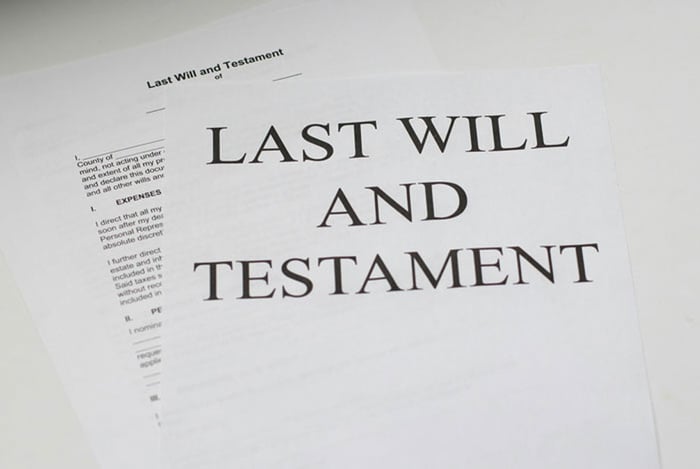
Last will and testament white printer paper.

In their initial meeting with their attorney, Kim and Jeff’s lawyer talked with them about not only Wills, but Revocable Trusts as another option. Kim and Jeff learned that:

  • A Revocable Trust Agreement is often used as a “Will substitute” in cases where a person might want to avoid probate.
  • It’s called “revocable” because the donor retains the right to amend or revoke the trust as long as they’re alive and not incapacitated.
  • Generally, property in a trust is outside of a person’s probate estate, and so if all probate property is transferred to the Revocable Trust, there will be no need for a probate when the person passes away.
  • Although the Revocable Trust is a separate legal entity from the donor, because the donor—who typically also would serve as both initial trustee and beneficiary—retains virtually complete control over the Revocable Trust property during life, the IRS treats the property in a Revocable Trust the same as if the donor owned it individually (it’s a “disregarded entity” for tax purposes).

Probate or No Probate?

Why would people care about avoiding probate? Many times, probate goes smoothly and relatively simply. However, in a probate proceeding, whether with a Will or if a person passes away without a Will (called “intestacy”):

  • The Personal Representative who administers the estate must wait for court approval before making distributions or taking various other actions. With a Revocable Trust, the trustee or successor trustee may be able to act more quickly without needing court approval.
  • Probate proceedings are in the public record, open to public inspection, while some people prefer the privacy afforded by a Revocable Trust.
  • If real estate is owned in more than one state an additional probate (called an “ancillary probate”) will have to be opened in each such state outside of the owner’s state of residence but could be avoided by putting the out-of-state real estate in a Revocable Trust.

In Kim and Jeff’s case, a Revocable Trust made sense because they owned a piece of real estate in another state outside of Minnesota. Their attorney also prepared for them simple Wills called “Pour-Over Wills” to have just in case some probate property they owned didn’t make it into the Revocable Trust. Those Pour-Over Wills would give everything in the probate estate to the trustee of the Revocable Trust (“poured over” to the trust), to be administered consistent with the rest of the Revocable Trust assets. It’s expected that the Pour-Over Wills wouldn’t ever be used but are important to have just in case they are needed.

Wills and Trusts Don’t Control All Property

Kim and Jeff learned too that not all property they own is controlled by a Will or Revocable Trust Agreement. For example:

  • Property held as joint tenants or as “joint tenants with right of survivorship” (sometimes abbreviated as JTWROS) would not pass through the Will or Revocable Trust but would go automatically by operation of law to the surviving joint tenant(s).
  • Retirement accounts, such as IRA, 401(k), and 403(b) accounts, all are controlled not by Wills or Revocable Trusts, but instead by beneficiary designations on the accounts pursuant to the account plan agreements.
  • Similarly, the death benefits on their various life insurance policies also are governed by beneficiary designations per the life insurance policy contracts.

Kim and Jeff realized their single most valuable category of property—their retirement accounts—were among those “nonprobate” assets. Their attorney advised them to update their beneficiary designations along with their Wills and Revocable Trust Agreements so as not to have their intent frustrated with something accidentally going where it's not intended to go.

Powers of Attorney and Health Care Directives

Kim and Jeff’s attorney explained to them that a comprehensive estate plan includes more than just the primary planning documents of a Will or Revocable Trust Agreement. In addition to coordinating various beneficiary designations, it’s important to have in place a current Durable Power of Attorney as well as a Health Care Directive (sometimes called a “Living Will” and/or “Health Care Power of Attorney”).

With a Durable Power of Attorney:

  • You appoint an “Attorney-in-Fact” to act on your behalf and handle non-medical matters, like:
    • paying bills,
    • handling financial accounts and investments,
    • buying, selling, or maintaining real estate or other property,
    • filing and paying taxes,
    • making gifts (if authorized),
    • operating businesses,
    • representing you in claims or court matters, and
    • various other tasks and responsibilities.
  • The power of attorney continues to be effective even if you become incapacitated or incompetent. (This is what “durable” means.)
  • The person named as Attorney-in-Fact does not have to be (and usually is not) an attorney at law, but should be someone you trust to act in your best interests.
  • You retain the right to make decisions on your own, or to revoke or change the power of attorney, as long as you are living and have capacity and competence.
  • It ceases to be effective, and the power of attorney ends, when you no longer are living.

With a Health Care Directive:

  • You make known what you want and don’t want for medical care.
  • You appoint a “Health Care Agent” (or more than one Health Care Agent) to make medical decisions on your behalf if you’re not able to communicate your wishes.
  • Your health care provider is required to follow your wishes as stated in your Health Care Directive.
  • Your Health Care Agent is required to make decisions consistent with what you have stated as your wishes.

Kim and Jeff appointed each other as Attorney-in-Fact and as Health Care Agent for themselves, and appointed one of their adult children as the first successor, with another adult child as the second successor.

How Much to Family and How Much to Charity?

Happy family enjoying dinner in garden.

One of the things Kim and Jeff appreciated about their estate planning attorney was the way their lawyer helped them achieve what they wanted to accomplish both for their kids and for the world. She first asked them what they wanted to do for their children and grandchildren. After some discussion and tallying up all of their distributable assets and what would happen without a thoughtful plan, three things stood out to Kim and Jeff:

  1. Significant income taxes would have to be paid by their children when the children took distributions from any inherited IRAs and other non-Roth retirement accounts. Further, even though their estates were not large enough for them to have to worry about Federal estate taxes, some state estate taxes might be owed because of the total amount going to children.
  2. Even net of the taxes that were projected to be owed, their children stood to receive far more than Kim and Jeff realized (or thought was ideal).
  3. Although Kim and Jeff gave money every year to their favorite charities and thought of it as an important part of who they are and a part of their value system, their current plans contained no provision to benefit the world beyond their family. They wished to do something to help those around them as well as their legal heirs.

Kim and Jeff’s attorney asked what they thought would be an ideal or optimal amount to leave to each of their three children. After some discussion—the attorney noted the answer can be different for every family—they decided that, in an ideal world, they would be thrilled if they could leave each child $1 million but they also were concerned about reducing their kids’ incentive to remain productive if they received more than that, either outright or in trust. Based on that decision and explanation, their attorney made a suggestion that Kim and Jeff liked. With total distributable assets of approximately $4 million, they decided to treat charity like a fourth child, dividing the residue of their trusts into four shares, with one share going to each child, and one share going to MNHS and a couple of other favorite nonprofit organizations.

To maximize the amounts going to family and minimize taxes, the attorney told Kim and Jeff that they should make their charitable gifts by using the beneficiary designations on their retirement accounts, while leaving the nontaxable assets to their kids through their Revocable Trust and life insurance policies.

Giving with Greater Meaning

The attorney suggested Kim and Jeff contact MNHS to discuss how their significant planned gift might be used in a way most meaningful to them. They talked with a MNHS Gift Officer, who made the suggestion of a permanent endowed fund to support the sites and programs that had been important to their family. Kim and Jeff were thrilled with the idea of establishing a legacy that would last in perpetuity. They found joy in setting up a named endowed fund agreement designated to provide resources to the three MNHS historic sites that had been most important to them and their kids, and to make sure those wonderful learning opportunities would be there forever for other Minnesota families.

Kim and Jeff had never thought of themselves as philanthropists. The largest gifts they had ever made so far in life wouldn’t be considered major gifts by most people. And yet, by being shown how by their attorney and an MNHS Gift Officer, Kim and Jeff had become real philanthropists through their six-figure planned gift of retirement assets to MNHS, and similar gifts to other favorite charities.

* Not actual names of specific people. Information is provided solely for education and illustration, and is not legal, financial, or tax advice. Please contact your own professional legal, accounting, financial, or tax advisors to determine how an idea may affect your particular circumstances.