

Disability Communities in Minnesota
Disability history is Minnesota history.
MNHS welcomes and serves all people of Minnesota. We are committed to working toward reflecting the diversity of the state, including preserving and sharing the stories of disability communities in Minnesota.
Connect with the MNHS Inclusion & Community Engagement Department
The Inclusion and Community Engagement department at MNHS works to repair, build and strengthen trusting, sustained relationships with communities who have been historically excluded in the field of public history. We support community-identified priorities for preserving and sharing our histories.
If you are interested in collaborating with us to preserve and share local disability history, we invite you to complete our Collaboration Interest Form.
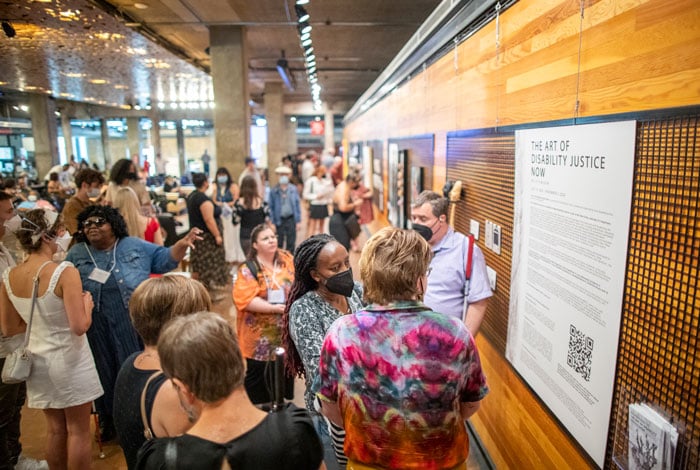
In 2024, the Minnesota Historical Society partnered with AmplifyMN: A Disability Justice Collective, to host The Art of Disability Justice Now , a disability community-centered exhibition that was curated, organized, and supported by artists, activists, and community organizers to serve as a snapshot of what Disability Justice is now in the Twin Cities and why it’s important. The exhibit was on display at Mill City Museum July through November. Several collaborative community-led public programs were held to accompany the exhibit.
Gale Family Library resources
The Minnesota History Center’s Gale Family Library is free and open to the public and contains many resources about the history of disability in Minnesota.
Visiting the library | Disability History LibGuide
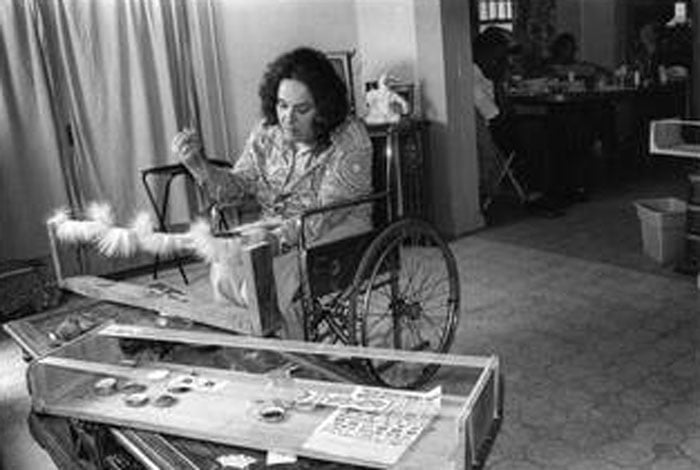
Our Disability History LibGuide was created with input from local disability community members and historians. The guide contains a variety of online and print resources to help researchers navigate the varied disability materials held in the Minnesota Historical Society collection. Featured subjects include a historical timeline, core concepts, terminology glossary, and examples in our collections of advocacy and organizational history, legal reform, state hospital records, and state school records.
Articles
The online encyclopedia MNopedia and the magazine Minneota History both offer articles that document the history of disability in Minnesota. Examples include:
Classroom resources
Experiences of People with Disabilities (1867-1977)
This primary source set was compiled by Wendy Harris, a high school teacher at Metro Deaf School in St. Paul, Minnesota. The resource is a contribution to including disability history in the classroom.
Accessibility at the Minnesota Historical Society
Our historic sites welcome all visitors. We recognize the diverse needs of our audience and strive to offer accessible programming to enable all visitors to explore our historic sites. Our goal is to provide as much information as possible to guests before their visit to any of our sites and museums. We invite you to visit the “Accessibility” webpages below to learn more through our site specific social narratives, accessibility maps, and more.
If you have questions or feedback regarding accessibility at an MNHS site, we encourage you to reach out to the site’s phone number or email address listed on their webpage.
MNHS YouTube channel
Disability and the ADA: Cultural, Demographic, Legal and Technical Implications
This session discusses how disability and the ADA affect society and people’s lives. It provides a demographic and cultural analysis of disability while setting the stage for the technical application of the ADA. Presenter: David Fenley, ADA Director, Minnesota Council on Disability.
Modifying Historic Properties for Increased Accessibility
The process of deciding how to make historic structures and sites accessible to people with disabilities, must consider multiple factors. This session addresses types of structures, types of changes to be considered, limitations and uses of the structures, along with what to do if all areas of historic structures cannot be made accessible. This session is intended to provide participants with guidance in order to successfully strike a balance between accessibility and preservation. Presenter: Ray Bloomer, Accessibility Specialist
Strategies for Accessibility Improvements to Historic Properties
This session will consider strategies for increasing physical access to historic structures. Universal Design concepts will be reviewed, with methods and construction approaches illustrated through review of case studies.Presenters: Bill Hickey is Principal at Collaborative Design Group Inc.; Bess McCollough is an Architect at Collaborative Design Group Inc.