DesJarlait, Patrick (1921–1972)

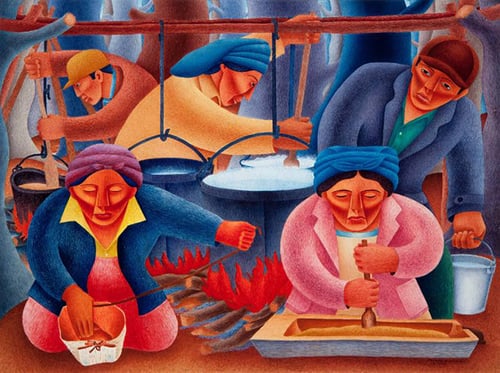
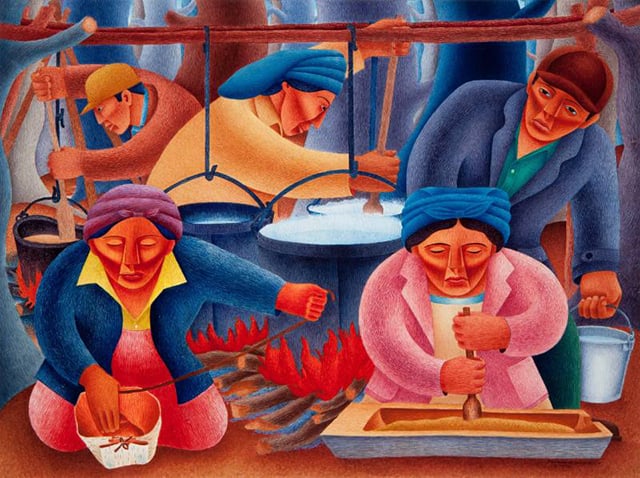
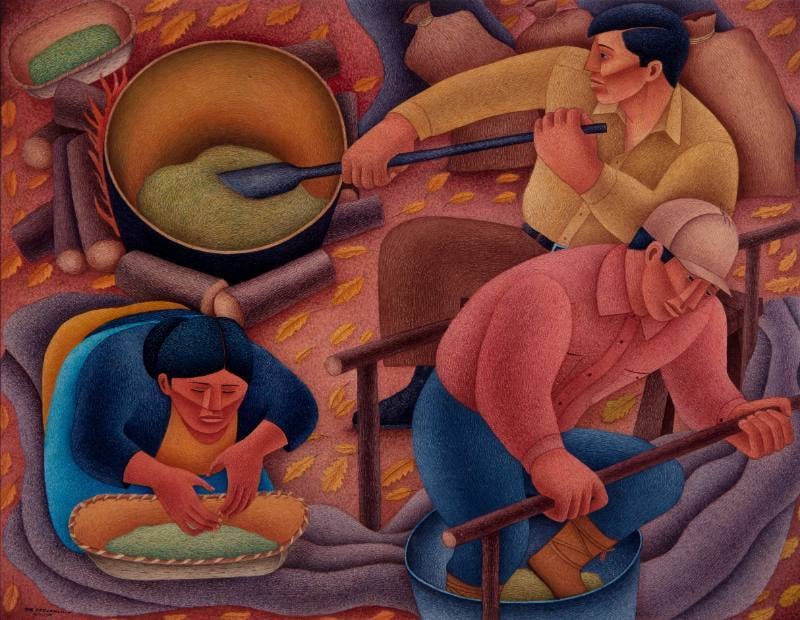
Six figures act out the steps of making maple sugar.
Maple Sugar Time by Patrick DesJarlait, 1946. Watercolor on paper.

Patrick DesJarlait (Red Lake Nation), a recognized Native modernist painter, is best known for depicting Red Lake Ojibwe people between the 1940s and 1970s. He lived a short but full life, attending a federal Native American boarding school, serving in World War II, and building a commercial art career. DesJarlait is best known for his depictions of the Hamm's Beer bear and the Land O’Lakes butter maiden.

Patrick DesJarlait offered a new way of seeing Native Americans in art. During a time when Native people were stereotyped as either the foil or the sidekick in cowboy films, DesJarlait portrayed the Red Lake Ojibwe with dignity, in a heroic style depicting the tribal community as a part of a living culture.

Born on the Red Lake Reservation in Minnesota on March 2, 1921, DesJarlait spent his early years exploring the outdoors. His Ojibwemowin name was Nagawbo, or Boy in the Woods. He sat, observed, and sketched the world around him. Animals and woodland scenes became the first subjects of his drawings. He watched and drew his relatives while they worked, depicting the daily life of the Red Lake Ojibwe people. He was eventually given the name Gwiwizens Odayn Ozhibii’ignaak: Boy with a Pencil.

At five years old, DesJarlait contracted trachoma, a common illness among Native families at the time. He was blind for several months, but recovered with full sight. Soon after, DesJarlait was separated from his family and sent to boarding school. At his first school, St. Mary's, engaging in Ojibwe crafts, games, or dancing was strictly forbidden. The struggle deepened with the death of his mother when he was just seven years old. Soon after, his father remarried; the family relocated to Red Lake, where DesJarlait attended Red Lake Boarding School. In 1928, DesJarlait transferred 300 miles south to Pipestone Indian School. After graduating from Pipestone in 1935, he attended Red Lake High School.

Although there were no art classes in his high school, DesJarlait was encouraged to draw by his English teacher, Dorothy Ross. In 1939, he graduated from Red Lake High School and received a Bureau of Indian Affairs scholarship to study art at Arizona State College, which he attended from 1940 to 1942.

DesJarlait began his military career after the Japanese attack on Pearl Harbor and the United States' entrance into World War II. He left school in April 1942 and accepted a position as an art supervisor at a Japanese concentration camp in Poston, Arizona, offered by the Bureau of Indian Affairs. He left Arizona in September of that year to serve in the US Navy in San Diego, producing propaganda and instructional films.

DesJarlait’s first solo exhibition was in 1945. His paintings, all depicting Ojibwe people, were displayed in a small room at the Fine Arts Gallery in San Diego. He sold all of his paintings in one week. In November of 1945, after the solo show and the conclusion of the war, DesJarlait was honorably discharged from the navy and returned to Red Lake. He spent a year painting at Red Lake Reservation, studying and drawing his people.

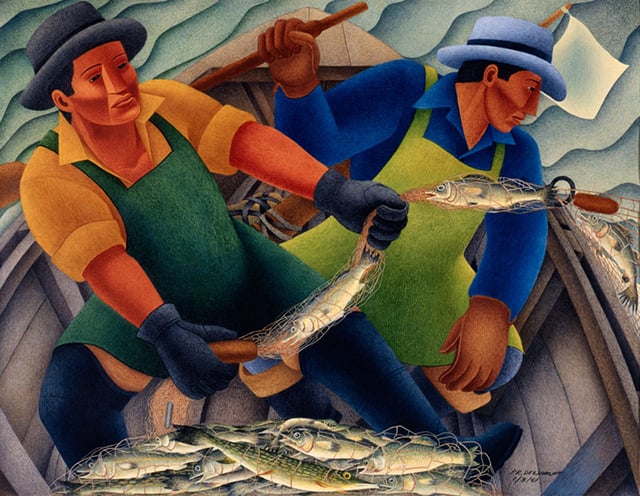
In 1947, DesJarlait moved with his family to St. Paul and pursued a commercial art career, making three of his most famous works in one year: Maple Sugar Time, Red Lake Fishermen, and Making Wild Rice. The latter painting won first prize at the Philbrook Indian Annual exhibition of 1947. DesJarlait worked as a commercial artist for the next twenty-six years at advertising agencies in the Twin Cities.

His most notable project was his 1954 revision of Mia, the Land O’Lakes butter maiden, originally designed by a white artist in 1928. DesJarlait reworked the design, drawing on his own life experience. He updated her clothing with Ojibwe beadwork designs along her dress and lowered the “O” in the Land O’Lakes logo to appear halo-like, evoking a feature of Byzantine religious icons. At Reid Ray Films and Campbell-Mithun he created campaigns that incorporated Northern Woodland Indian references, including a series of animated commercials featuring the Hamm’s Beer bear.

In the last years of his life, DesJarlait spoke at Minnesota public schools and colleges, making presentations about the importance of educating non-Indians about Ojibwe life. His commitment to educating the public grew in tandem with the American Indian Movement (AIM), formed in Minneapolis in the summer of 1968. Though DesJarlait was not associated with AIM, he shared with younger AIM members a commitment to fostering a sense of Native pride and knowledge of Native lifeways.

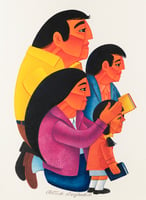
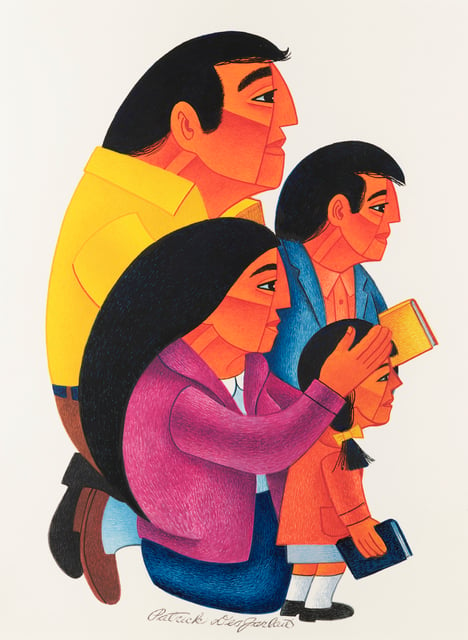
It was in the context of AIM and a commitment to education that DesJarlait created Indian Educations in 1970. He painted Native families in the Red Lake community, with positive imagery. Despite the prevalence of cultural stereotypes, he wanted to show loving Native families—specifically, loving Native fathers—with the belief that his paintings were relevant for the younger generation of urban Native Americans.

DesJarlait continued to paint up until his death, in 1972 at age fifty-one, from cancer-related complications.

.
First Published: June 24, 2026
Last Modified: June 24, 2026

Bibliography

Anthes, Bill. “The Importance of Place: The Ojibwe Modernism of Patrick DesJarlait and George Morrison.” Chap. 4 in Native Moderns: American Indian Painting, 1940–1960, Duke University Press, 2006.

Child, Brenda J., and Howard Oransky, eds. Dreaming Our Futures: Ojibwe and Očhéthi Šakówiŋ Artists and Knowledge Keepers. Translated by Baabiitaw Boyd, Šišóka Duta, and Benay McNamara. University of Minnesota Press, 2024.

Deloria, Philip Joseph. Becoming Mary Sully: Toward an American Indian Abstract. University of Washington Press, 2019.
https://search.ebscohost.com/login.aspx?direct=true&scope=site&db=nlebk&db=nlabk&AN=2107140

DesJarlait, Patrick, and Neva Williams. Patrick DesJarlait: Conversations with a Native American Artist. Runestone Press, 1995.

DesJarlait, Patrick, William R. Hegeman, Robert DesJarlait, Katherine Van Tassell, and Minnesota Museum of American Art. Patrick DesJarlait and the Ojibwe Tradition. Minnesota Museum of American Art, 1995.

Rosenthal, Nicolas G. Painting Native America: Indigenous Artists in the Twentieth Century. University of Nebraska Press, 2025.

Shipley, Florence D.“Cherokee Speaks With Paint.” The Telegraph-Herald, November 6, 1970.
https://books.google.com/books?id=d9hFAAAAIBAJ&pg=PA20

Related Resources

Primary

“Ojibwe Art Expo93.” Speaking of Ourselves = Ni-mah-mi-kwa-zoo-min, March 1, 1993.
https://newspapers.mnhs.org/jsp/PsImageViewer.jsp?doc_id=b0e780ce-3f60-4737-9502-3c5861d696ca

“Patrick DesJarlait and the Ojibwe Tradition.” The Ojibwe News, September 23, 1994.
https://www.mnhs.org/newspapers/oclc/33499558/1993-03-01/ed-1/seq-6

Secondary

DesJarlait, Robert. “My Native American Father Drew the Land O’Lakes Maiden. She Was Never a Stereotype.” The Washington Post, April 29, 2000.
https://www.washingtonpost.com/opinions/2020/04/29/my-ojibwe-father-drew-land-olakes-maiden-she-was-never-stereotype

Dragseth, Kevin. “Is the Land O’Lakes Maiden a Racist Trope or a Symbol of Native Pride?” TPT Originals blog, July 16, 2020.
https://www.tptoriginals.org/is-the-land-olakes-maiden-a-racist-trope-or-symbol-of-native-pride

Wolfe, Lauren. “Land O’Lakes Finally Drops Native American ‘Maiden’ From Packaging.” Women’s Media Center, April 22, 2020.
https://womensmediacenter.com/news-features/land-olakes-finally-drops-native-american-maiden-from-packaging

Wu, Katherine J. “Land O'Lakes Drops the Iconic Logo of an Indigenous Woman From Its Branding.” Smithsonian magazine, April 28, 2020.
https://www.smithsonianmag.com/smart-news/mia-land-olakes-iconic-indigenous-woman-departs-packaging-mixed-reactions-180974760

Web

Philbrook Museum of Art. Patrick DesJarlait.
https://philbrook.emuseum.com/people/2212/patrick-desjarlait

Related Images

Six figures act out the steps of making maple sugar.
Maple Sugar Time by Patrick DesJarlait, 1946. Watercolor on paper.
Men in green aprons, hats, and long-sleeved collared shirts sit in a boat, with one figuring pulling in fish in a net.
Red Lake Fishermen by Patrick DesJarlait, 1946. Watercolor on paper, 14 x 18 inches, Katherine G. Ordway Fund, Purchase 95.01. Used with the permission of the Minnesota Museum of American Art.
Three figures at work in a swirl of curving shapes and pastel colors, with one bending over a basket of wild rice, another stirring a pot, and another treading the rice.
Making Wild Rice by Patrick DesJarlait, 1946. Watercolor on paper.
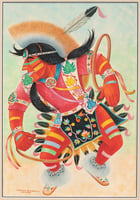
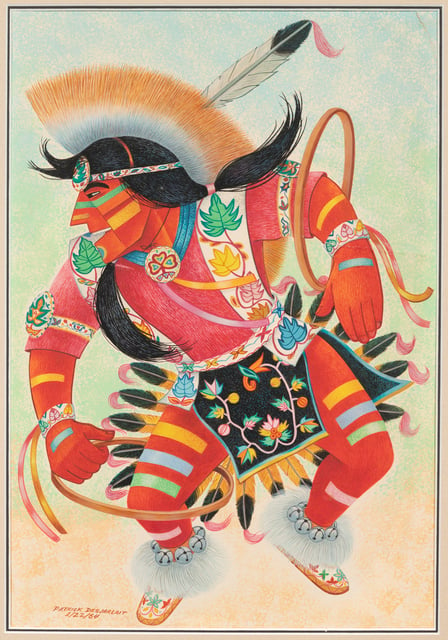
A brightly colored dancer moves his limbs while wearing a feathered roach, a beaded loincloth with floral decoration, and moccasins.
Chippewa Dancer by Patrick DesJarlait, 1964. Mixed media.
Four figures stand in profile facing to the right. Two children hold books; a woman knees and a man kneels behind her.
Indian Educations by Patrick DesJarlait, 1970. Watercolor on board.
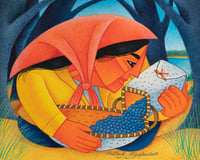
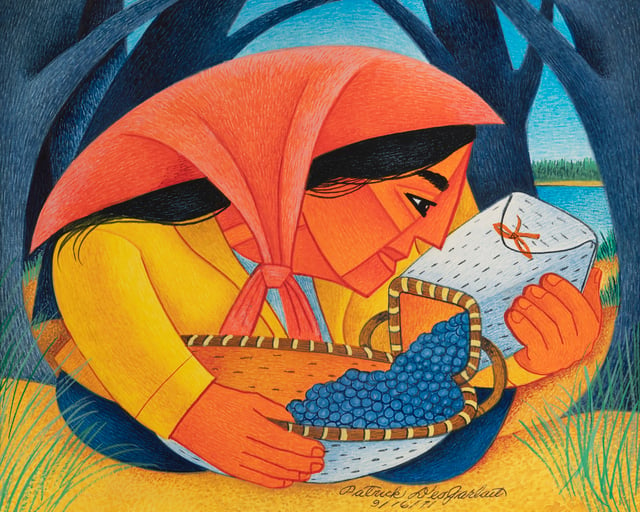
A woman in a salmon-colored kerchief kneels, taking up most of the picture space, while transferring blueberries from one birchbark container into another.
Woman and Blueberries by Patrick DesJarlait, 1971. Watercolor on board.
Six figures act out the steps of making maple sugar.

Maple Sugar Time

Maple Sugar Time by Patrick DesJarlait, 1946. Watercolor on paper.
Men in green aprons, hats, and long-sleeved collared shirts sit in a boat, with one figuring pulling in fish in a net.

Red Lake Fishermen

Red Lake Fishermen by Patrick DesJarlait, 1946. Watercolor on paper, 14 x 18 inches, Katherine G. Ordway Fund, Purchase 95.01. Used with the permission of the Minnesota Museum of American Art.

Holding Location

 Minnesota Museum of American Art
Three figures at work in a swirl of curving shapes and pastel colors, with one bending over a basket of wild rice, another stirring a pot, and another treading the rice.

Making Wild Rice

Making Wild Rice by Patrick DesJarlait, 1946. Watercolor on paper.
A brightly colored dancer moves his limbs while wearing a feathered roach, a beaded loincloth with floral decoration, and moccasins.

Chippewa Dancer

Chippewa Dancer by Patrick DesJarlait, 1964. Mixed media.
Four figures stand in profile facing to the right. Two children hold books; a woman knees and a man kneels behind her.

Indian Educations

Indian Educations by Patrick DesJarlait, 1970. Watercolor on board.
A woman in a salmon-colored kerchief kneels, taking up most of the picture space, while transferring blueberries from one birchbark container into another.

Woman and Blueberries

Woman and Blueberries by Patrick DesJarlait, 1971. Watercolor on board.

Turning Point

After his first solo show in San Diego and at the conclusion of World War II, DesJarlait returns to Red Lake in 1945 to spend a year painting his Ojibwe kin and neighbors at Red Lake Reservation.

Chronology

1921
Patrick DesJarlait is born to Solomon and Elizabeth Blake DesJarlait on Red Lake Reservation in Minnesota on March 2.
1929
DesJarlait contracts trachoma and is blind for several months.
1928
DesJarlait’s mother dies. The family relocates to Red Lake after DesJarlait’s father remarries.
1935
DesJarlait graduates from Pipestone Indian School.
1939
With encouragement from teacher Dorothy Ross, DesJarlait graduates from Red Lake High School.
1940
DesJarlait enrolls in Arizona State College in Phoenix. While attending college, he attends art classes at the nearby Phoenix Indian School.
1942
DesJarlait leaves Arizona State College without graduating. The Bureau of Indian Affairs recruits him to serve as the director of an art program at a Japanese concentration camp (Colorado River War Relocation Center).
1942
In September, DesJarlait is drafted into the US Navy.
1945
San Diego’s Fine Arts Gallery holds the first solo exhibition of DesJarlait’s work.
1945
In November, DesJarlait is honorably discharged from the US Navy. He returns to Red Lake to spend a year painting at Red Lake Reservation, studying and drawing his people.
1947
DesJarlait moves with his family to St. Paul and begins his career as a commercial artist.
1954
The dairy cooperative Land O’Lakes asks DesJarlait to rework the existing design of Mia, the butter maiden, for its new butter packaging.
1970
DesJarlait paints the watercolors Indian Educations and Basket Maker.
1972
DesJarlait dies on November 5 at the age of fifty one.

Bibliography

Anthes, Bill. “The Importance of Place: The Ojibwe Modernism of Patrick DesJarlait and George Morrison.” Chap. 4 in Native Moderns: American Indian Painting, 1940–1960, Duke University Press, 2006.

Child, Brenda J., and Howard Oransky, eds. Dreaming Our Futures: Ojibwe and Očhéthi Šakówiŋ Artists and Knowledge Keepers. Translated by Baabiitaw Boyd, Šišóka Duta, and Benay McNamara. University of Minnesota Press, 2024.

Deloria, Philip Joseph. Becoming Mary Sully: Toward an American Indian Abstract. University of Washington Press, 2019.
https://search.ebscohost.com/login.aspx?direct=true&scope=site&db=nlebk&db=nlabk&AN=2107140

DesJarlait, Patrick, and Neva Williams. Patrick DesJarlait: Conversations with a Native American Artist. Runestone Press, 1995.

DesJarlait, Patrick, William R. Hegeman, Robert DesJarlait, Katherine Van Tassell, and Minnesota Museum of American Art. Patrick DesJarlait and the Ojibwe Tradition. Minnesota Museum of American Art, 1995.

Rosenthal, Nicolas G. Painting Native America: Indigenous Artists in the Twentieth Century. University of Nebraska Press, 2025.

Shipley, Florence D.“Cherokee Speaks With Paint.” The Telegraph-Herald, November 6, 1970.
https://books.google.com/books?id=d9hFAAAAIBAJ&pg=PA20

Related Resources

Primary

“Ojibwe Art Expo93.” Speaking of Ourselves = Ni-mah-mi-kwa-zoo-min, March 1, 1993.
https://newspapers.mnhs.org/jsp/PsImageViewer.jsp?doc_id=b0e780ce-3f60-4737-9502-3c5861d696ca

“Patrick DesJarlait and the Ojibwe Tradition.” The Ojibwe News, September 23, 1994.
https://www.mnhs.org/newspapers/oclc/33499558/1993-03-01/ed-1/seq-6

Secondary

DesJarlait, Robert. “My Native American Father Drew the Land O’Lakes Maiden. She Was Never a Stereotype.” The Washington Post, April 29, 2000.
https://www.washingtonpost.com/opinions/2020/04/29/my-ojibwe-father-drew-land-olakes-maiden-she-was-never-stereotype

Dragseth, Kevin. “Is the Land O’Lakes Maiden a Racist Trope or a Symbol of Native Pride?” TPT Originals blog, July 16, 2020.
https://www.tptoriginals.org/is-the-land-olakes-maiden-a-racist-trope-or-symbol-of-native-pride

Wolfe, Lauren. “Land O’Lakes Finally Drops Native American ‘Maiden’ From Packaging.” Women’s Media Center, April 22, 2020.
https://womensmediacenter.com/news-features/land-olakes-finally-drops-native-american-maiden-from-packaging

Wu, Katherine J. “Land O'Lakes Drops the Iconic Logo of an Indigenous Woman From Its Branding.” Smithsonian magazine, April 28, 2020.
https://www.smithsonianmag.com/smart-news/mia-land-olakes-iconic-indigenous-woman-departs-packaging-mixed-reactions-180974760

Web

Philbrook Museum of Art. Patrick DesJarlait.
https://philbrook.emuseum.com/people/2212/patrick-desjarlait