Origins of Commercial Logging, 1821–1839
Creator:
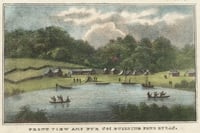
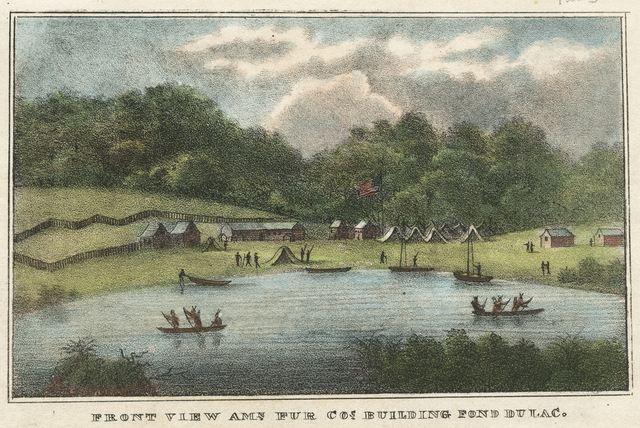
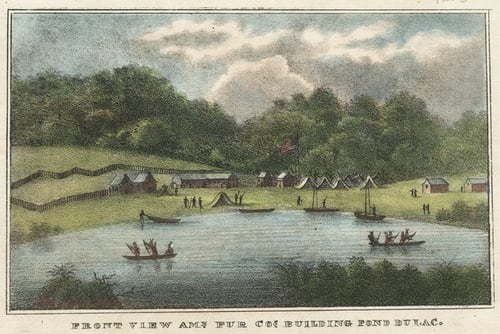
Scene of a shoreline and encampment, with canoes on the water, people standing on shore, and buildings, trees, and a cloudy sky in the background.
Fort St. Louis (Fond du Lac) southwest of present-day Duluth, Minnesota, 1827. Lithograph by an unidentified artist.

Even before the formation of Minnesota Territory in 1849, the vast pine forests and navigable rivers west of the St. Croix River influenced the interactions of US politicians with the Native nations who lived there. The lure of logging for profit intensified in the 1830s, when settlers pressured the US government to sign treaties that would transform Dakota and Ojibwe homeland into a business opportunity.

Eastern white pine was among the most valuable tree species in early US history, and the most sought-after wood for building. It is strong, light, attractive, straight-grained, and easy to work—qualities that made it the premier building material. Its buoyancy, too, was invaluable in a period before railroads, when companies transported logs by floating them to downstream mills. White pine was so desirable, in fact, that the first commercial loggers selectively cut it from forests, leaving other trees standing.

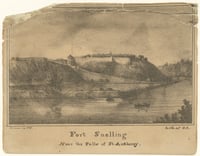
Minnesota marks the westernmost limits of eastern white pine in the US. As logging deforested northeastern states in the early nineteenth century, the white-pine logging industry slowly shifted westward to the Great Lakes. Soldiers stationed at Fort Snelling built Minnesota’s first sawmill at St. Anthony Falls in 1821. This operation, however, remained small, and most of the wood produced was used locally.

It was not until the 1830s, when white settlers moved to the Upper Mississippi lead-mining district, that demand for local supplies of pine lumber soared. Like most white Americans at the time, settlers in the lead district used pine lumber to build their towns and homes; most of their supply, however, came from as far away as Pennsylvania. This made lumber prohibitively expensive—in some instances ten times more expensive than back East.

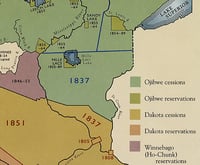
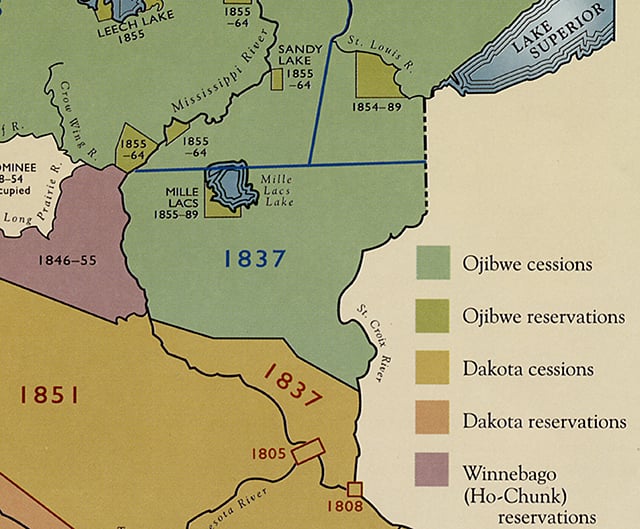
In 1837, settlers in the lead district pushed for the federal government to make treaties with the Ojibwe, Dakota, and Menominee peoples that would let them log the seemingly inexhaustible pinelands east and southeast of Lake Superior. One of them, the so-called “White Pine Treaty,” marked the beginning of large-scale logging operations in Minnesota. As in other treaties, what the Ojibwe and Dakota thought they were agreeing to differed from what American officials desired. Some Ojibwe and Dakota people thought they were ceding the right to log their lands (i.e., stumpage rights), not the land itself. As Eshkibagikoonzh (Flat Mouth), a prominent Pillager Ojibwe leader from Leech Lake, explained at the 1837 treaty negotiation, “It is hard to give up the land. It will remain and cannot be destroyed, but you may cut down the trees, and others will grow up. You know we cannot live deprived of lakes and rivers. There is some game on the land yet, and for that we wish to remain upon it.”

Before the treaty, some Native people had allowed settlers to establish sawmills on their lands in return for payment. White loggers operated sawmills on the Chippewa and Black Rivers as early as 1817, but they did so at the discretion of the tribal leaders upon whose lands they were cutting. The loggers often paid these leaders with tobacco, food, or ammunition. At the 1837 treaty negotiations, some Ojibwe leaders argued that the sawmill operators on the Chippewa River, and any others to whom they had granted logging privileges, should retain their ability to continue logging on the newly ceded lands.

Before Congress ratified the White Pine Treaty or paid any of the signatory nations, however, white lumbermen commenced cutting. One man, John Boyce, established the first commercial sawmill in present-day Minnesota in late 1837 on the Snake River. When Ojibwe people returned to the area in the spring of 1838, according to the missionary William T. Boutwell, “they had never seen…such a pile of logs!” Boutwell recalled that the Ojibwe demanded Boyce pay them in pork and flour for their logs, since they had not yet received payment from the federal government. But Boyce refused to pay, insisting that he had cut the logs legally. Unpaid and unhappy Ojibwe people chased Boyce down the St. Croix as he rafted his logs, causing him to lose most of the logs and equipment.

The steamboat Palmyra saved Boyce, and once aboard he learned of the treaty’s ratification. With most of his logs and equipment lost, however, “Boyce was disgusted and left the country.” Prior to the treaty’s ratification, Wisconsin Territorial Governor Henry Dodge, who coincidentally had presided over the signing, asserted that the pine region had “been taken possession of by the whites,” and that “The Government must purchase the Country from these Indians [by ratifying the treaty], or a War, will be the inevitable consequence.”

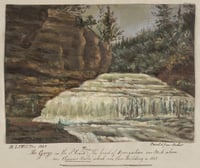
Large-scale logging commenced in Minnesota after the 1837 treaty, slowly growing through the 1840s and 1850s. These early operations focused around the Upper Mississippi, St. Anthony Falls, and the St. Croix River, sticking to the waterways that facilitated log transport. Minnesota’s logging industry remained in its early stages through the Civil War, clinging to river valleys and an industry marked by smaller companies composed of small logging crews.

First Published: July 01, 2026
Last Modified: July 01, 2026

Bibliography

Blegen, Theodore C. “With Ax and Saw: A History of Lumbering in Minnesota.” Forest History Newsletter 7, no. 3 (Autumn 1963): 2–13.

Bromley, Edward A. “Old Mills at the Falls of St. Anthony.” Minnesota Historical Society Collections X, no. 2 (1905): 635–643.

Case, Martin. The Relentless Business of Treaties: How Indigenous Land Became U.S. Property. Minnesota Historical Society Press, 2018.

Cleland, Charles E. Faith in Paper: The Ethnohistory and Litigation of Upper Great Lakes Indian Treaties. University of Michigan Press, 2011.

Durant, Edward W., Captain. “Lumbering and Steamboating on the St. Croix River.” Minnesota Historical Society Collections X, no. 2 (1905): 654–675.

Hotchkiss, George W. History of the Lumber and Forest Industry of the Northwest. G. W. Hotchkiss, 1898.
https://catalog.hathitrust.org/Record/002008895

Glaser, Emma. “How Stillwater Came to Be.” Minnesota History 24, no. 3 (September 1943): 195–206.
https://storage.googleapis.com/mnhs-org-support/mn_history_articles/24/v24i03p195-206.pdf

Goodman, Nancy, and Robert Goodman. Joseph R. Brown: Adventurer on the Minnesota Frontier, 1820–1849. Lone Oak Press, 1996.

Karamanski, Theodore J., and Eileen M. McMahon. North Woods River: The St. Croix River in Upper Midwest History. University of Wisconsin Press, 2009.

——— . Time and the River: A History of the Saint Croix. Midwest Regional Office of the National Park Service, 2002.
https://permanent.fdlp.gov/lps27889/www.cr.nps.gov/history/online_books/sacr/hrs/hrs.htm

Larson, Agnes M. The White Pine Industry in Minnesota: A History. University of Minnesota Press, 2007 (reprint).

Loehr, Rodney C. “Caleb D. Dorr and the Early Minnesota Lumber Industry.” Minnesota History 23, no. 2 (June 1943): 125–141.
https://storage.googleapis.com/mnhs-org-support/mn_history_articles/24/v24i02p125-141.pdf

Magnolia, Alex. “Steele, Franklin (ca. 1813–1880).” MNopedia, December 5, 2025.
https://www.mnhs.org/mnopedia/search/index/person/steele-franklin-ca.-1813-1880

Neill, Rev. Edward D. “Fort Snelling, Minnesota, while in Command of Col. Josiah Snelling, Fifth Infantry.” Magazine of Western History VIII (May–October 1888): 171–180.

Ratified treaty no. 223, Documents relating to the negotiation of the treaty of July 29, 1837, with the Chippewa Indians.
https://digital.library.wisc.edu/1711.dl/72Y56TMA4TH5A8G

Related Resources

Primary

Bloom, John Porter, ed. "The Territorial Papers of the United States." The Territory of Wisconsin Executive Journal, 1836–1848, vol. XXVII. Government Printing Office, 1969.

Chippewa Indian Historical Project records, 1936–1942
Works Progress Administration
Microfilm Collection, Wisconsin Historical Society, Madison
Description: Records of a WPA project to collect Chippewa Indian folklore sponsored by the Great Lakes Indian Agency and directed by Sister M. Macaria Murphy of St. Mary's Indian School, Odanah, Wisconsin. Included are narrative and statistical reports, interview outlines, and operational records; and essays concerning Chippewa religious beliefs and rituals, food, liquor, transportation, trade, clothing, games and dances, and history. Also includes copies of materials from the John A. Bardon collection concerning the Superior, Wisconsin region, La Pointe baptismal records, the family tree of Qui-ka-ba-no-kwe, and artwork of Peter Whitebird.
https://digicoll.library.wisc.edu/cgi/f/findaid/findaid-idx?c=wiarchives;cc=wiarchives;view=text;rgn=main;didno=uw-whs-micr0532

M35-A
Lawrence Taliaferro papers, 1813–1868 (bulk 1821–1839)
Microfilm Collection, Minnesota Historical Society, St. Paul
Description: Correspondence, journals and typed transcripts of the journals, order books, financial records, an autobiography, data sheets, and research note cards, the bulk of which document Taliaferro's career as U.S. Indian agent to the Ojibwe and Dakota at the St. Peters Agency near Fort Snelling in present-day Minnesota (1820–1839).
https://storage.googleapis.com/mnhs-finding-aids-public/library/findaids/01236.html

M105
Letters received, St. Peters, 1837
United States Office of Indian Affairs
Microfilm Collection, Minnesota Historical Society, St. Paul
Description: Selected letters and other documents relating largely to the St. Peters Indian agency near Fort Snelling, with some concerning the agency at Sault Ste. Marie. Many are from Lawrence Taliaferro, Henry Dodge, Henry R. Schoolcraft, and John Tanner, and concern the Dakota Indians. They discuss agency operations and employees, Indian lands, annuity goods, traders, treaties, the Fort Snelling military reservation, relations among Indian tribes, and the government saw and grist mills operated by the Fort Snelling garrison at the Falls of St. Anthony.

M222
Consolidated correspondence file relating to Fort Snelling, 1819–1868
United States Army Quartermaster Corps
Microfilm Collection, Minnesota Historical Society, St. Paul
Description: The microfilm contains selections from Record Group 92 in the National Archives: (a) Consolidated Correspondence File, Fort Snelling, ca. 1820-1868, selected from boxes 1055, 1056, 1060, and 1061; (b) Consolidated Correspondence File, Josiah Snelling, 1822-1833; (c) Consolidated Correspondence File, St. Louis, 1819-1826, selected from box 960.
https://storage.googleapis.com/mnhs-finding-aids-public/library/findaids/M222.html

Long, Stephen H. The Northern Expeditions of Stephen H. Long: The Journals of 1817 and 1823 and Related Documents. Edited by Lucile M. Kane, June D. Holmquist, and Carolyn Gilman. Minnesota Historical Society Press, 1978.

P2528
William T. Boutwell papers, 1832–1881
Manuscripts Collection, Minnesota Historical Society, St. Paul
Description: A copy of a diary kept on Henry R. Schoolcraft's expedition to the source of the Mississippi River in 1832 and throughout Boutwell's residence as missionary to the Ojibwe at Leech Lake; rough notes made by J. Fletcher Williams at the time of an interview with Boutwell and reminiscent of the latter's life as a missionary; two autobiographical articles by Boutwell; a letter received from his father-in-law, Ramsay Crooks, in 1836; and photostats of two letters written by Boutwell in 1832, the originals of which are in the possession of La Forest C. Parkhurst of Stillwater.

Ratified Indian Treaty 223: Chippewa—St. Peters, Wisconsin Territory, July 29, 1837. National Archives, NAID 68144559.
https://catalog.archives.gov/id/68144559

Secondary

Folsom, William H.C. Fifty Years in the Northwest. With an Introduction and Appendix Containing Reminiscences, Incidents and Notes. St. Paul Pioneer Press, 1888.

Prescott, Philander. “Autobiography and Reminiscences of Philander Prescott.” Collections of the Minnesota Historical Society 6 (1894): 475–491.

Prucha, Francis Paul. Broadax and Bayonet: The Role of the United States Army in the Development of the Northwest, 1815–1860. University of Nebraska Press, 1953.

Sibley, Henry H. “Address Delivered Before the Minnesota Historical Society, at its Sixth Anniversary, February 1st, 1856.” Minnesota Historical Society, 1856[?]. https://hdl.handle.net/2027/uc2.ark:/13960/t81j9j611

Smith, Hampton. Confluence: A History of Fort Snelling. Minnesota Historical Society Press, 2021.

Treuer, Anton. The Assassination of Hole in the Day. Borealis Books, 2011.

Westerman, Gwen, and Bruce White. Mni Sota Makoce: The Land of the Dakota. Minnesota Historical Society Press, 2012.

Web

Treaties Matter. 1837 Land Cession Treaties with the Ojibwe & Dakota.
https://treatiesmatter.org/treaties/land/1837-ojibwe-dakota

Related Images

Scene of a shoreline and encampment, with canoes on the water, people standing on shore, and buildings, trees, and a cloudy sky in the background.
Fort St. Louis (Fond du Lac) southwest of present-day Duluth, Minnesota, 1827. Lithograph by an unidentified artist.
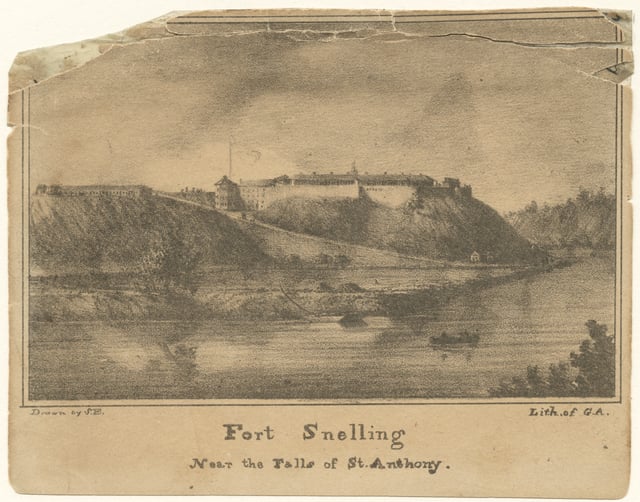
Lithograph torn across the top showing the intersection of two rivers and a fort sitting on a ridge behind it.
Fort Snelling in 1833. Lithograph by Seth Eastman.
Map with colored squares indicating the locations of Ojibwe, Dakota, and Ho-Chunk land cessions and reservations south of Duluth and wests of the St. Croix River.
Detail of a map showing Ojibwe and Dakota land cessions west of the St. Croix River in 1837. The complete map, showing the lands within Minnesota Territory ceded by Native Americans by 1858, was created by Alan Ominsky ca. 1999. Reproduced in Making Minnesota Territory, 1849–1858 (Minnesota Historical Society Press, 1999), page 7.
Painting showing a shallow, multi-tiered waterfall with a rocky promontory to the left and trees to the right.
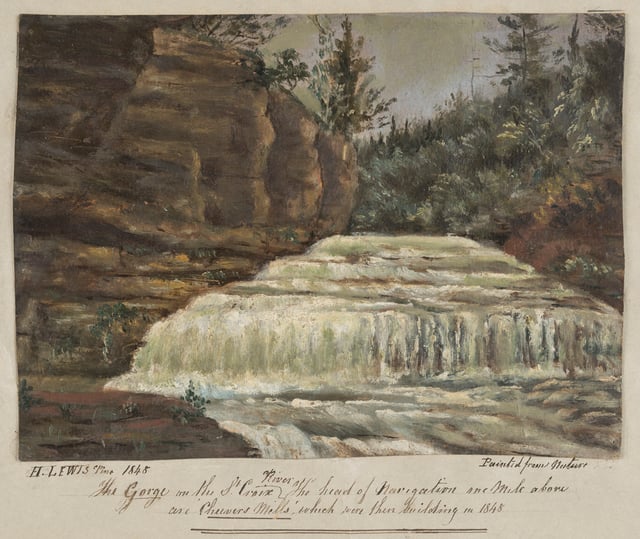
Gorge on the St. Croix River. Painting by Henry Lewis, 1848.
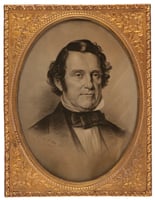
Gold frame with an oval black-and-white image of a man's head and shoulders. He wears a suit jacket with a bow tie and a high shirt collar.
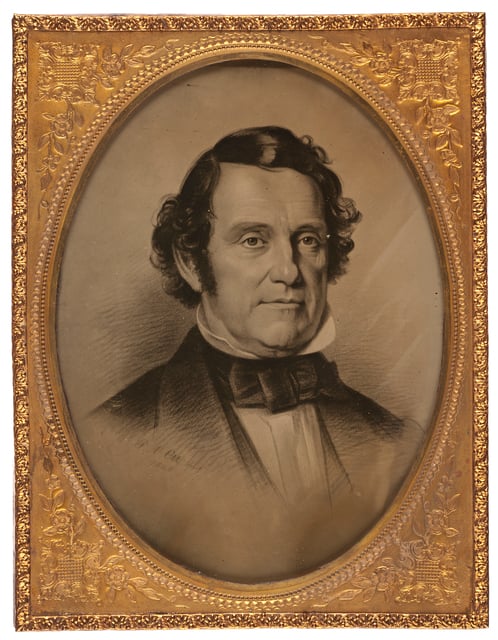
An ambrotype of Franklin Steele, who emerged as one of the most prominent sawmill owners after the US government's two Treaties of 1837: one with the Dakota and one with the Ojibwe.
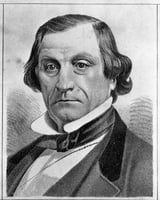
Black-and-white drawing of a man's head and shoulders. His wavy hair partially covers his ears, and he wears a suit jacket, tie, and high collar.
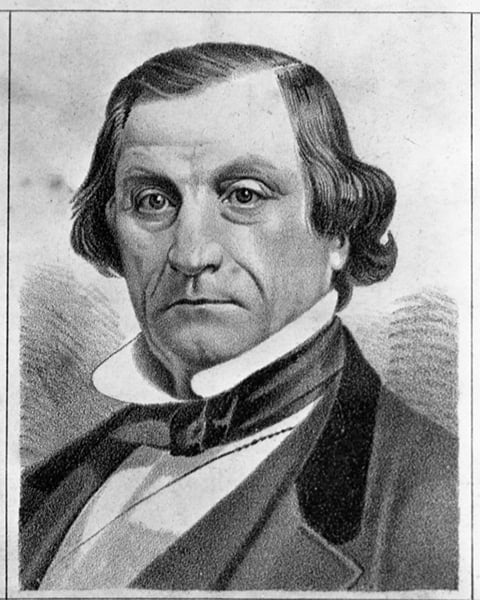
Black-and-white drawing of Joseph R. Brown, an early lumberman in Minnesota whose logging activities were largely illicit.
Scene of a shoreline and encampment, with canoes on the water, people standing on shore, and buildings, trees, and a cloudy sky in the background.

Fort St. Louis (Fond du Lac)

Fort St. Louis (Fond du Lac) southwest of present-day Duluth, Minnesota, 1827. Lithograph by an unidentified artist.
Lithograph torn across the top showing the intersection of two rivers and a fort sitting on a ridge behind it.

Fort Snelling in 1833

Fort Snelling in 1833. Lithograph by Seth Eastman.
Map with colored squares indicating the locations of Ojibwe, Dakota, and Ho-Chunk land cessions and reservations south of Duluth and wests of the St. Croix River.

Detail of map showing Ojibwe and Dakota land cessions west of the St. Croix River, 1837

Detail of a map showing Ojibwe and Dakota land cessions west of the St. Croix River in 1837. The complete map, showing the lands within Minnesota Territory ceded by Native Americans by 1858, was created by Alan Ominsky ca. 1999. Reproduced in Making Minnesota Territory, 1849–1858 (Minnesota Historical Society Press, 1999), page 7.
© Minnesota Historical Society    

All rights reserved

Painting showing a shallow, multi-tiered waterfall with a rocky promontory to the left and trees to the right.

Gorge on the St. Croix River, 1848

Gorge on the St. Croix River. Painting by Henry Lewis, 1848.
Gold frame with an oval black-and-white image of a man's head and shoulders. He wears a suit jacket with a bow tie and a high shirt collar.

Franklin Steele, ca. 1856

An ambrotype of Franklin Steele, who emerged as one of the most prominent sawmill owners after the US government's two Treaties of 1837: one with the Dakota and one with the Ojibwe.
Black-and-white drawing of a man's head and shoulders. His wavy hair partially covers his ears, and he wears a suit jacket, tie, and high collar.

Joseph R. Brown, ca. 1860

Black-and-white drawing of Joseph R. Brown, an early lumberman in Minnesota whose logging activities were largely illicit.

Turning Point

US and Ojibwe leaders sign the White Pine Treaty of 1837. The treaty’s terms give logging companies access to pine forests in present-day east-central Minnesota for the first time, paving the way for commercial logging.

Chronology

1817
Stephen H. Long notes sawmills operating on the Black and Chippewa Rivers in present-day Wisconsin.
1821
Soldiers stationed at Fort Snelling establish the first sawmill in Minnesota at St. Anthony Falls.
1822
With the help of the Indian Agent Lawrence Taliaferro, Hardin Perkins, Joseph Rolette, and James H. Lockwood agree to terms with Wabasha’s band of Dakota to construct a sawmill on the Red Cedar River in present-day Wisconsin. A spring freshet washes it away before it can become operational.
1824
The government sawmill at Fort Snelling has a capacity of 3,500 board-feet per day.
1832
After the Black Hawk War, the settler population of the Upper Mississippi Lead Region quickly grows, providing sizable local demand for pine lumber.
ca. 1833–1837
Joseph R. Brown cuts 200,000 board-feet of pine out of the St. Croix Valley around Taylors Falls. Most of the logs burn in a forest fire before they can be floated downriver. It is possible that Ojibwe people started the fire as retribution for Brown’s illegal action.
1837
Ojibwe leaders agree to let Henry Sibley, Lyman Warren, and William Aitkin cut down timber on their lands along the St. Croix River.
1837
Federal officials secure a series of treaties with Ho-Chunk, Dakota, and Ojibwe people for most of present-day Wisconsin and a sizable portion of what is now Minnesota. The Ojibwe agreement is known as the White Pine Treaty.
1837
John Boyce establishes the first private sawmill in Minnesota at the confluence of the Snake and St. Croix Rivers. (In spring 1838, Ojibwe people run Boyce out of the woods for not paying them for his logs.)
1838
Henry Dodge (a prominent landowner, a US representative at negotiations for the White Pine Treaty, and the Governor of Wisconsin Territory) presses Congress to ratify the treaty.
1838
The White Pine Treaty is ratified in July.
1838
Franklin Steele and six business partners found the St. Croix Lumber Company at St. Croix Falls (present-day Wisconsin).
1838
The US government ratifies a treaty with the Dakota in December.
1838
Immediately after learning of the Dakota treaty’s ratification, Franklin Steele stakes a claim on the east bank of the Mississippi River, beside St. Anthony Falls (Owámniyomni). This location and its waterpower become the basis of Steele’s wealth.
1839
 A second group of business partners establishes a mill at Marine on St. Croix, twenty miles below St. Croix Falls. It is the first commercial operation of its kind in present-day Minnesota. 

Bibliography

Blegen, Theodore C. “With Ax and Saw: A History of Lumbering in Minnesota.” Forest History Newsletter 7, no. 3 (Autumn 1963): 2–13.

Bromley, Edward A. “Old Mills at the Falls of St. Anthony.” Minnesota Historical Society Collections X, no. 2 (1905): 635–643.

Case, Martin. The Relentless Business of Treaties: How Indigenous Land Became U.S. Property. Minnesota Historical Society Press, 2018.

Cleland, Charles E. Faith in Paper: The Ethnohistory and Litigation of Upper Great Lakes Indian Treaties. University of Michigan Press, 2011.

Durant, Edward W., Captain. “Lumbering and Steamboating on the St. Croix River.” Minnesota Historical Society Collections X, no. 2 (1905): 654–675.

Hotchkiss, George W. History of the Lumber and Forest Industry of the Northwest. G. W. Hotchkiss, 1898.
https://catalog.hathitrust.org/Record/002008895

Glaser, Emma. “How Stillwater Came to Be.” Minnesota History 24, no. 3 (September 1943): 195–206.
https://storage.googleapis.com/mnhs-org-support/mn_history_articles/24/v24i03p195-206.pdf

Goodman, Nancy, and Robert Goodman. Joseph R. Brown: Adventurer on the Minnesota Frontier, 1820–1849. Lone Oak Press, 1996.

Karamanski, Theodore J., and Eileen M. McMahon. North Woods River: The St. Croix River in Upper Midwest History. University of Wisconsin Press, 2009.

——— . Time and the River: A History of the Saint Croix. Midwest Regional Office of the National Park Service, 2002.
https://permanent.fdlp.gov/lps27889/www.cr.nps.gov/history/online_books/sacr/hrs/hrs.htm

Larson, Agnes M. The White Pine Industry in Minnesota: A History. University of Minnesota Press, 2007 (reprint).

Loehr, Rodney C. “Caleb D. Dorr and the Early Minnesota Lumber Industry.” Minnesota History 23, no. 2 (June 1943): 125–141.
https://storage.googleapis.com/mnhs-org-support/mn_history_articles/24/v24i02p125-141.pdf

Magnolia, Alex. “Steele, Franklin (ca. 1813–1880).” MNopedia, December 5, 2025.
https://www.mnhs.org/mnopedia/search/index/person/steele-franklin-ca.-1813-1880

Neill, Rev. Edward D. “Fort Snelling, Minnesota, while in Command of Col. Josiah Snelling, Fifth Infantry.” Magazine of Western History VIII (May–October 1888): 171–180.

Ratified treaty no. 223, Documents relating to the negotiation of the treaty of July 29, 1837, with the Chippewa Indians.
https://digital.library.wisc.edu/1711.dl/72Y56TMA4TH5A8G

Related Resources

Primary

Bloom, John Porter, ed. "The Territorial Papers of the United States." The Territory of Wisconsin Executive Journal, 1836–1848, vol. XXVII. Government Printing Office, 1969.

Chippewa Indian Historical Project records, 1936–1942
Works Progress Administration
Microfilm Collection, Wisconsin Historical Society, Madison
Description: Records of a WPA project to collect Chippewa Indian folklore sponsored by the Great Lakes Indian Agency and directed by Sister M. Macaria Murphy of St. Mary's Indian School, Odanah, Wisconsin. Included are narrative and statistical reports, interview outlines, and operational records; and essays concerning Chippewa religious beliefs and rituals, food, liquor, transportation, trade, clothing, games and dances, and history. Also includes copies of materials from the John A. Bardon collection concerning the Superior, Wisconsin region, La Pointe baptismal records, the family tree of Qui-ka-ba-no-kwe, and artwork of Peter Whitebird.
https://digicoll.library.wisc.edu/cgi/f/findaid/findaid-idx?c=wiarchives;cc=wiarchives;view=text;rgn=main;didno=uw-whs-micr0532

M35-A
Lawrence Taliaferro papers, 1813–1868 (bulk 1821–1839)
Microfilm Collection, Minnesota Historical Society, St. Paul
Description: Correspondence, journals and typed transcripts of the journals, order books, financial records, an autobiography, data sheets, and research note cards, the bulk of which document Taliaferro's career as U.S. Indian agent to the Ojibwe and Dakota at the St. Peters Agency near Fort Snelling in present-day Minnesota (1820–1839).
https://storage.googleapis.com/mnhs-finding-aids-public/library/findaids/01236.html

M105
Letters received, St. Peters, 1837
United States Office of Indian Affairs
Microfilm Collection, Minnesota Historical Society, St. Paul
Description: Selected letters and other documents relating largely to the St. Peters Indian agency near Fort Snelling, with some concerning the agency at Sault Ste. Marie. Many are from Lawrence Taliaferro, Henry Dodge, Henry R. Schoolcraft, and John Tanner, and concern the Dakota Indians. They discuss agency operations and employees, Indian lands, annuity goods, traders, treaties, the Fort Snelling military reservation, relations among Indian tribes, and the government saw and grist mills operated by the Fort Snelling garrison at the Falls of St. Anthony.

M222
Consolidated correspondence file relating to Fort Snelling, 1819–1868
United States Army Quartermaster Corps
Microfilm Collection, Minnesota Historical Society, St. Paul
Description: The microfilm contains selections from Record Group 92 in the National Archives: (a) Consolidated Correspondence File, Fort Snelling, ca. 1820-1868, selected from boxes 1055, 1056, 1060, and 1061; (b) Consolidated Correspondence File, Josiah Snelling, 1822-1833; (c) Consolidated Correspondence File, St. Louis, 1819-1826, selected from box 960.
https://storage.googleapis.com/mnhs-finding-aids-public/library/findaids/M222.html

Long, Stephen H. The Northern Expeditions of Stephen H. Long: The Journals of 1817 and 1823 and Related Documents. Edited by Lucile M. Kane, June D. Holmquist, and Carolyn Gilman. Minnesota Historical Society Press, 1978.

P2528
William T. Boutwell papers, 1832–1881
Manuscripts Collection, Minnesota Historical Society, St. Paul
Description: A copy of a diary kept on Henry R. Schoolcraft's expedition to the source of the Mississippi River in 1832 and throughout Boutwell's residence as missionary to the Ojibwe at Leech Lake; rough notes made by J. Fletcher Williams at the time of an interview with Boutwell and reminiscent of the latter's life as a missionary; two autobiographical articles by Boutwell; a letter received from his father-in-law, Ramsay Crooks, in 1836; and photostats of two letters written by Boutwell in 1832, the originals of which are in the possession of La Forest C. Parkhurst of Stillwater.

Ratified Indian Treaty 223: Chippewa—St. Peters, Wisconsin Territory, July 29, 1837. National Archives, NAID 68144559.
https://catalog.archives.gov/id/68144559

Secondary

Folsom, William H.C. Fifty Years in the Northwest. With an Introduction and Appendix Containing Reminiscences, Incidents and Notes. St. Paul Pioneer Press, 1888.

Prescott, Philander. “Autobiography and Reminiscences of Philander Prescott.” Collections of the Minnesota Historical Society 6 (1894): 475–491.

Prucha, Francis Paul. Broadax and Bayonet: The Role of the United States Army in the Development of the Northwest, 1815–1860. University of Nebraska Press, 1953.

Sibley, Henry H. “Address Delivered Before the Minnesota Historical Society, at its Sixth Anniversary, February 1st, 1856.” Minnesota Historical Society, 1856[?]. https://hdl.handle.net/2027/uc2.ark:/13960/t81j9j611

Smith, Hampton. Confluence: A History of Fort Snelling. Minnesota Historical Society Press, 2021.

Treuer, Anton. The Assassination of Hole in the Day. Borealis Books, 2011.

Westerman, Gwen, and Bruce White. Mni Sota Makoce: The Land of the Dakota. Minnesota Historical Society Press, 2012.

Web

Treaties Matter. 1837 Land Cession Treaties with the Ojibwe & Dakota.
https://treatiesmatter.org/treaties/land/1837-ojibwe-dakota