Recent State Archives Acquisitions: January 2012
Background Information
A primary collecting strength of the State Archives is the records of the state’s public institutions for the care and treatment of persons with developmental disabilities, the mentally retarded, the chemically dependent, and other illnesses. This month that area of research is greatly enhanced with transfers of records from several now defunct, or significantly downsized, public institutions (known as state hospitals or regional treatment centers). A variety of records were transferred concerning the state hospitals at Brainerd (opened in 1958 and still extant), Cambridge (operated 1925-1977), and Faribault (operated 1879-1998), and will be useful for family history research, as well as research concerning the policies, organization, and operations of these facilities.
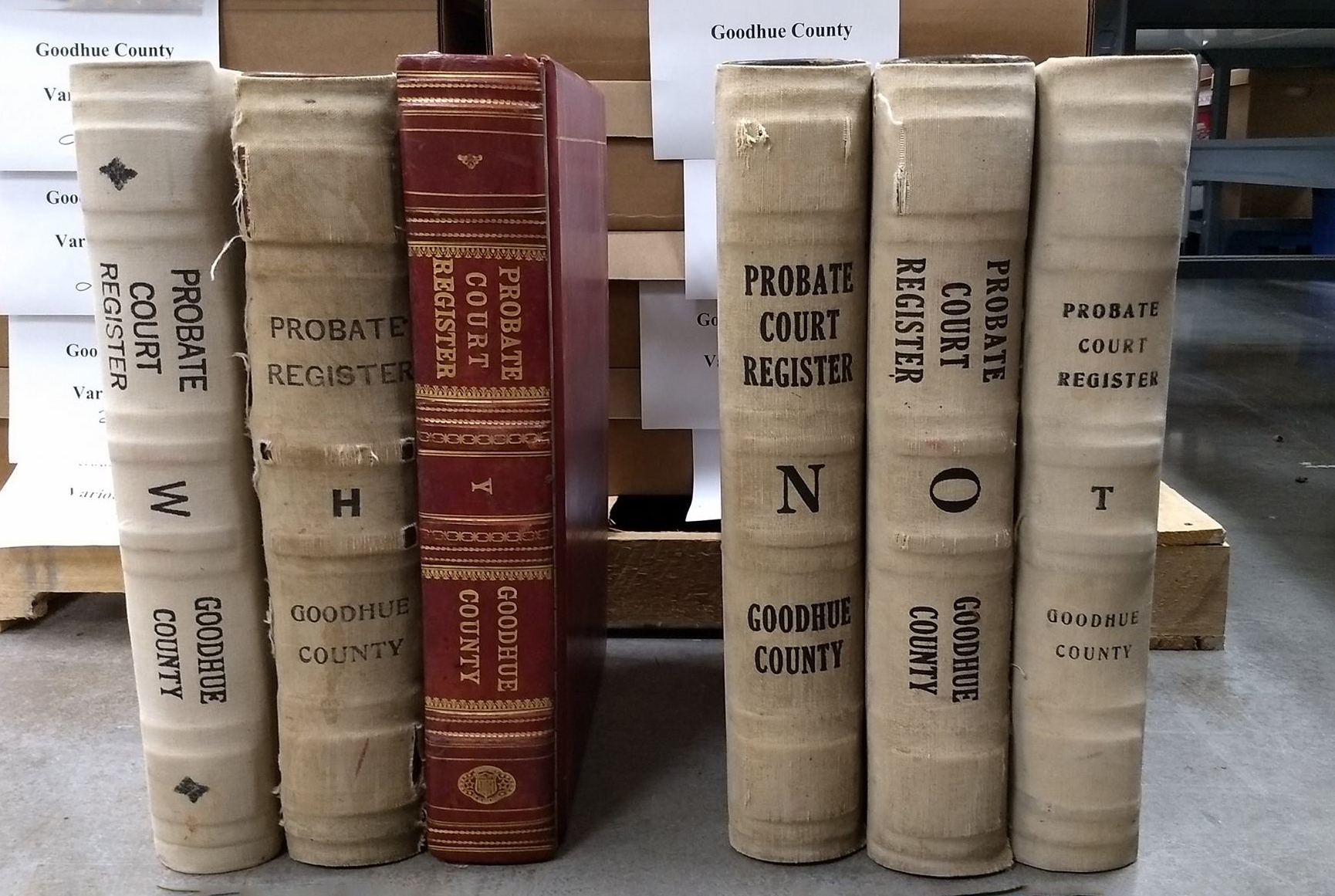
The Houston County District Court transferred records that will enhance access to related court records already preserved in the State Archives, and will be useful for family history research. The district court defendant/plaintiff indexes (dated 1856-1936), and civil (1856-1950) and criminal (1860-1940) registers of action will enhance access to other district court records already preserved in the State Archives. Some of the probate court records (dated 1854-1980), with a few dating during the Minnesota territorial period, may pre-date the use of probate case files, and will particularly valuable for family historians.
The Kandiyohi County Assessor transferred county board of equalization meeting minutes (dated 2000-2001) which continue an existing set of meeting minutes dating from 1986, and concern the classifications or valuations of county properties.
Another strength, and collecting priority, of the State Archives, is records of the state legislature. The Legislative Citizen Commission on Minnesota Resources transferred its 2005 project files which continue an existing set dating from 1972. The files are for all projects funded by the Commission, and include periodic and final reports (some published), budgets, work programs, correspondence and internal memos.
Records (dated 2005-2011) of the Electronic Real Estate Recording Task Force were transferred, including meeting minutes, bylaws, and the final report. The Task Force was commissioned in 2001, and authorized to establish statewide standards for electronic real estate records in Minnesota. In 2008 the authority of the Task Force was ended, and the Electronic Real Estate Recording Commission was established to adopt standards to implement the electronic recording of land records; the Commission is administered by the Legislative Coordinating Commission.
Shortly after the Sesquicentennial Commission was sunsetted in late 2008, the staff transferred a number of records (dated circa 2005-2009) to the State Archives. Included, are subject files (including event and speaking files) of Executive Director Jane Leonard and Chair Cay Hellevic, meeting minutes, newspaper clippings, reports and published records, event and project files, and a box labeled “Time Capsule”. In the spirit of keeping the time capsule’s contents private, the inventory of items in the box will not be publicly available. The time capsule is to be opened May 11, 2057 by the Minnesota Bicentennial Commission! Also, two videos of the Sesquicentennial Statehood Ceremony and the Statehood Day events (held at the State Capitol May 18, 2008), plus a video entitled “Real or Imagined” which is the Commission-produced video about Minnesota’s “future history”. The three videos are in digital form, and we plan to post them on-line.
A private donor donated a photocopy of bark marks and stamp marks registered to various companies, compiled August 26, 1938. The record will be cataloged with other records of the Surveyor of Logs and Lumber. The marks are arranged by lumber company, and include dates registered (1901-1938), drawings of the bark or stamp mark, and what the mark is called. This office was established in 1919, and charged with scaling all state timber cut on any state lands (estimating the amount of sound lumber in timber stands and cut logs), surveying such timber before the Division of Forestry closed the sale, and scaling privately owned timber for fees when requested by the owner; the office was abolished in 1967. Many similar records of this office are preserved in the State Archives, but an original of this document was not located.
Acquisitions
1. Brainerd State Hospital. Posters (undated) concerning interpreter services, the mission statement, and an organizational chart of the hospital; aerial photographs (1958, 1998) and site plans (undated, 1991-1992) of the campus; and photographs (undated, 1998) of residents’ daily activities, staff and visitors, and the celebration of the hospital’s 40th anniversary in 1998. 1 box.
2. Cambridge State Hospital. Silent movie films (8 millimeter) showing various educational and recreational therapy activities, and a summer parade and carnival at the hospital, dated in the 1960s. Along with the 8mm films, the private donor also donated DVD copies of the films which will be the patron use copies. Also, published and unpublished research papers produced by staff regarding the use of psychotropic drugs with persons who have developmental disabilities. 1 folder, four 8mm films, 3 DVDs.
3. Faribault State Hospital. Patient index cards, dated circa 1879-1997. Two sets of patient index cards with information that includes patient’s name, correspondents, address, date committed, date of admission, birth date, mental history, religion, family history, and burial notes. 7 boxes.
4. Houston County. Defendant/plaintiff indexes (1856-1936), registers of civil action (1856-1950) and criminal action (1860-1940), record of oaths and bonds (1964-1989), oversize civil case files (1921-1929), minutes (1989), and bar memorials (1951-1962) of the District Court; registers of probate action (ca. 1867-1980), probate record books (1854-1972), and index to probate records (ca. 1857-1959). 24 boxes.
5. Kandiyohi County. Board of Equalization meeting minutes, dated 2000-2001. Continue an existing set of meeting minutes dating from 1986, and concern the classifications or valuations of county properties. 1 folder.
6. Legislative Commission on Minnesota Resources. Project files (dated 2005) for all projects funded by the Commission, including periodic and final reports (some published), budgets, work programs, correspondence and internal memos. 6 boxes.
7. Secretary of State. Electronic Real Estate Recording Task Force records (dated 2005-2011). 4 folders.
8. Sesquicentennial Commission. Records (dated circa 2005-2009). 9 boxes.
9. Surveyor General of Logs and Lumber. Bark marks and stamp marks registered to various companies, compiled August 26, 1938 (photocopy). 1 folder.
Back to Recent Acquisitions.
February 6, 2012