
Volunteer Spotlight: Jerry Wood
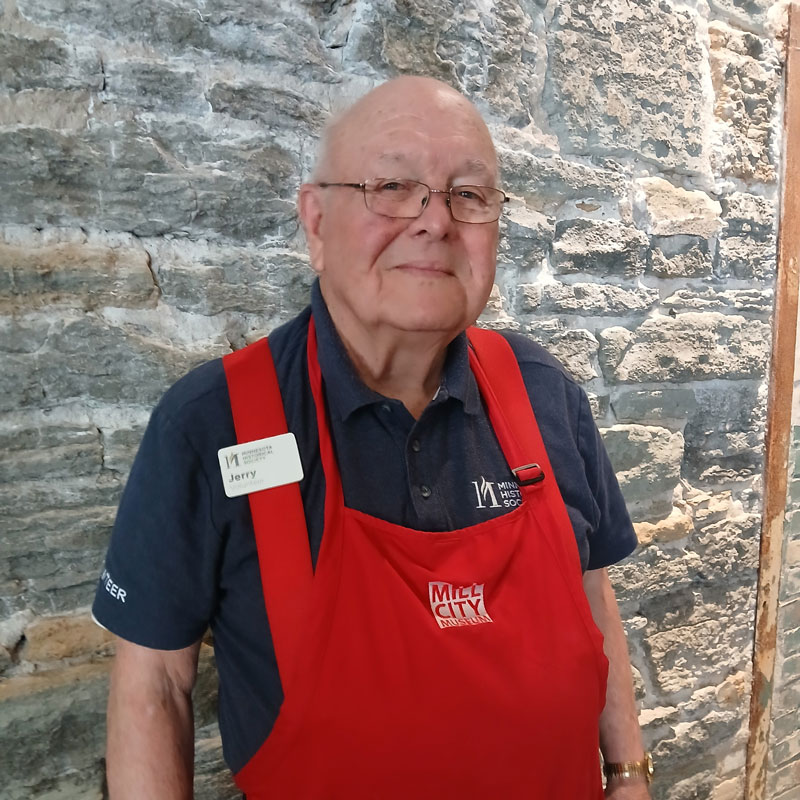
Born and raised in Central Missouri, MNHS member Jerry Wood describes himself as a “husband for 68 years, a father of two, a grandfather of six, and a great-grandfather of eleven.” All family members reside in the Twin Cities area with the exception of one household living in Wisconsin.
Prior to retiring, Jerry was a railroad civil engineer. His career required a lot of moving: from the prairies, to the mountains, to the west coast and back again. His first job was Assistant Engineer with the Wabash Railroad and he eventually became Chief Engineer for Burlington Northern’s Denver Region. After 21 career relocations, Jerry and his wife’s 22nd and final move was to Plymouth, MN.
Once settled into retirement, it was time to get involved with something that piqued his interest. Describing himself as a “history nut”, Jerry was intrigued by the volunteer options he learned about at MNHS. Since becoming an official MNHS volunteer in 2014, he has logged over 1,200 hours.
His first volunteer assignment was at the Minnesota History Center, talking with visitors or directing them to new exhibits. Since that time he has volunteered at three additional MNHS sites: Historic Fort Snelling, Oliver Kelley Farm and Mill City Museum.
Currently, the tenured volunteer is active at the Oliver Kelley Farm and Mill City Museum. At the farm he offers guests transportation, via a golf cart, to and from the historic 1860s farmstead and welcomes visitors to the site.
In his role as School Programs Assistant at Mill City Museum, Jerry makes sure that the field trip students, teachers, and chaperones make it safely from their bus and into the museum where staff are waiting to begin their 10:00 a.m. tours. The rest of the morning, he helps with the school groups or answers questions posed by visitors walking through the museum.
Jerry notes that he especially likes to work with young people and enjoys observing their “aha” moments or listening to intergenerational conversations. "What’s really neat is when kids understand that horses or oxen do the same work as tractors today. Or when grandparents say, “Well, when I was a kid” and the grandkids respond or ask questions.”
He feels that young people are more open minded than adults - searching for answers rather than having all the answers. He notes that, “second graders are more receptive to understanding than seventh graders who have already begun to form their opinions.”
Jerry also volunteers with the Wayzata School District, working one on one with elementary school students as a Literacy Mentor. “My job isn’t to teach kids how to read but rather to teach kids to love to read.”
His advice to new volunteers? Jerry has several recommendations. 1) Routinely review the MNHS website so that you can be conversant with what the organization is presenting to the public; 2) Get to know staff on a first-name basis; 3) Expand your knowledge by reading more about the venue you are assigned to; 4) Learn to distinguish the differing expectations and perspectives of various guest groups.
An 1879 St. Paul and Pacific Boxcar with a freight capacity of 136 barrels of flour, humbly sits on display at Mill City Museum waiting for someone to tell its story. How appropriate that a long-time railroad civil engineer does just that, and much more.
Thank you, Jerry, for enthusiastically sharing Minnesota’s history wherever your MNHS volunteer journey takes you.